What Are the Three Goals of Cybersecurity?
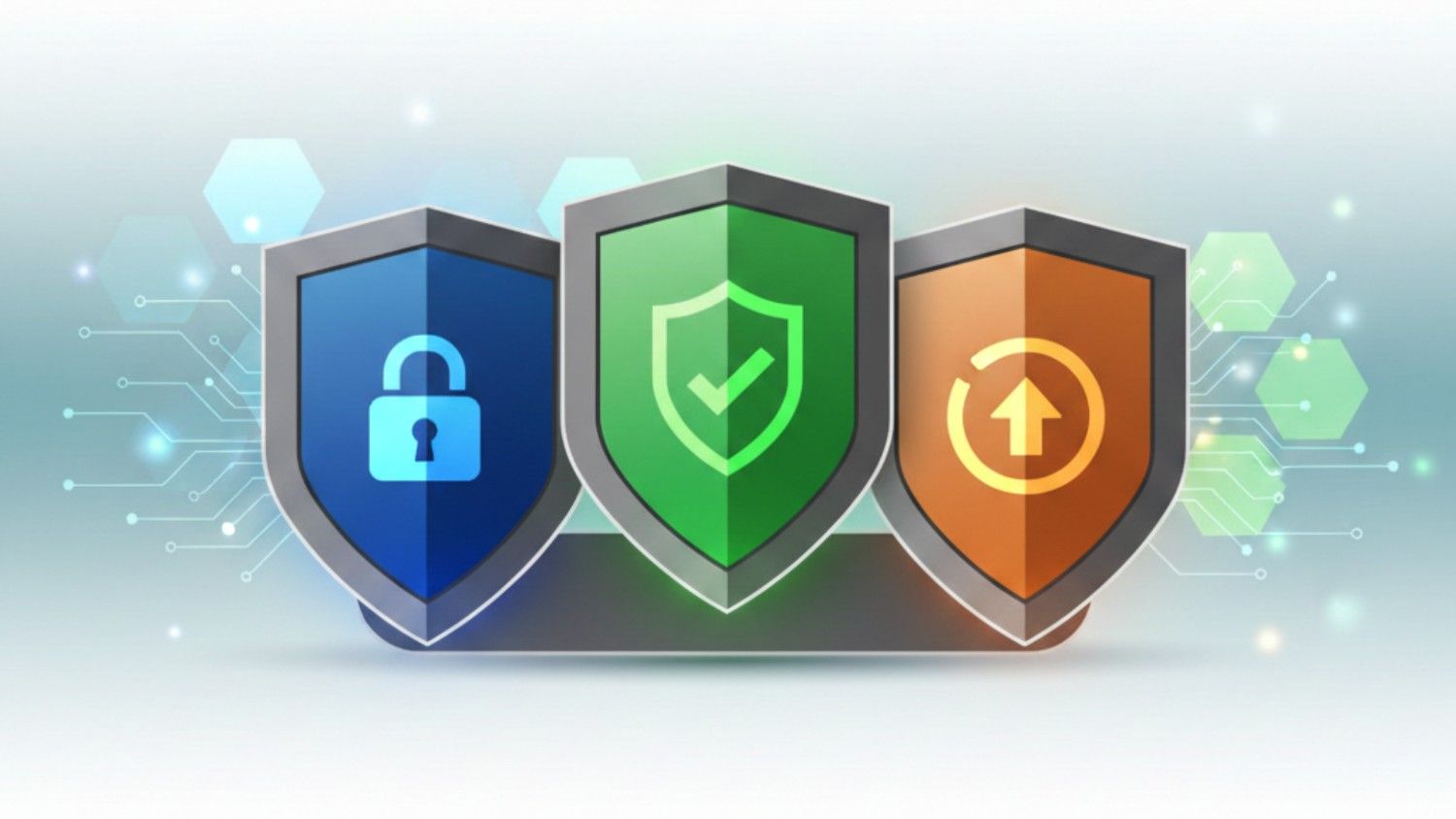
Table of Contents
ToggleYou’re sitting at your desk, coffee in hand, when suddenly your screen freezes. An ominous message appears: “Your files have been encrypted.” Your heart races. Did you click that suspicious email link yesterday? Is your business data gone forever?
This nightmare scenario happens to thousands of businesses and individuals every day. In 2024 alone, cybercrime damages exceeded $9.5 trillion globally—more than the GDP of Japan. Whether you’re a small business owner, IT professional, or simply someone who wants to protect their digital life, understanding cybersecurity fundamentals isn’t optional anymore. It’s essential.
At the heart of every cybersecurity strategy lie three fundamental goals, often called the CIA Triad: Confidentiality, Integrity, and Availability. These aren’t just buzzwords—they’re the pillars that keep your data safe, your systems running, and your reputation intact.
Let me break down what these three goals actually mean and, more importantly, how they protect you in the real world.
Understanding the CIA Triad: The Foundation of Cybersecurity
The National Institute of Standards and Technology (NIST) provides a comprehensive cybersecurity framework that organizations worldwide use to implement these three core security goals.”
The CIA Triad has been the cornerstone of information security since the early days of computing. Think of it as a three-legged stool—remove any one leg, and the whole thing collapses.
| Security Goal | What It Protects | Real-World Impact |
|---|---|---|
| Confidentiality | Privacy of sensitive data | Prevents data breaches and identity theft |
| Integrity | Accuracy and trustworthiness of information | Ensures data hasn’t been tampered with |
| Availability | Access to systems when needed | Keeps business operations running smoothly |
Goal #1: Confidentiality – Keeping Secrets Secret
Confidentiality means ensuring that sensitive information is accessible only to those who are authorized to view it. Simple concept, right? But the execution is where things get tricky.
Why Confidentiality Matters
Think about the information you handle daily: customer credit cards, employee social security numbers, proprietary business strategies, medical records. If any of this falls into the wrong hands, the consequences can be devastating.
Take the 2017 Equifax breach, for example. Hackers accessed the personal information of 147 million people. The fallout? Over $1.4 billion in settlement costs, massive reputation damage, and countless individuals facing identity theft risks for years.
How to Maintain Confidentiality
Encryption is your first line of defense. When data is encrypted, it becomes unreadable gibberish to anyone without the decryption key. Whether data is “at rest” (stored on a server) or “in transit” (being sent across the internet), encryption keeps it protected.
Here are practical ways to enforce confidentiality:
- Strong access controls: Implement role-based access where employees only see data necessary for their job
- Multi-factor authentication (MFA): Require two or more verification methods before granting access
- Data classification: Label information by sensitivity level (public, internal, confidential, restricted)
- Regular security training: Teach employees to recognize phishing attempts and social engineering tactics
- Secure communication channels: Use encrypted messaging and email systems
I’ve seen companies transform their security posture simply by implementing MFA. One client reduced unauthorized access attempts by 87% within three months of deployment.
Common Confidentiality Threats
Phishing attacks remain the most common threat. These deceptive emails trick users into revealing passwords or downloading malware. They’ve gotten sophisticated—some are nearly impossible to distinguish from legitimate communications.
Insider threats are equally dangerous. Whether malicious or accidental, employees with legitimate access can expose sensitive data. According to a 2024 Verizon report, 28% of breaches involved internal actors.
Goal #2: Integrity – Trusting Your Data
Integrity ensures that information remains accurate, complete, and unaltered except by authorized individuals. If you can’t trust your data, you can’t make reliable decisions.
The High Cost of Compromised Integrity
Imagine discovering that your financial records have been subtly altered. Invoices changed, payments redirected, balances manipulated. This isn’t hypothetical—it happens regularly through sophisticated attacks.
In 2020, hackers compromised the SolarWinds software update system, inserting malicious code that went undetected for months. Organizations that trusted the integrity of these updates unknowingly installed backdoors into their networks. The breach affected thousands of companies and government agencies.
Protecting Data Integrity
Version control and checksums help verify that files haven’t been tampered with. A checksum is like a digital fingerprint—if even one byte changes, the fingerprint changes too.
Digital signatures provide mathematical proof that a document came from a specific source and hasn’t been modified. They’re essential for contracts, software distributions, and sensitive communications.
Practical integrity safeguards include:
- Audit trails: Maintain detailed logs of who accessed or modified data and when
- Input validation: Verify that data entered into systems meets expected formats and ranges
- Backup systems: Regularly backup data to enable restoration if corruption occurs
- Hash functions: Use cryptographic hashes to detect unauthorized changes
- Change management processes: Require approval and documentation for system modifications
Real-World Integrity Challenges
Ransomware doesn’t just encrypt files—it can corrupt them. Even after paying the ransom (which experts strongly advise against), recovered data may be incomplete or damaged.
Man-in-the-middle attacks intercept and potentially alter communications between two parties. Without integrity protections, you might think you’re reading an authentic message when it’s actually been modified.
Goal #3: Availability – Access When You Need It
Availability ensures that authorized users can access information and resources when required. Your security can be airtight, but if legitimate users can’t get to their data, you’ve still got a problem.
Why Availability Is Critical
In today’s 24/7 digital economy, downtime equals lost revenue. Amazon reportedly loses $220,000 per minute during outages. For healthcare providers, unavailable systems can literally be life-threatening.
Distributed Denial of Service (DDoS) attacks flood systems with traffic, overwhelming servers and making services unavailable to legitimate users. In 2023, the largest recorded DDoS attack peaked at 71 million requests per second.
Ensuring System Availability
Redundancy is key. This means having backup systems, multiple internet connections, and failover capabilities so that if one component fails, another seamlessly takes over.
Disaster recovery planning outlines exactly how to restore operations after an incident. Companies with tested disaster recovery plans resume operations 3x faster than those without.
Availability best practices:
- Load balancing: Distribute traffic across multiple servers to prevent overload
- Regular maintenance: Update and patch systems during planned windows to prevent unexpected failures
- Network monitoring: Continuously watch for unusual traffic patterns or performance issues
- Scalable infrastructure: Design systems that can handle traffic spikes
- Geographic distribution: Host critical services in multiple physical locations
Common Availability Threats
Ransomware is perhaps the most visible availability threat. When systems are encrypted and held hostage, business operations grind to a halt. The Colonial Pipeline attack in 2021 caused fuel shortages across the Eastern United States, demonstrating how cybersecurity failures cascade into real-world disruptions.
Hardware failures, natural disasters, and power outages also threaten availability. While not cyberattacks per se, comprehensive cybersecurity planning addresses all threats to system accessibility.
How the Three Goals Work Together
Here’s the thing: you can’t prioritize one goal at the expense of others. They’re interconnected.
Consider this scenario: You implement strict confidentiality controls that require multiple authentication steps. Great for privacy! But if the authentication system becomes so complex that it crashes frequently, you’ve sacrificed availability. Or if employees start writing down passwords because they can’t remember them all, you’ve undermined confidentiality.
Balance is everything.
A hospital’s electronic health records system illustrates this beautifully. Confidentiality protects patient privacy (HIPAA compliance). Integrity ensures medical histories are accurate for proper treatment. Availability means doctors can access records immediately in emergencies. Remove any element, and patient care suffers.
Practical Steps to Implement the CIA Triad
For Small Businesses
You don’t need a Fortune 500 budget to implement solid cybersecurity. Start with these fundamentals:
- Conduct a risk assessment: Identify what data you have and what threats you face
- Implement basic controls: Strong passwords, MFA, automatic updates
- Backup regularly: Follow the 3-2-1 rule (3 copies, 2 different media, 1 offsite)
- Train your team: Security is everyone’s responsibility
- Create an incident response plan: Know what to do when (not if) something goes wrong
For Individuals
Your personal cybersecurity matters too:
- Use a password manager to create and store unique passwords for each account
- Enable two-factor authentication everywhere it’s offered
- Keep software updated on all devices
- Be skeptical of unsolicited emails asking for information or action
- Use VPNs on public WiFi networks
For additional guidance on implementing cybersecurity measures, the Cybersecurity & Infrastructure Security Agency offers free resources and best practices for organizations of all sizes.
Beyond the CIA Triad: Modern Cybersecurity Considerations
While the CIA Triad remains fundamental, modern cybersecurity has evolved to address new challenges:
Authenticity verifies that users and systems are who they claim to be. In an era of deepfakes and sophisticated impersonation, proving identity is increasingly complex.
Non-repudiation ensures that actions can be traced back to specific individuals, preventing them from denying their actions later. Digital signatures and comprehensive logging support this goal.
Privacy goes beyond confidentiality to address how personal data is collected, used, and shared—increasingly important with regulations like GDPR and CCPA.
Common Mistakes That Undermine Cybersecurity Goals
Through years of working with organizations, I’ve seen these mistakes repeatedly:
Focusing solely on perimeter defense: Building a fortress around your network while ignoring internal threats and user behavior creates a false sense of security.
Neglecting employee training: Technology alone can’t protect you. Your employees are both your greatest vulnerability and your strongest defense.
Inconsistent security practices: Requiring complex passwords but allowing them to be shared via email. Encrypting databases but sending sensitive reports in plain text. These inconsistencies create exploitable gaps.
Treating security as a one-time project: Cyber threats evolve daily. Your defenses must evolve too.
The Future of Cybersecurity
Artificial intelligence and machine learning are transforming both attack and defense capabilities. AI can analyze patterns to detect anomalies faster than any human, but attackers also use AI to craft more convincing phishing emails and discover vulnerabilities.
Zero Trust Architecture is becoming the new standard—assuming that no user or system should be automatically trusted, even if they’re inside your network perimeter.
Quantum computing looms on the horizon, potentially rendering current encryption methods obsolete. Organizations are already preparing post-quantum cryptography strategies.
Frequently Asked Questions
None is more important—they're equally essential. However, different industries may prioritize differently. Healthcare emphasizes availability (lives depend on access to records), financial services focus heavily on integrity (accurate financial data is crucial), and legal firms prioritize confidentiality (attorney-client privilege).
Industry experts recommend allocating 10-15% of your IT budget to security. However, even modest investments in fundamentals—backups, MFA, training—provide significant protection. The cost of prevention is always less than the cost of recovery from a breach.
No system is completely immune to attacks. Cybersecurity is about risk management—reducing vulnerabilities and preparing to respond when incidents occur. The goal is making attacks difficult enough that attackers move to easier targets.
Continuously. Apply security patches as soon as they're released. Review and update policies quarterly. Conduct comprehensive security audits annually. Test your incident response plan at least twice yearly.
Act immediately. Disconnect affected systems from the network (don't shut them down—preserve evidence). Contact your IT security team or a cybersecurity professional. Document everything. Notify appropriate stakeholders based on your incident response plan.
Your Next Steps: Building a Resilient Security Posture
Understanding the three goals of cybersecurity is just the beginning. Knowledge without action won’t protect you.
Start today by:
Assessing your current state: Where are your vulnerabilities? Which of the three goals needs the most attention in your organization or personal life?
Implementing quick wins: Enable MFA, start backing up critical data, update your passwords. These steps take minutes but dramatically improve your security.
Developing a comprehensive strategy: Create a roadmap that addresses confidentiality, integrity, and availability systematically over time.
Staying informed: Cybersecurity evolves rapidly. Subscribe to security blogs, follow reputable sources, and continuously educate yourself and your team.
Remember, cybersecurity isn’t about achieving perfection—it’s about making consistent progress. Every improvement in confidentiality, integrity, or availability makes you more resilient against threats.
The digital world grows more interconnected and vulnerable every day. But armed with understanding of these three fundamental goals and commitment to implementing them, you’re far better prepared to protect what matters most.
What’s your biggest cybersecurity concern right now? Have you experienced a security incident that changed how you think about digital protection? The conversation about cybersecurity is ongoing, and your experiences matter.
Stay safe out there.
Looking for more insights on protecting your digital assets? Explore our other cybersecurity resources on zprostudio.com to build a comprehensive security strategy tailored to your needs.