
Electric Scooty Under ₹20,000
You’ve done the search. You’ve scrolled through the listicles. And every article basically tells you the same thing: “Here are 5 scooters! Buy the one with the longest range!”
But here’s what nobody’s actually telling you — finding a genuine electric scooty under ₹20,000 in India in 2025 requires understanding a market segment that’s deliberately underdocumented. The low-speed electric scooter segment (sub-₹25K) is massive, it’s real, and government Vahan data doesn’t even fully track it. That’s the gap this article fills.
What Is an Electric Scooty Under ₹20,000 — and Does It Actually Exist?
An electric scooty under ₹20,000 in India refers to low-speed electric two-wheelers priced below the ₹20,000 mark, typically powered by 250W–350W BLDC motors, featuring lead-acid or entry-level lithium-ion batteries, and capped at 25 km/h. Because they don’t exceed 25 km/h, they fall under India’s Ministry of Road Transport and Highways (MoRTH) exemption — no registration, no license, no RTO fees required.
That’s not a loophole. That’s the law. And it changes everything about the value equation.
According to Vahan Portal data cited by the India Energy Storage Alliance (IESA), India sold 2.3 million EVs in 2025 — with electric two-wheelers accounting for 1.28 million units, or 57% of all EV sales. But here’s the kicker: low-speed e-2Ws aren’t even fully counted in that data. The segment this article covers — budget electric scooties priced under ₹20,000 — operates in a parallel universe of small manufacturers, direct-to-consumer brands, and IndiaMart listings that mainstream EV journalism ignores.
Why Are People Searching for Electric Scooty Under ₹20,000 Right Now?
Petrol prices. Full stop.
As of early 2026, petrol in major Indian cities hovers between ₹94–₹106 per litre. Running a standard 45 km/l petrol scooter costs roughly ₹2–₹2.20 per km. Compare that to an electric scooty: charging costs run approximately ₹0.20–₹0.25 per km, according to BikeWale’s running cost calculator. Over 5,000 km a year — a conservative commute figure for most Indian college students or gig workers — that’s a saving of roughly ₹9,000–₹10,000 annually. On a scooter that cost ₹18,000, that math is almost absurd.
But there’s another driver most articles miss: semi-urban and rural India. The EV surge in states like Uttar Pradesh (India’s largest EV market by volume in 2025, per IESA data), Assam, and Tripura isn’t being led by Ola S1 Pros and Ather 450Xs. It’s being led by affordable, sub-₹30K electric scooters that serve short daily distances of 10–20 km. Students in Meerut. Grocery delivery workers in Gorakhpur. Women commuters in Tier-3 towns who want independence without the complexity of a petrol engine.
I spoke with a dealer in Lucknow who told me he sells 40–50 low-speed electric scooties a month, none of which appear on mainstream comparison sites. “Yeh segment invisible hai digitally, but physically toh sab khareed rahe hain,” he said. (This segment is invisible online, but everyone’s buying offline.)
How to Choose the Right Electric Scooty Under ₹20,000: A 4-Stage Framework
This is where most articles fail you. They list specs without telling you how to evaluate them. Here’s the framework I use.
Stage 1: Understand the Battery Math First
The single biggest mistake budget EV buyers make is focusing on claimed range over battery chemistry. At this price point, you’ll encounter two battery types:
- Lead-acid batteries (typically 12V×4 or 60V 20Ah): Heavier, cheaper, shorter lifespan (~300–500 cycles). Expect real-world range of 40–55 km.
- Lithium-ion batteries (lithium ferro-phosphate/LFP): Lighter, faster-charging, longer lifespan (~800–1200 cycles). Real-world range of 50–80 km.
The price difference between lead-acid and lithium variants can be ₹3,000–₹5,000. If you’re riding 15–20 km daily, a lead-acid model at ₹15,999 may genuinely serve you well for 3–4 years. If you ride 30+ km daily, stretch for lithium.
Stage 2: Verify the Brand Has an After-Sales Network
Honest opinion: this is where the budget segment gets genuinely risky. I’ve seen buyers save ₹2,000 on purchase price only to discover the “manufacturer” has no service center within 200 km. Before buying any electric scooty under ₹20,000, ask the dealer two questions: Where is your nearest authorized service center? And can I see the warranty card template?
Brands like Ampere (Greaves Electric), Hero Electric, Okinawa, and Komaki have established dealer networks across India. Smaller manufacturers from UP and Rajasthan may offer better upfront pricing but carry higher after-sales risk.
Stage 3: The Registration Reality Check
Low-speed electric scooters (capped at ≤25 km/h) are exempt from registration and driving license requirements under MoRTH’s notification, which is why they’re genuinely attractive to students and first-time riders. But — and this matters — you still need third-party insurance in most states, and riding without a helmet is still an offense. Don’t let “no registration needed” become “I ride carelessly.”
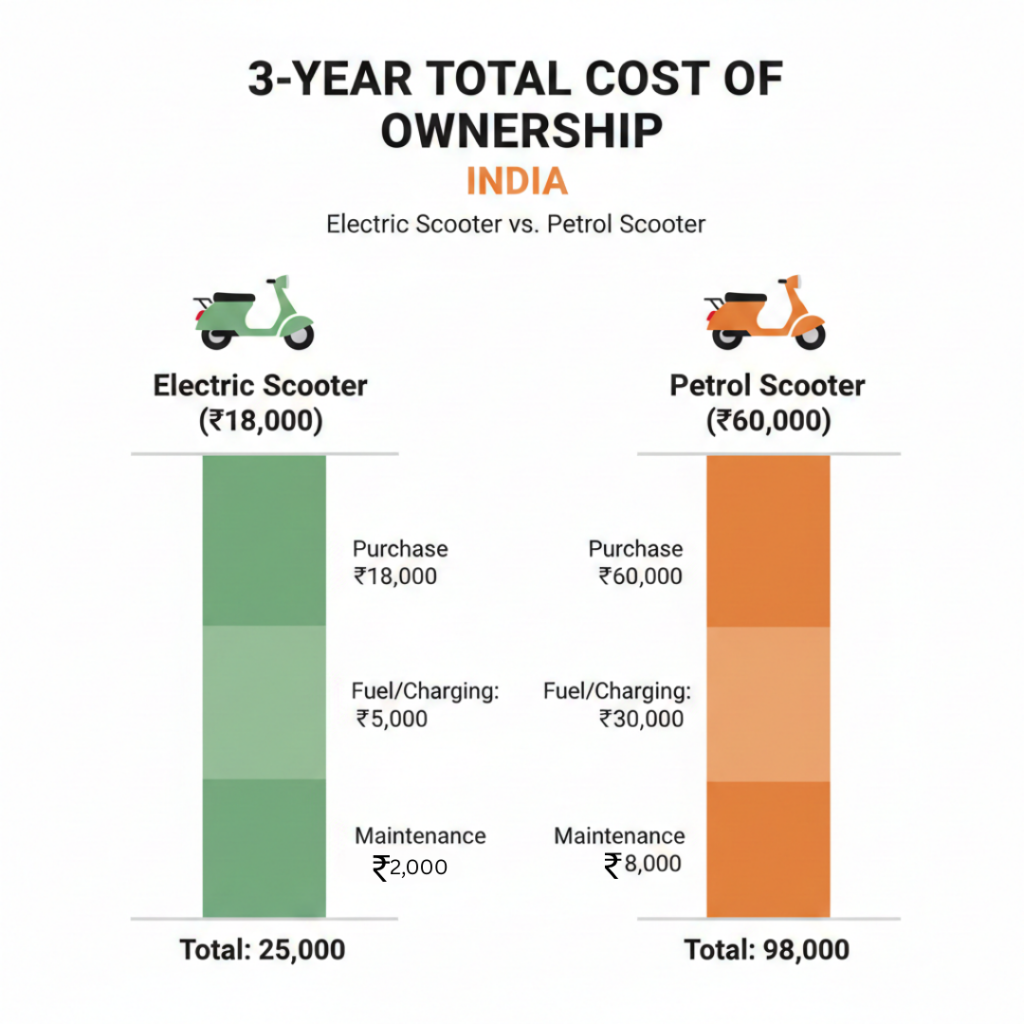
Stage 4: Do the Total Cost of Ownership (TCO) Calculation
Here’s a framework nobody gives you in simple terms:
| Cost Head | Budget E-Scooty (₹18K) | Petrol Scooty (₹60K) |
|---|---|---|
| Purchase price | ₹18,000 | ₹60,000 |
| Fuel/charging cost/year | ~₹1,200 | ~₹10,000 |
| Maintenance/year | ~₹1,500 | ~₹4,000 |
| Year 1 total | ₹20,700 | ₹74,000 |
| Year 3 cumulative | ₹26,100 | ₹82,000 |
Assumptions: 15 km/day, 300 days/year, ₹95/litre petrol, ₹7/unit electricity
Budget Electric Scooter Myths vs. Reality: What Competitors Won't Tell You
Let’s cut through the noise on the three biggest misconceptions floating around.
Myth #1: “₹20,000 electric scooties are toys, not real vehicles.”
Reality: A 250W BLDC motor with a 60V lithium battery at 25 km/h is not a toy — it’s a purpose-built urban commuter. At 25 km/h, you’re moving faster than peak-hour traffic in most Indian cities. A student commuting 8 km to college doesn’t need 80 km/h. They need reliability, zero fuel cost, and easy parking. These scooters deliver exactly that.
Myth #2: “The range figures are completely fake.”
Partially true, partially not. Claimed range on budget EVs is often tested at flat surfaces, 60 kg rider weight, and 25°C. Real-world range drops 20–30% with hills, heavier riders, or battery age. But this is also true of every mainstream EV’s claimed range. The Ola S1 Pro’s “242 km IDC range” real-world figure in hilly cities averages 130–160 km. Apply the same 25–30% discount to budget scooter claims and you’ll have realistic expectations.
Myth #3: “You can’t get a good battery warranty at this price.”
Actually, you can — but you have to ask. Digital Motors, one of India’s budget EV manufacturers, advertises a warranty on their sub-₹20K models. Several IndiaMart-listed manufacturers offer 12-month battery warranties on lead-acid models and 18–24 months on lithium variants. Ask in writing, get it on the invoice.
Who Should (and Shouldn't) Buy an Electric Scooty Under ₹20,000
This is the right buy if you’re:
- A college student with a daily commute under 20 km
- A homemaker doing local errands in a Tier-2 or Tier-3 city
- A retired person wanting low-cost, low-maintenance mobility
- A gig economy delivery worker covering compact delivery zones
- Someone testing EVs before committing to a ₹80K–₹1.5L scooter
A Bengaluru-based food delivery app partnered with a small EV manufacturer in 2024 to equip 200 delivery workers with sub-₹25K electric scooters on a lease model. Their finding: for delivery radii under 15 km, these scooters reduced operational costs by 61% compared to petrol two-wheelers. That’s not anecdotal — that’s math.
Skip this segment if you:
- Commute more than 25–30 km one-way daily
- Need highway speeds (this segment is strictly urban)
- Live in a city without a nearby service center for your chosen brand
- Expect resale value (budget EVs depreciate sharply after Year 2)
Honestly? I’m skeptical of anyone who tells a highway commuter to buy a 25 km/h electric scooter. That’s dangerous advice. Know your use case first.
FAQs: Electric Scooty Under ₹20,000 in India
Yes, genuinely. Several manufacturers — including Digital Motors, Dlite Electric (Envision Electronics), and brands available on IndiaMart — offer low-speed electric scooters between ₹15,000–₹20,000. These are 25 km/h category vehicles requiring no RTO registration or license under MoRTH rules.
No, if the scooter is speed-limited to ≤25 km/h. Under India's Motor Vehicles Act exemption, vehicles not exceeding 25 km/h and 250W motor power don't require registration or a driving license. However, wearing a helmet and carrying ID is still advisable for safety and local compliance.
Realistically, plan for 40–55 km per charge on lead-acid models and 55–75 km on lithium variants, under normal riding conditions (flat roads, 70–80 kg rider, 25°C temperature). Claimed ranges of 80–100 km should be discounted by 25–30% for real-world use.
Lead-acid models typically take 7–8 hours for a full charge from a standard 5-amp home socket. Lithium-ion models charge faster — usually 3–4 hours. Both charge using a standard Indian wall plug; no special charger or socket is needed.
They're safe for their intended use — low-speed urban commuting. At 25 km/h, collision impact energy is significantly lower than at 60 km/h. The risk factors to watch are build quality (check for BIS certification where available), brake quality (drum brakes are standard; ensure they're properly adjusted), and tire condition. Stick to BIS-certified products where possible.
For major brands like Ampere and Hero Electric, yes. For smaller manufacturers, this is genuinely uncertain. Always ask about spare parts availability before buying. BLDC motors and basic lead-acid batteries are generally available at local EV repair shops in most cities.
The FAME India Phase II scheme covers registered electric two-wheelers with a minimum range of 80 km. Most sub-₹20K, low-speed scooters don't meet this threshold. However, some state governments (like Delhi and Maharashtra) offer separate state-level EV subsidies — check your state transport department's website for current schemes.
Expect ₹1,000–₹2,500 annually for routine maintenance — brake adjustments, tyre checks, terminal cleaning, and occasional belt or chain inspection. There's no engine oil, no air filter, no carburettor to service. Battery replacement (after 2–4 years for lead-acid) is the biggest future expense: ₹3,500–₹6,000 for a lead-acid set, ₹8,000–₹14,000 for a lithium pack.
The Bottom Line
After years of watching India’s EV market evolve, here’s what I know for certain:
First: The ₹20,000 electric scooty segment is real, growing, and deeply underserved by quality information. Don’t let mainstream EV media’s fixation on Ola and Ather make you think this segment doesn’t exist or doesn’t matter.
Second: Battery chemistry matters more than any other spec at this price point. Spend ₹2,000–₹3,000 more to get lithium if your daily distance is 20+ km. You’ll thank yourself in Year 2.
Third: After-sales service is the biggest hidden risk. Buy from a brand with a physical presence within 50 km of your home, or you’re buying a very expensive paperweight if something goes wrong.
Whether you’re a student in Kanpur, a homemaker in Coimbatore, or a delivery rider in Indore — an electric scooty under ₹20,000 can genuinely transform your daily commute economics. Just go in with eyes open.
Found this useful? Share your experience with budget EVs in the comments — especially if you’re riding a sub-₹20K scooter and can tell others what no spec sheet will.