Rules of the Internet
The Unwritten Code Governing 5.66 Billion People Online
Table of Contents
ToggleYou’ve probably felt it before—that moment when someone posts something so bizarre, so unhinged, or so strangely on-brand for the internet that you just nod and think, “Yep, that’s the internet.” There’s no handbook. No judge. No magistrate who decides what flies and what gets you dragged in the comments. And yet somehow, billions of people operate online with a shared sense of what’s acceptable, what’s funny, and what absolutely crosses the line.
That shared sense? Those are the rules of the internet—and they’re more powerful than most people realize.
As someone who’s spent over a decade studying online behavior, digital communication, and community dynamics, I can tell you: these rules aren’t random chaos. They’re layered, evolving, and deeply human. According to the Digital 2026 report by Meltwater and We Are Social, global social media user identities now stand at 5.66 billion—68.7% of the world’s total population. Meltwater That’s an enormous number of people who need some shared framework for coexisting online. The rules of the internet are that framework.
What Are the Rules of the Internet, Really?
The rules of the internet are the informal, community-enforced behavioral norms, cultural conventions, and digital etiquette standards that govern how people communicate and interact in online spaces. They exist in two distinct layers: the satirical “numbered rules” born from early internet culture, and the practical netiquette principles that shape everyday online behavior across email, social media, forums, and beyond.
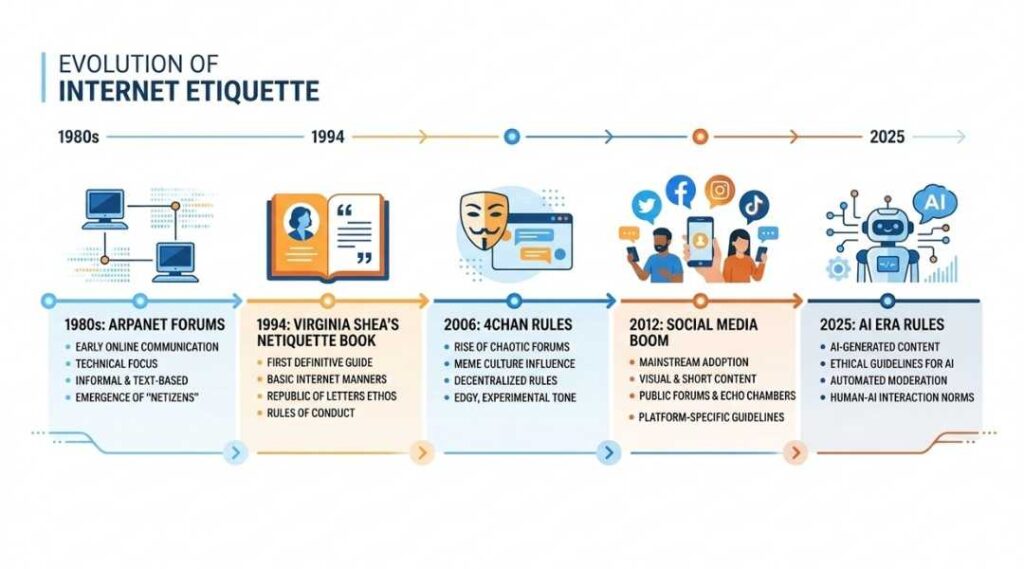
The numbered rules—things like the infamous Rule 34—originated on 4chan and Encyclopedia Dramatica around 2006. They were originally written to serve as a guide for those who identified themselves with the internet group Anonymous, serving as a summation of popular catchphrases and axioms commonly associated with 4chan. Know Your Meme But the deeper, more practical set of internet rules? Those trace back even further.
The idea of netiquette has been around since the 1980s. In 1994, author and tech expert Virginia Shea wrote a book titled Netiquette, outlining 10 core rules for people to follow when using the internet. Many of Shea’s original rules still apply today, but netiquette practices have inevitably evolved as the internet has grown and started to play a larger role in modern life. ExpressVPN
Here’s what most articles miss: these two layers—the satirical and the serious—aren’t separate. They reinforce each other. The absurdist humor of Rule 34 and the earnest guidance of Shea’s netiquette both emerge from the same human need to create order in a chaotic, boundary-free digital space.
Why the Rules of the Internet Matter More Than Ever in 2025
Five years ago, you might have shrugged at this. “Rules? On the internet? Good luck with that.”
But something shifted.
Global internet traffic rose 19% year-on-year in 2025, reflecting increased use for personal and professional activities. A key trend was the rapid growth in generative AI platforms, with ChatGPT leading in generative AI usage. Digital Watch Observatory More people online means more friction, more misunderstanding, and more need for a shared behavioral code. And the stakes have gotten real.
Statistics show that $78 billion is lost yearly due to misinformation and fake news alone. Africa Tech Report That’s not just a number—it’s a direct consequence of people ignoring the rule that says: verify before you share.
A 2025 ExpressVPN survey found that 92% of Americans say they’re concerned about online censorship, with more than a third describing themselves as “very concerned.” ExpressVPN People feel the internet slipping. They sense that without some agreed-upon rules, the whole ecosystem degrades.
And there’s a newer wrinkle nobody’s talking about enough: AI. More than 1 billion people now use standalone generative AI tools every month, and there’s been a steady decline in the number of people who use a conventional search engine each month. Meltwater The rules of the internet are now being tested by machines that don’t inherently know them. That changes everything.
The 4 Tiers of Internet Rules (A Framework Nobody Else Uses)
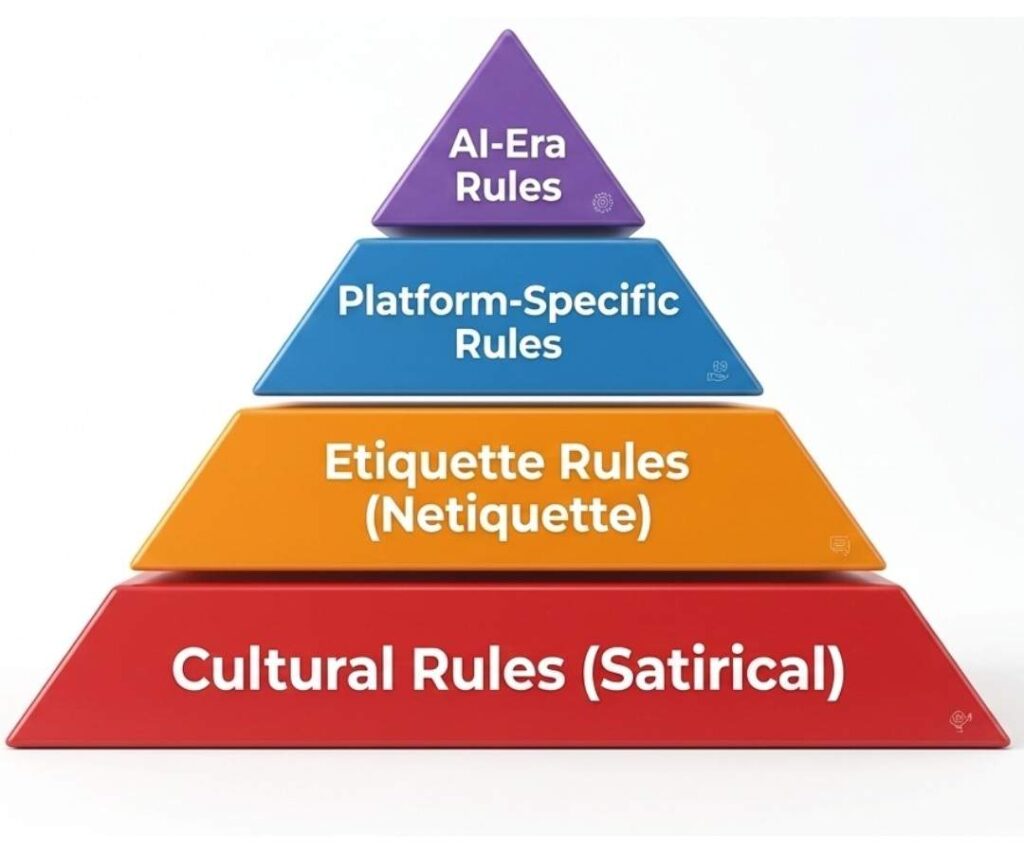
Most articles give you a flat list. That’s not wrong, exactly—it’s just incomplete. Here’s a better way to think about it.
Tier 1: The Cultural Rules (Satirical but Real)
These are the numbered rules that emerged from early internet culture. Rule 34 (“if it exists, there is porn of it”) is the most famous, but the spirit of the whole list is this: the internet reflects humanity’s full spectrum, including its darkest corners, whether you like it or not. Understanding this rule doesn’t mean endorsing it—it means being prepared for it. New users who discover this the hard way tend to leave feeling shocked. Experienced users understand it as a description, not a prescription.
Tier 2: The Etiquette Rules (The Core Netiquette)
Netiquette, or network etiquette, is concerned with the “proper” way to communicate in an online environment—and the golden rule applies: do unto others as you would have others do unto you. Remember, your written words are read by real people, all deserving of respectful communication. Colostate
The classic netiquette rules include things like: don’t type in all caps (it reads as shouting), don’t spam, respect people’s time, and don’t say anything online you wouldn’t say to someone’s face. Simple. Timeless. And broken constantly.
Tier 3: The Platform-Specific Rules
This is where it gets interesting—and where most guides fail completely. The rules of netiquette may vary across different platforms. LinkedIn What’s totally acceptable on Reddit (blunt, anonymous, community-moderated) will get you muted on LinkedIn (professional, identity-attached, reputation-sensitive). The rule isn’t “be polite everywhere.” The rule is read the room—or in digital terms, read the community.
I learned this the hard way years ago when I jumped into a niche Discord server and posted the same way I would on Twitter. The community had its own inside jokes, its own tone, its own unspoken hierarchy. I violated about six unwritten rules in my first message. It took me two weeks to rebuild credibility. (Yes, I’ve made this mistake.)

Tier 4: The Emerging AI-Era Rules
This is the frontier. Nobody has fully codified these yet, but they’re forming right now. They include things like: disclose when content is AI-generated, don’t use AI to impersonate real people, and understand that AI systems have their own “rules” baked in through training. Eisha Buch, head of teaching and learning at Common Sense Media, notes that digital citizenship has expanded far beyond internet safety—it now encompasses how people use digital tools, and generative AI is reshaping expectations that people place on real human interactions. EdTech Magazine
Unwritten vs. Written: Where Most People Get Confused
Here’s a myth worth busting: many people assume “rules of the internet” means legal rules. It doesn’t—at least not primarily. Most of what governs online behavior is social enforcement, not legal.
That said, the two are increasingly overlapping. In 2025, artificial intelligence governance rapidly expanded, the global wave of privacy reform continued, and cybersecurity threats led to strengthened regulation—with enforcement activities growing globally. IAPP Countries like India are rolling out strict data protection laws with penalties up to $27 million per breach. The EU’s Digital Services Act is actively reshaping platform behavior. The unwritten rules are slowly becoming written ones.
But here’s the contrarian view most experts won’t admit: written rules often lag 10 years behind online culture. By the time a government codifies a digital behavior norm, the internet has already moved on. That’s why understanding the unwritten rules still matters more for day-to-day online life than knowing the legal framework.
Virginia Shea’s netiquette principle from 1994 that says “remember the human” is still more practically useful than most legislation passed in the last five years.
Who Actually Enforces the Rules of the Internet?
Nobody. And everybody.
That’s the beauty and the terror of it. Unlike physical communities, the internet has no central authority. Enforcement happens through:
- Community moderation (upvotes, downvotes, bans, public call-outs)
- Platform algorithms that reward or suppress certain behaviors
- Social pressure (the court of public opinion, cancel culture, pile-ons)
- Legal systems that are slowly catching up
If you feel compelled to respond to someone’s mistake, the classic netiquette guidance is to do so in a private message rather than a public forum. Colostate That’s the kind of nuanced rule that separates experienced internet citizens from newcomers—and it’s one that gets violated approximately ten thousand times per day on Twitter/X alone.
FAQs About the Rules of the Internet
Rule 34 states that if something exists, there is internet pornography of it. It originated on 4chan around 2006 as part of the satirical "Rules of the Internet" document and has since become one of the most widely recognized internet culture axioms. It's less a rule and more an empirical observation about the breadth of human creativity—and appetite—online.
Most are not. The majority of internet rules are social norms enforced by communities, platforms, and peer pressure rather than law. However, laws around harassment, copyright infringement, defamation, and data privacy do overlap with some internet behavioral norms—and these legal frameworks are expanding rapidly through 2025 and 2026.
Netiquette (network etiquette) refers specifically to the practical code of polite online behavior—things like not typing in all caps, responding promptly to messages, and not spamming. The "rules of the internet" is a broader term that includes both netiquette and the satirical, culture-specific norms born from communities like 4chan and Reddit.
Increasingly, yes. As AI tools like ChatGPT and others become major players in online interaction, questions about how they should behave are being actively debated. Disclosure of AI-generated content is becoming an emerging standard, and some platforms are building explicit policies around AI behavior.
Because each platform has a distinct culture, user base, and moderation philosophy. Reddit's anonymity encourages bluntness; LinkedIn's professional context demands polish; Discord communities develop hyper-specific local norms. The underlying principle stays consistent—respect the people on the other side of the screen—but expression varies wildly.
Probably the one Virginia Shea put first in 1994: remember the human. Behind every username is a real person with real emotions. This rule is violated constantly—through trolling, harassment, pile-ons, and thoughtless comments. The internet's capacity for dehumanization is its biggest failure, and it stems almost entirely from forgetting this single rule.
The emergence of AI-generated content, deepfakes, and AI-powered social accounts has added a new layer of complexity. New emerging norms include: label AI-generated content, don't use AI to impersonate individuals, be skeptical of information that seems suspiciously perfect or unverifiable. The rulebook is being rewritten in real time.
Yes, frequently. Platform moderators—both human and algorithmic—enforce community standards that often go beyond what's explicitly written in terms of service. Subtler violations like consistently bad-faith arguing, context-collapse posting, or cultural insensitivity in the wrong community can get you removed even when you've technically broken no written rule.
Three Takeaways That Actually Matter
After years of watching online communities thrive and collapse, here’s what I keep coming back to:
First: The most important rule of the internet isn’t Rule 34 or any numbered entry—it’s Shea’s original prime directive: the people you’re talking to online are real humans. Everything else flows from that.
Second: Context is the master rule. The “right” behavior shifts platform to platform, community to community. Spend time observing before posting. Lurk before you speak. The internet rewards people who read the room.
Third: The rules are evolving faster than ever. AI has introduced genuinely new ethical territory that neither the satirical rules of 4chan nor Virginia Shea’s 1994 netiquette fully address. Staying digitally literate means actively updating your understanding—not assuming the rules you learned five years ago still apply.
Whether you’re navigating a Reddit thread, managing a professional LinkedIn presence, or trying to understand why your Discord message landed wrong—the rules of the internet are the invisible architecture shaping every interaction. Learn them, and the online world becomes dramatically more navigable.
What’s your experience with unwritten internet rules? Share in the comments—especially if you’ve had a memorable moment of discovering a community norm you didn’t know existed.