
What Is DMO Meaning in Software
If you searched dmo meaning and got a mix of confusing results, you are not alone. The problem is simple: in software, DMO does not have one universal meaning. Depending on the platform, it can refer to Data Model Object in Salesforce, Database Migration Option in SAP, or DirectX Media Object in older Microsoft media frameworks. That is exactly why so many “definition” pages feel incomplete.
For technology learners, this matters more than it seems. If you read the wrong definition, you can misread an entire tutorial, migration guide, or architecture discussion. And once that happens, every term around it starts feeling harder than it really is. This guide fixes that by explaining what DMO meaning in software usually refers to, where each version appears, and how to identify the right one fast.
Quick answer: In software, DMO usually means a platform-specific object or process. In Salesforce Data Cloud, a DMO is a Data Model Object used to organize and standardize customer data. In SAP, DMO means Database Migration Option, a feature in Software Update Manager that combines software update and database migration. In older Microsoft media stacks, DMO means DirectX Media Object, a COM-based component that transforms media data.
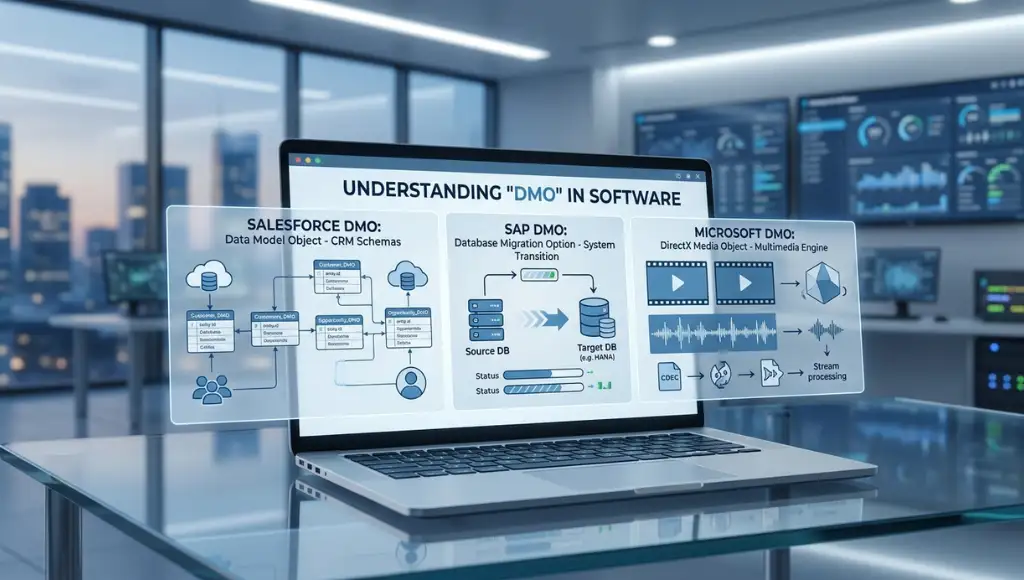
Why DMO Is So Confusing in Software
The confusion comes from acronym overload. Software teams, enterprise platforms, and legacy frameworks often reuse the same three-letter acronym for totally different purposes. So when someone searches “what does dmo mean,” they are not really asking for one answer. They are asking for the right answer for the product they are reading about.
That is the key point most weak articles miss.
In software content, context is everything. If the page mentions Customer 360, Data Cloud, attributes, or segmentation, it is almost certainly talking about Salesforce DMOs. If it mentions SUM, ABAP, SAP HANA, or migration, it is SAP. And if it mentions COM objects, DirectShow, Windows Media, or codec processing, it is Microsoft’s older DirectX media terminology.
DMO Meaning in Software: The 3 Main Definitions
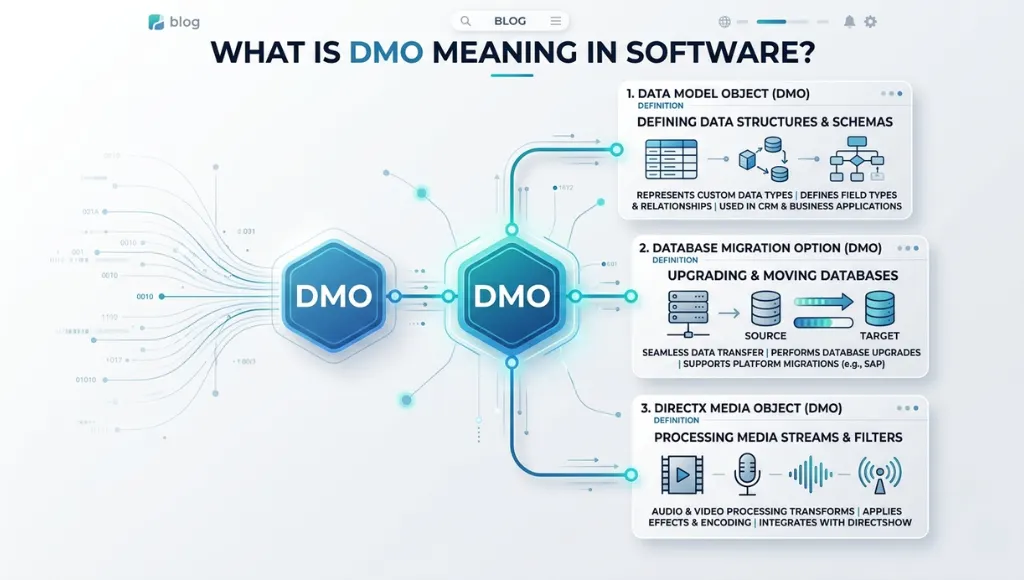
1. DMO in Salesforce: Data Model Object
In Salesforce Data Cloud, a Data Model Object is a grouped representation of business data inside the Customer 360 Data Model. Salesforce explains that a DMO is a grouping of data that describes an instance of a thing or an action, and that these objects help standardize data coming from different systems. In plain English, a DMO gives your data a shared structure so records from different sources can still make sense together.
That matters because customer data is usually messy. One system may store an email subscriber one way, another may store the same person under a CRM contact ID, and another may use a loyalty number. Salesforce’s model exists to align those records, their attributes, and their relationships so teams can unify, segment, and activate data more reliably. Salesforce Help also notes that businesses can create custom DMOs when standard objects do not fit unique business needs.
So if you are reading about data mapping, attributes, subject areas, or identity resolution, DMO almost certainly means Data Model Object.
2. DMO in SAP: Database Migration Option
In SAP, DMO means Database Migration Option. SAP’s documentation says DMO is part of Software Update Manager (SUM) and combines a software update with a database migration for ABAP-based systems. That is why SAP teams talk about DMO during major modernization work, especially when moving toward SAP HANA or consolidating upgrade and migration work into one guided process.
This is a very different meaning from Salesforce. Here, DMO is not a data object inside an app. It is a migration path and operational procedure. SAP also notes that standard DMO is an in-place procedure, meaning the application server level remains unchanged while the database side changes, and that SAP supports additional move scenarios and downtime-optimized variants.
So if your article or documentation talks about upgrades, downtime, SUM, or database transitions, DMO means Database Migration Option.
3. DMO in Microsoft: DirectX Media Object
In Microsoft’s older media stack, DMO stands for DirectX Media Object. Microsoft describes DMOs as COM-based data-streaming components that take input data and produce output data. In related Media Foundation docs, Microsoft says a DMO is a COM object that transforms data, such as taking uncompressed media and returning compressed media through a codec encoder.
This version of DMO shows up in legacy Windows multimedia development, audio effects, codecs, and older DirectShow-era workflows. Microsoft also says these DMOs have been superseded by Media Foundation Transforms (MFTs), although the DMO interfaces are still supported. That means the term still matters for maintenance, documentation, and older codebases, even if it is not the first choice for new implementations.
So if the page mentions DirectShow, media streams, IMediaObject, or codec processing, DMO refers to DirectX Media Object.
How to Tell Which DMO a Page Means
Use this quick context filter:
1. Look at the product name first.
Salesforce, SAP, and Microsoft each use DMO differently. The platform name usually gives the answer immediately.
2. Check the nearby terms.
Words like attributes, Customer 360, and segmentation point to Salesforce. Migration, SUM, and HANA point to SAP. COM, codec, and DirectShow point to Microsoft.
3. Ask whether DMO is an object or a process.
In Salesforce and Microsoft, DMO is an object or component. In SAP, it is a migration option and workflow. That single distinction clears up a lot of confusion.
4. Watch for legacy clues.
If the documentation feels older and centers on Windows media processing, you are probably looking at the Microsoft meaning, especially since Microsoft now points new custom codec work toward MFTs instead of DMOs.
DMO Comparison Table
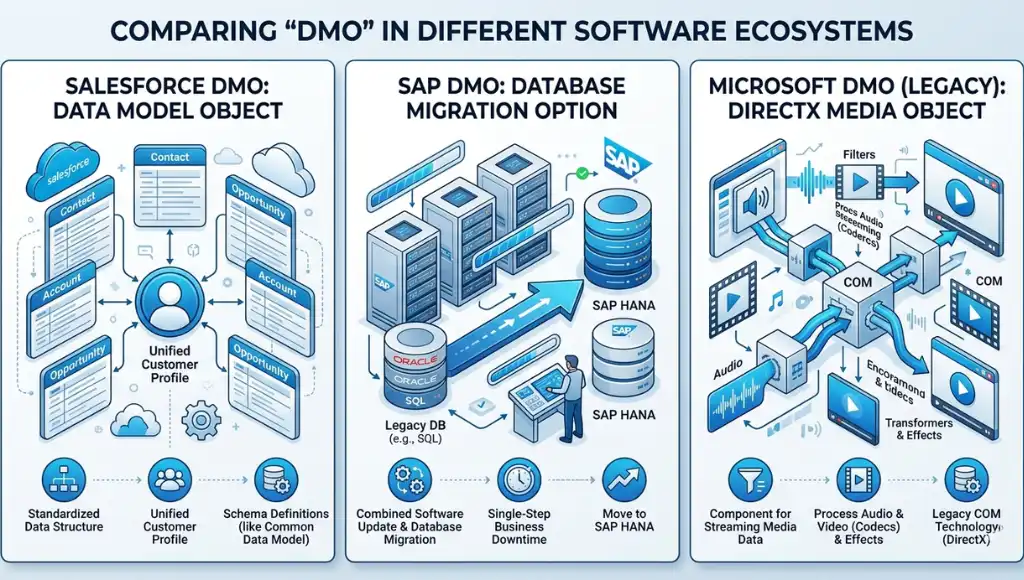
The table below pulls together the three most common software meanings of DMO from official platform documentation.
| Context | Full Form | What It Does | Where You’ll See It |
|---|---|---|---|
| Salesforce Data Cloud | Data Model Object | Organizes and standardizes business data in the Customer 360 model | Data mapping, attributes, segmentation |
| SAP | Database Migration Option | Combines software update and database migration in SUM | SAP upgrades, HANA migration, ABAP systems |
| Microsoft media stack | DirectX Media Object | Transforms input media data into output media data | DirectShow, codecs, Windows media processing |
| Salesforce customization | Custom DMO | Stores data unique to a business when standard objects are not enough | Enterprise customer data modeling |
| SAP operations | Downtime-optimized DMO | Reduces downtime during selected migration scenarios | Large SAP migration projects |
| Microsoft legacy support | DMO interfaces | Still supported, but newer work is pushed toward MFTs | Maintenance of older multimedia apps |
Why This Keyword Matters for Learners and SEO
Here is the part that gives this topic real search value: “dmo meaning” is a mixed-intent keyword. Your own keyword snapshot already shows that. Some users want tourism, some want dental insurance, and some want software. So a software article has to do two things at once: answer the software meaning fast, and then explain the platform-specific definitions before the user leaves.
That is also why a generic one-line definition usually underperforms for this topic. It answers too little. A better page explains that DMO meaning in software depends on the ecosystem, then breaks the acronym into Salesforce, SAP, and Microsoft use cases. That gives beginners clarity and gives search engines stronger semantic coverage around related terms like Data Model Object, Database Migration Option, and DirectX Media Object.

Common Mistakes to Avoid
Mistake 1: Assuming DMO has only one software definition.
It does not. Official docs from SAP, Salesforce, and Microsoft use the same acronym for different concepts.
Mistake 2: Ignoring the platform context.
A Salesforce learner reading an SAP definition will come away more confused, not less. Always identify the platform first.
Mistake 3: Treating Microsoft DMO as the modern default.
Microsoft still supports DMOs, but its documentation says they have been superseded by Media Foundation Transforms for newer custom codec or audio/video processing work.
Mistake 4: Forgetting user intent when writing content.
For this keyword, the winning article is not the shortest one. It is the clearest one.
FAQ
DMO in software usually means different things depending on the platform. The three most common meanings are Data Model Object in Salesforce, Database Migration Option in SAP, and DirectX Media Object in Microsoft’s older media framework docs.
No. In Salesforce, DMO is a data structure concept inside the Customer 360 model. In SAP, DMO is a migration and update option inside Software Update Manager. They share the acronym, not the meaning.
A DMO in Salesforce Data Cloud is a Data Model Object that describes a thing or action in the Customer 360 Data Model. It helps standardize incoming data and map attributes across different systems.
SAP DMO is used to combine a software update with a database migration through Software Update Manager. It is commonly discussed in ABAP-based system upgrades and HANA migration planning.
Yes, but mostly in legacy or maintenance contexts. Microsoft says DMO interfaces are still supported, but newer custom codec or audio/video processing work should generally consider Media Foundation Transforms instead.
Because it is a cross-industry acronym. Even inside software, multiple official vendors use DMO differently. That means the only reliable way to define it is to match the acronym to the product or framework being discussed.
Conclusion
If you want the clearest answer, here it is: DMO meaning in software depends on context, not on one universal definition. In Salesforce, think Data Model Object. In SAP, think Database Migration Option. In older Microsoft media development, think DirectX Media Object. Once you learn that pattern, the acronym stops being confusing and starts being easy to decode.
Looking for more technology guides, tutorials, and insights tailored for Indian tech enthusiasts? Explore the extensive resource library at ZProStudio, where we publish in-depth articles covering everything from software development and digital marketing to mobile technology and emerging tech trends.