
Pentagon Big Tech Tesla Cybertruck
In 2024, the U.S. Department of Defense requested $842 billion in its annual budget, according to the U.S. Department of Defense. At the same time, electric vehicle maker Tesla rolled out the stainless-steel, angular Tesla Cybertruck to consumers across the U.S.
Coincidence? Maybe.
But here’s the real question people are quietly Googling: Is Big Tech getting closer to the Pentagon—and could the Cybertruck play a role?
As a tech industry analyst who’s spent 12+ years covering defense innovation and mobility tech, I’ve noticed something interesting. Most articles either hype a futuristic “battlefield Cybertruck” or dismiss the idea entirely. What they don’t explain is the deeper shift happening between the Pentagon, Big Tech firms, and next-generation vehicle platforms.
Let’s break it down—clearly, factually, and without conspiracy noise.
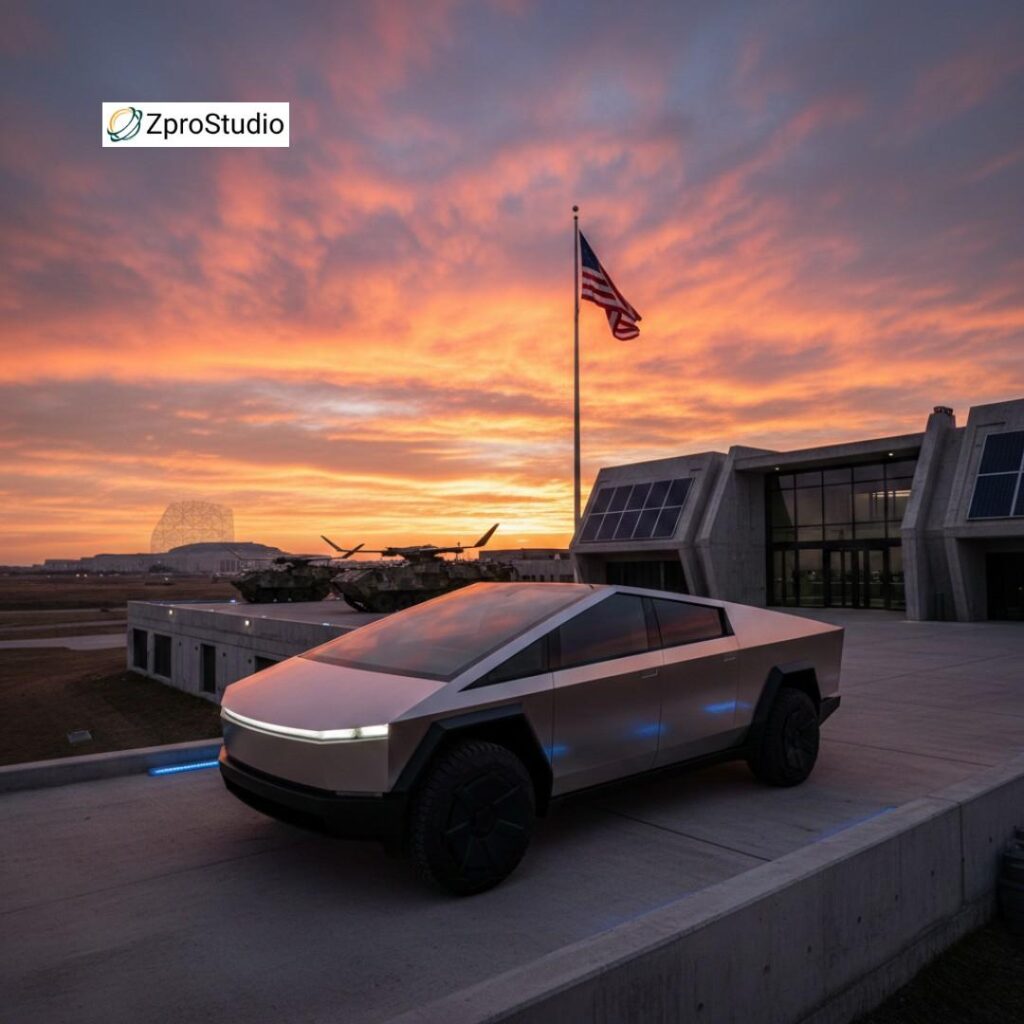
What Is the Pentagon–Big Tech–Tesla Cybertruck Connection?
The Pentagon–Big Tech–Tesla Cybertruck discussion refers to growing collaboration between the U.S. Department of Defense and major technology companies—alongside interest in electric and autonomous vehicle platforms like Tesla’s Cybertruck—for logistics, resilience, and battlefield modernization.
This isn’t about turning mall parking lots into war zones.
It’s about:
Electrification of military fleets
Cybersecurity in connected vehicles
Autonomous mobility systems
Energy independence on the battlefield
According to a 2023 report from the Congressional Research Service, the Department of Defense is actively exploring electric and hybrid tactical vehicles to reduce fuel logistics vulnerabilities. Fuel convoys, historically, are among the most vulnerable military supply lines.
Energy equals survival.
And that’s where Big Tech enters.
Why the Pentagon Is Increasingly Partnering With Big Tech
The short answer? Speed and software.
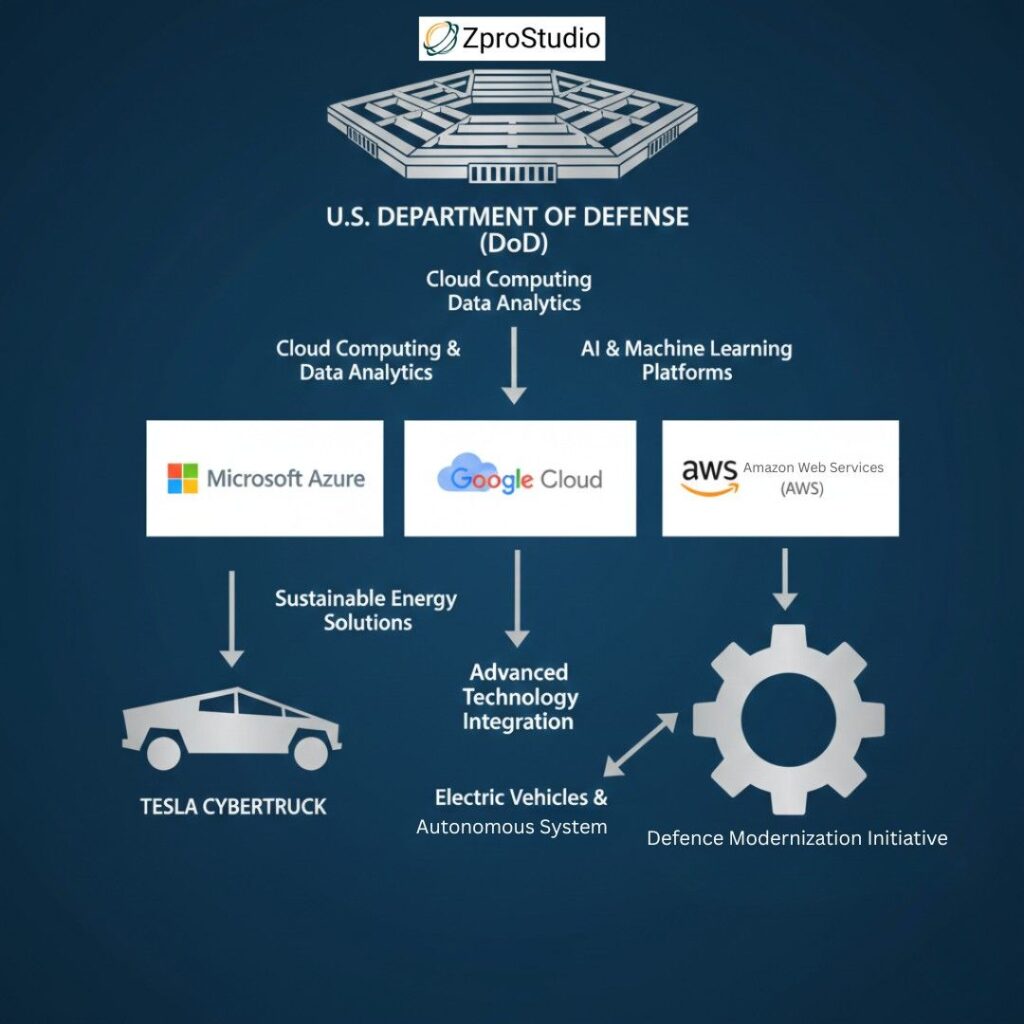
The Pentagon can’t innovate alone at Silicon Valley velocity. Over the last decade, it has partnered with companies like:
Microsoft (cloud & defense AI contracts)
Amazon Web Services (federal cloud infrastructure)
Google (AI research collaborations)
In 2022, the Department of Defense awarded a $9 billion Joint Warfighting Cloud Capability contract split among Microsoft, AWS, Google, and Oracle (DoD announcement).
That’s not small change.
And here’s the shift nobody talks about:
Modern warfare runs on software as much as hardware.
Electric vehicles like the Cybertruck are essentially rolling computers—powered by OTA updates, AI systems, and sensor stacks. That aligns more closely with Big Tech’s DNA than traditional defense contractors.
Plot twist: It’s not about the truck. It’s about the tech inside the truck.
Could the Tesla Cybertruck Actually Be Used by the Military?
Short answer: Not officially. But conceptually? It checks interesting boxes.
The U.S. military already operates electric prototypes. The U.S. Army tested hybrid-electric vehicles for silent mobility operations, according to research published by the U.S. Army Combat Capabilities Development Command.
Here’s why the Cybertruck gets attention:
1. Stainless Steel Exoskeleton
Tesla claims its ultra-hard 30X cold-rolled stainless steel improves durability. While not military armor, its structural strength could inspire tactical adaptations.
2. Electric Torque & Silent Operation
Electric motors generate instant torque and quieter movement—valuable for reconnaissance.
3. Onboard Power Supply
The Cybertruck supports bidirectional charging and external power output. On the battlefield, mobile energy matters. The DoD has emphasized energy resilience in its 2021 Climate Adaptation Plan.
But let’s be realistic.
The Cybertruck wasn’t built for combat. It lacks:
Ballistic armor
EMP hardening
Military-grade communication systems
Classified cybersecurity frameworks
Still, civilian platforms often influence defense innovation. Think of how drones evolved.
The 4-Stage Framework: How Big Tech Vehicles Enter Defense Ecosystems
Here’s a pattern I’ve seen repeatedly in defense-tech crossovers:
Stage 1: Civilian Innovation
A company builds a commercial product—fast, cheap, scalable.
Stage 2: Defense Evaluation
Military R&D teams test viability for non-combat roles (logistics, base mobility, energy resilience).
Stage 3: Specialized Adaptation
Private defense contractors modify core architecture—add armor, encrypted systems, secure firmware.
Stage 4: Parallel Development
Instead of using the original product, the military develops its own derivative system.
In most cases, the military doesn’t deploy the commercial model. It adapts lessons learned.
That’s likely the path if anything ever emerges from the Pentagon Big Tech Tesla Cybertruck narrative.
Big Tech vs Traditional Defense Contractors: Who Wins?
This is where things get interesting.
Traditional defense giants like Lockheed Martin and Raytheon Technologies specialize in classified systems and long procurement cycles.
Big Tech companies prioritize:
Rapid iteration
AI integration
Cloud-native systems
Consumer-scale manufacturing
According to a 2024 RAND Corporation defense modernization study, commercial technology adoption cycles are 5–7 times faster than traditional military procurement systems.
But speed isn’t everything.
Military systems require:
Hardened cybersecurity
Long-term maintenance guarantees
Interoperability across NATO systems
Big Tech can innovate quickly. Defense contractors ensure survivability.
The future likely blends both.
Real-World Use Cases Beyond Combat
Now let’s move away from Hollywood fantasies.
Where could electric platforms like the Cybertruck realistically support military operations?
Base Operations
Non-combat fleet vehicles on domestic bases transitioning to electric power reduce fuel costs.
Disaster Response
Military units assisting in wildfire or hurricane recovery benefit from silent, power-generating vehicles.
Energy Backup
Mobile battery storage during grid outages. The DoD has identified energy resilience as a national security priority.
And here’s something most commentators miss:
Electrification reduces thermal signature compared to combustion engines. That matters in certain tactical scenarios.
Expert Perspective: Electrification and Defense Strategy
Dr. Erin Sikorsky, former Director of the Center for Climate & Security, has noted that climate resilience and energy security are increasingly embedded in defense planning.
The Pentagon’s 2021 Climate Risk Analysis report emphasizes reducing dependence on vulnerable fuel supply chains.
Electric mobility supports that goal.
Not because it’s trendy.
Because it’s strategic.
FAQs: What People Are Asking
No. As of 2026, there is no confirmed deployment of Cybertrucks in U.S. military operations.
Primarily for cloud computing, AI, cybersecurity, and digital modernization initiatives—not consumer vehicle deployment.
Not entirely. Electric systems may supplement logistics and base operations, but frontline armored vehicles require specialized engineering.
Not directly. Historically, military and civilian technologies influence each other in cycles.
Yes. Connected vehicles introduce potential cyber vulnerabilities, which is why military adaptations require secure, isolated systems.
Tesla itself does not have major public defense contracts. However, its technologies influence broader electric mobility ecosystems.
What This Really Means
Let’s zoom out.
The Pentagon Big Tech Tesla Cybertruck conversation isn’t about stainless steel aesthetics. It’s about something bigger:
The digitization of warfare
The electrification of mobility
The convergence of Silicon Valley and defense strategy
And here’s my honest take:
We’re not going to see Cybertrucks storming battlefields.
But we are going to see electric, AI-powered tactical vehicles shaped by lessons from companies like Tesla.
Civilian innovation feeds defense modernization. That cycle isn’t new—it’s accelerating.
3 Key Takeaways
First: Big Tech’s real value to the Pentagon is software, AI, and cloud infrastructure—not flashy vehicles.
Second: Electric mobility aligns with military energy resilience goals, according to official DoD strategy documents.
Third: The Cybertruck symbolizes a broader shift—commercial innovation influencing defense procurement.
Whether you’re a tech investor, policy analyst, or just curious about the Pentagon Big Tech Tesla Cybertruck debate, one thing’s clear:
The future of defense won’t just be built in factories.
It’ll be coded.
If you’re interested in emerging tech and defense modernization trends, subscribe for deeper breakdowns each week.