
Wireless Charging
Imagine placing your phone on a small pad, walking away, and coming back to a fully charged battery—no cables, no ports, no hassle. That simple convenience is the reason wireless charging has quickly moved from a luxury feature to something most smartphone users expect.
By 2026, wireless charging is built into nearly every premium smartphone. Devices from Apple Inc., including the iPhone lineup, support it by default. Android manufacturers such as Samsung Electronics and Google have also adopted the technology across many of their flagship devices.
But wireless charging is still evolving. The introduction of the Qi2 charging standard is making wireless charging faster and more reliable, while new accessories and charging surfaces are expanding how and where devices can power up.
This guide explains everything you need to know about wireless charging in 2026. You’ll learn how the technology works, what speeds you can expect, which devices support it, and where the future of cable-free charging is heading.
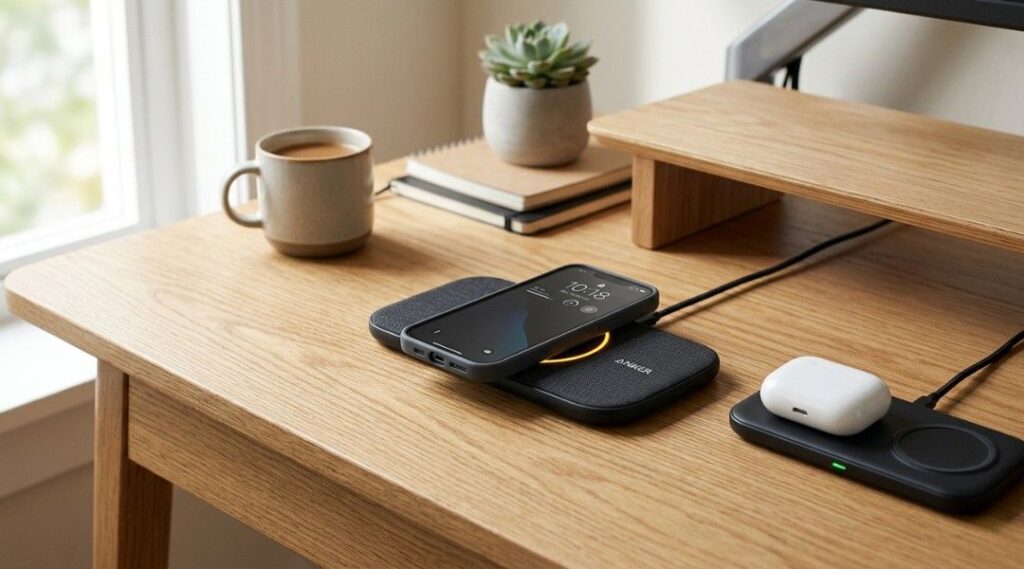
Wireless Charging Quick Facts
| Feature | Details |
|---|---|
| Technology | Electromagnetic induction |
| Main Standard | Qi wireless charging |
| New Standard | Qi2 magnetic charging |
| Typical Speed | 5W – 15W |
| Main Benefit | Cable-free charging convenience |
| Supported Devices | iPhone, Samsung Galaxy, Pixel phones, earbuds |
What Is Wireless Charging?
Wireless charging allows devices such as smartphones, earbuds, and smartwatches to recharge their batteries without a physical cable connection. Instead of plugging a cable into your phone, you simply place the device on a charging pad or stand.
Power transfers through the air over a short distance using a technology called electromagnetic induction.
Most modern devices use the Wireless Power Consortium’s Qi wireless charging standard, which ensures compatibility between chargers and devices from different brands.
The idea of wireless power isn’t new. Experiments date back to the late 19th century when Nikola Tesla explored transmitting electricity without wires. However, practical consumer versions didn’t become widely available until the late 2000s when Qi was introduced.
Today, wireless charging is common in:
smartphones
wireless earbuds
smartwatches
electric toothbrushes
some laptops and tablets
The appeal is simple: fewer cables, less wear on charging ports, and a much more convenient way to keep devices powered throughout the day.
How Wireless Charging Works
At first glance, wireless charging can seem almost magical. In reality, it relies on a straightforward physics principle.
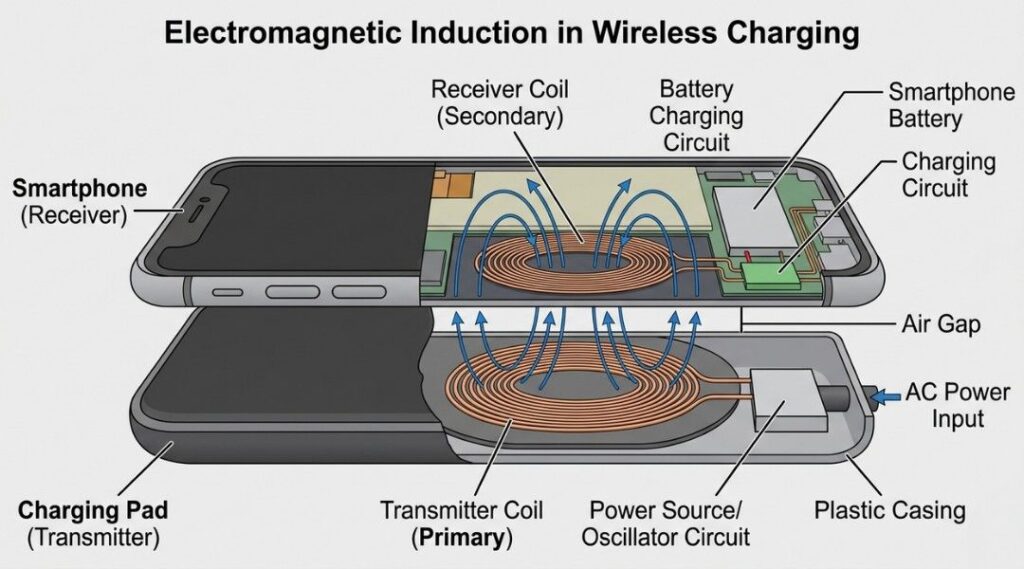
Inside every wireless charger is a transmitter coil, which is a spiral of copper wire connected to a power source.
When electricity flows through this coil, it creates a changing magnetic field.
Inside your phone, there is another coil called the receiver coil. When the phone is placed on the charging pad, the magnetic field generated by the charger passes through the receiver coil and produces an electric current.
That current is then converted into power that charges the battery.
This process is called electromagnetic induction, and it’s also known as inductive charging. Wireless charging relies on electromagnetic induction. You can explore the physics behind this process in our guide How Does an Induction Charger Work.
One important limitation is distance. The magnetic field weakens quickly, which means the phone must be placed very close to the charging pad. A thin phone case is usually fine, but a large gap between the device and the charger will prevent charging.
The Qi standard defines how devices communicate during this process. It sets rules for:
power levels
safety features
heat control
foreign object detection
Because of this standardization, a Qi-compatible phone can usually charge on any Qi charger.
Most modern devices use lithium-based cells such as the 18650 rechargeable battery, known for its high energy density and long lifespan.
If you want a deeper technical breakdown, read our full guide on How Does Wireless Charging Work to understand the technology step by step.
Types of Wireless Charging Technologies
Wireless charging is not a single technology. Several different standards and implementations exist today.
Qi Wireless Charging
Qi wireless charging standard is the most widely used wireless charging system in the world.
Developed by the Wireless Power Consortium, Qi has become the default standard for smartphones and accessories.
Basic Qi chargers deliver around 5 watts, while newer chargers can provide 10W to 15W depending on the device.
Because of its wide compatibility, Qi chargers work with devices from multiple manufacturers.
If you want recommendations and buying tips, check our detailed Qi Wireless Charger guide covering the best models available today.
MagSafe Wireless Charging
Apple MagSafe is Apple’s improved version of wireless charging introduced with the iPhone 12.
MagSafe adds a ring of magnets around the charging coil. These magnets automatically align the phone with the charger, ensuring the coils match perfectly.
This alignment improves efficiency and allows iPhones to reach 15W charging speeds.
MagSafe also created a large ecosystem of accessories including:
magnetic wallets
car mounts
battery packs
Apple introduced MagSafe wireless charging to improve coil alignment and charging efficiency for iPhone devices.
Qi2 Charging Standard
The Qi2 charging standard represents the next generation of wireless charging.
Qi2 builds on the original Qi system but adds magnetic alignment, similar to MagSafe. The difference is that Qi2 is an open universal standard, meaning Android devices can use the same magnetic charging system.
This improves reliability because the device automatically snaps into the ideal charging position.
Qi2 currently supports speeds of up to 15W, with faster versions expected in future updates.
Reverse Wireless Charging
Reverse wireless charging allows your smartphone to act as a wireless charger for other devices.
Some phones, such as certain models in the Samsung Galaxy series, offer this feature under names like Wireless PowerShare.
You can place accessories such as earbuds on the back of the phone to charge them.
The charging speed is usually slower (around 5W), but it can be extremely useful in emergencies.
Battery chemistry also plays a key role in performance. If you’re comparing options, read our detailed guide on lithium ion vs zinc ion batteries to understand efficiency, safety, and charging behavior.
Wireless Charging Speed and Watt Output
Wireless charging speed depends on the charger, the phone, and the technology being used.
Here’s a simple comparison.
| Charging Type | Typical Speed |
|---|---|
| Basic Qi | 5W |
| Fast Wireless Charging | 10W |
| Apple MagSafe | 15W |
| Qi2 Standard | Up to 15W |
| Samsung Fast Wireless | 15W |
| OnePlus AIRVOOC | Up to 50W |
However, these speeds are maximum theoretical values.
In real-world conditions, charging is often slower due to:
heat management
battery protection systems
energy transfer efficiency
Wireless charging typically operates at 70–80% efficiency, meaning some power is lost as heat.
For everyday charging—especially overnight—this speed difference usually doesn’t matter. But if you need a quick battery boost, wired charging is still faster.

Benefits of Wireless Charging
Wireless charging offers several practical advantages that explain why it has become so popular.
Convenience
You simply place your phone on the pad. There’s no cable to plug in or connector to align.
This makes charging easier in everyday situations, such as placing your phone on a nightstand before bed.
Reduced Port Wear
Charging ports experience wear over time from repeated cable insertions.
Wireless charging eliminates that mechanical stress and helps preserve the charging port.
Cleaner Workspace
A single wireless charging pad can replace multiple cables, making your desk or bedside table look more organized.
Cross-Device Compatibility
Because most devices support the Qi standard, a single charger can power multiple devices such as phones and earbuds.
Easy Shared Charging
Wireless charging pads are increasingly appearing in public places like airports, offices, and cafés.
Anyone with a compatible device can simply place their phone on the pad to charge.
Wireless Charging Limitations
Despite its convenience, wireless charging also has a few limitations.
Slower Charging
Wireless charging is generally slower than wired fast charging.
Many wired chargers now deliver 25W, 45W, or more, which is significantly faster.
Heat Generation
Wireless charging produces more heat because some energy is lost during transfer.
Modern phones manage this well, but excessive heat can reduce battery lifespan over time.
Alignment Sensitivity
Standard Qi chargers require the phone to be placed correctly on the pad.
If the coils are misaligned, charging may be slower or may not start at all.
MagSafe and Qi2 largely solve this problem with magnetic alignment.
Energy Efficiency
Because some power is lost during the wireless transfer process, wireless charging uses slightly more electricity than wired charging.
For a single phone, the difference is extremely small.
Wireless Charging: Pros vs Cons
| Pros | Cons |
|---|---|
| No cables required | Slower than wired charging |
| Reduces charging port wear | Generates more heat |
| Cleaner desk setup | Requires correct alignment |
| Works with many devices | Slightly less energy efficient |
Best Devices That Support Wireless Charging
Most modern flagship smartphones support wireless charging.
Apple iPhones
Wireless charging has been included in iPhones since the iPhone 8.
Recent models such as the iPhone 15 lineup support both Qi and MagSafe charging systems.
For a full breakdown of features and compatibility, explore our Best Wireless Charger for iPhone guide.
Samsung Galaxy Phones
Many phones in the Samsung Galaxy series include wireless charging along with reverse wireless charging capabilities.
Google Pixel Phones
Recent Pixel devices support Qi charging, with newer models beginning to adopt Qi2 compatibility.
Wireless Earbuds and Accessories
Many accessories also support wireless charging, including:
Apple AirPods
Samsung Galaxy Buds
Google Pixel Buds
Wireless Charging Myths (Debunked)
Several misconceptions about wireless charging continue to circulate online.
Myth: Wireless Charging Damages Batteries
Modern smartphones include advanced battery management systems that control charging speed and temperature.
Under normal conditions, wireless charging does not significantly harm battery health.
Myth: Wireless Charging Wastes Electricity
While wireless charging is slightly less efficient than wired charging, the difference in electricity use is extremely small.
For most users, the additional cost is only a few cents per year.
Myth: Wireless Charging Is Unsafe
Qi wireless chargers include safety features such as foreign object detection, which stops charging if metal objects are detected.
The electromagnetic fields involved are low-power and safe for everyday use.
Myth: Wireless Charging Works Through Any Surface
Wireless charging works best when the device is very close to the charger.
Most chargers work through thin phone cases but may struggle with thick cases or cases containing metal components.
The Future of Wireless Charging Technology
Wireless charging technology continues to improve every year.
Qi2 Expansion
As more manufacturers adopt the Qi2 standard, magnetic wireless charging will become common across both Android and iPhone devices.
Faster Charging
Companies such as OnePlus and Xiaomi have already demonstrated wireless charging speeds above 50W.
Future Qi updates may bring these faster speeds to universal standards.
Long-Distance Wireless Charging
Researchers are experimenting with systems that charge devices from several feet away using focused radio frequency energy.
Although still experimental, this technology could eventually eliminate charging pads altogether.
Automotive Charging
Some modern vehicles already include built-in wireless car charger pads designed specifically for smartphones. These chargers use the same technology found in home charging devices but are optimized for in-car use, making it easier to charge your phone while driving.
Many drivers also rely on external wireless car charger mounts, which attach to air vents or dashboards for better visibility and convenience during navigation.
Looking ahead, the future of automotive charging goes beyond smartphones. New innovations are exploring wireless charging for electric vehicles, where EVs can charge through pads embedded in parking spaces without plugging in cables.
Integrated Charging Surfaces
Furniture companies are beginning to integrate wireless charging directly into desks, tables, and countertops.
As the technology becomes more reliable, this type of built-in charging may become common in homes and workplaces.
Expert Tip: Get Faster Wireless Charging
To achieve the best wireless charging performance:
Use Qi2 or MagSafe chargers for better alignment.
Avoid thick phone cases that block charging coils.
Place the phone directly in the center of the charging pad.
Keep the charger on a cool surface to reduce heat buildup.
These simple adjustments can significantly improve charging speed and efficiency.
Frequently Asked Questions
Yes. Most Qi chargers work through cases up to about 3 mm thick. However, very thick cases or cases containing metal components may block charging.
Yes. Wireless charging usually ranges from 5W to 15W, while wired charging can reach much higher speeds.
No. A phone must include a built-in receiver coil to support wireless charging. Many budget phones still lack this hardware.
No. Modern smartphones regulate charging temperature and speed, preventing significant battery damage under normal conditions.
Qi2 is the next generation of wireless charging developed by the Wireless Power Consortium. It adds magnetic alignment to ensure perfect charger placement and supports speeds up to 15W.
Yes. To achieve full MagSafe speeds, you need a MagSafe-compatible charger. Standard Qi chargers will still work but at lower speeds.
Yes. Multi-device chargers are available that can charge phones, earbuds, and smartwatches at the same time.
Stands are better for desks because they allow you to view notifications while charging. Pads are more compact and often better suited for bedside tables.

If you’re ready to upgrade your setup, see our guide to choosing the right Wireless Charger for your desk, nightstand, or office.
Conclusion
Wireless charging has evolved from a slow experimental feature into a practical everyday technology.
Three key takeaways stand out.
First, wireless charging is quickly becoming the standard for modern smartphones. With the rise of the Qi2 standard, both iPhone and Android devices will share a more universal charging ecosystem.
Second, choosing the right charger matters. Devices supporting MagSafe or Qi2 provide better alignment and faster charging speeds.
Finally, the future of wireless charging looks promising. Faster speeds, built-in charging surfaces, and even long-distance wireless power could reshape how we power our devices.
For many users, wireless charging is already the easiest way to keep smartphones and accessories powered throughout the day.