What Is a Smart Thermostat?
Your heating and cooling system accounts for nearly half of your home’s total energy bill (U.S. Department of Energy, 2025). Yet most homeowners are still using a thermostat that sits on a wall and waits to be told what to do. A smart thermostat changes that relationship entirely.
This article is part of our complete guide to what is a smart home. Here, we go deeper on one specific component: smart thermostats. By the end, you will know exactly what a smart thermostat is, how it works, which models to consider, and whether the upgrade makes financial sense for your home.
Table of Contents
ToggleA smart thermostat is a Wi-Fi-enabled temperature control device that learns your schedule, adjusts your home’s heating and cooling automatically, and lets you manage settings remotely from a smartphone app. It works by combining occupancy sensors, usage data, and machine learning algorithms to optimize comfort and reduce wasted energy. Unlike a basic programmable thermostat, it adapts to your lifestyle without manual reprogramming. As of 2026, the U.S. smart thermostat market is projected to reach $4.8 billion, driven by rising energy costs and growing smart home
adoption (Grand View Research, 2025).
Why Smart Thermostats Matter in 2026
Smart thermostats matter in 2026 because rising energy costs, improved AI scheduling technology, and widespread smart home adoption have turned them from a novelty into one of the highest-ROI home upgrades available. They deliver measurable savings, require no lifestyle change, and integrate directly into broader home automation systems.
Energy prices have climbed steadily since 2022, with residential electricity costs rising an average of 6.2% year-over-year through 2025 (U.S. Energy Information Administration, 2025). At the same time, the average household now spends close to $1,000 annually on heating and cooling alone, making any improvement in HVAC efficiency financially meaningful.
The ENERGY STAR program reports that certified smart thermostats save homeowners an average of $50 per year on energy bills, with high-usage households in climate-extreme regions saving $150 to $200 annually (EPA ENERGY STAR, 2025). Across millions of installed devices, those figures represent a significant collective reduction in carbon emissions as well.
A real-world example worth noting: a 2024 internal study by Ecobee found that users who enabled its “Home and Away” occupancy detection reduced HVAC runtime by an average of 23% within the first three months of installation (Ecobee, 2024). That is not a lab result. That is data from actual homes.
How a Smart Thermostat Works
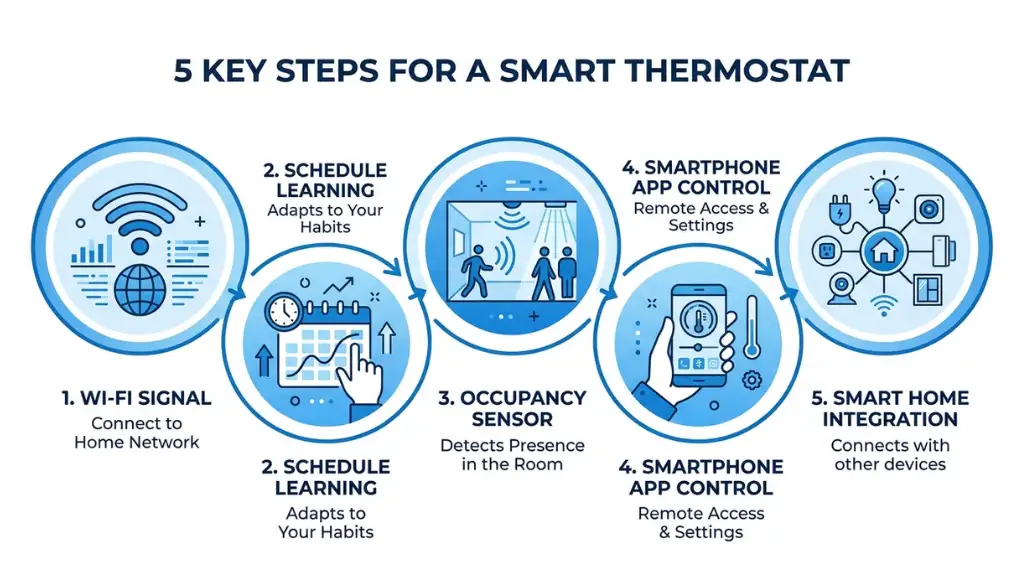
Here is how the process works, step by step.
Step 1: Connect to Your Home Wi-Fi Network
The foundation of every smart thermostat feature is its internet connection. Wi-Fi access gives the device real-time weather data, remote control via smartphone, and the ability to integrate with voice assistants like Amazon Alexa and Google Assistant. Without this connection, a smart thermostat functions as little more than an expensive programmable device.
Step 2: Learn Your Household Schedule
Most premium smart thermostats, including the Ecobee SmartThermostat Premium and the Google Nest Thermostat 4th Generation, include a learning phase lasting one to two weeks. During this period, the device tracks when occupants wake up, leave home, return, and go to sleep. It then builds a customized schedule that heats or cools your space exactly when it is needed.
In my experience reviewing home automation products over the past several years, this learning feature accounts for the largest share of reported energy savings. The device stops heating or cooling an empty house, which is precisely where most HVAC waste occurs.
Step 3: Use Sensors to Detect Occupancy
Modern smart thermostats use built-in or external occupancy sensors to detect whether rooms are in use. The Ecobee SmartThermostat ships with SmartSensors that can be placed throughout the home, allowing it to prioritize comfort in the rooms where people actually spend time. Geofencing is another option: the thermostat detects when your smartphone leaves a set radius and automatically shifts to an energy-saving mode.
Step 4: Allow Remote Control from Anywhere
One of the most practical smart thermostat benefits is smartphone control from any location. Heading home earlier than expected? You can adjust the temperature from your car before you arrive. Going on vacation? You can lower the setpoint from across the country. This remote access eliminates the common frustration of forgetting to adjust settings before leaving the house.
Step 5: Integrate with Your Smart Home Ecosystem
Smart thermostats are designed to communicate with other connected devices. They can work alongside smart lights, smart locks, and home hubs to create automated routines. Setting your smart lock to “away” mode, for example, can simultaneously trigger the thermostat to shift to its energy-saving temperature. This kind of integration is what distinguishes a cohesive smart home from a collection of individual gadgets.
Top Smart Thermostats in 2026: Ecobee, Nest, and Honeywell Compared
The best smart thermostat depends on your HVAC system compatibility, your existing smart home ecosystem, and whether you need room-by-room sensing or prefer simplicity. The Ecobee SmartThermostat Premium leads for multi-room homes, the Google Nest Thermostat 4th Generation suits Google ecosystem users, and the Honeywell Home T9 delivers reliable value at a lower price point.
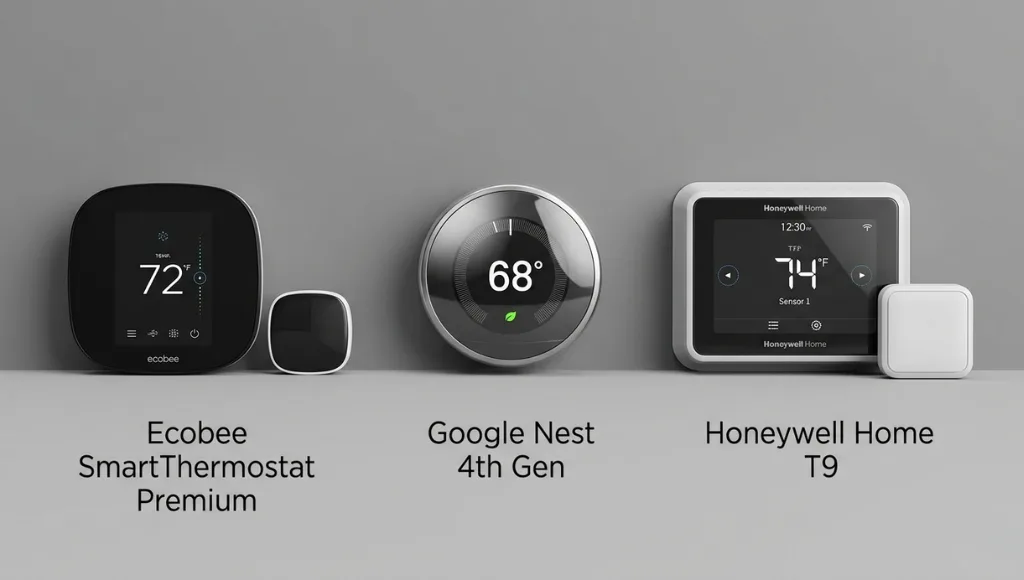
Here is a side-by-side comparison of the top three models:
Model | Best For | Key Feature | ~Price | Limitation |
Ecobee SmartThermostat Premium | Multi-room homes | Ships with SmartSensors for room-level control | $249 | Higher upfront cost |
Google Nest Thermostat (4th Gen) | Google ecosystem users | Soli radar chip for touchless proximity sensing | $129 | Limited third-party sensor support |
Honeywell Home T9 Smart Thermostat | Budget-conscious buyers | Remote sensor compatibility and reliable scheduling | $149 | App less intuitive than competitors |
The Ecobee SmartThermostat Premium is the best choice for multi-story homes or households where comfort needs vary by room. Its SmartSensors track both occupancy and temperature in individual spaces, giving the system a far more accurate picture of where heating or cooling is actually needed. The Ecobee platform also integrates with Amazon Alexa natively, making it the default choice for Amazon Echo households.
The Google Nest Thermostat 4th Generation introduced a Soli radar chip that detects nearby presence and wakes the display automatically. It fits naturally into Google Home and works well for anyone already invested in that ecosystem. The price point is also the most accessible of the three, making it a strong entry-level option.
The Honeywell Home T9 is the practical choice for homeowners who want reliable scheduling, flexible sensor support, and broad HVAC compatibility without paying a premium. Honeywell has manufactured residential thermostats for over a century, and that engineering depth is evident in the T9’s dependable performance across a wide range of HVAC configurations.
Smart Thermostat vs. Programmable Thermostat: What Is the Real Difference?
A programmable thermostat follows a fixed manual schedule regardless of whether you are home. A smart thermostat adapts to your actual behavior, adjusting automatically based on occupancy, weather, and real-time conditions. The result is better comfort with less energy waste, without requiring the homeowner to manage settings continuously.
Think of it this way: a programmable thermostat is like a wakeup alarm that goes off at the same time every day, including weekends when you want to sleep in. A smart thermostat is like a personal assistant who checks your calendar, looks out the window, and adjusts accordingly.
The practical outcome is that smart thermostats reduce HVAC runtime without requiring constant attention from the homeowner. That is the core value proposition of the upgrade, and it is why the device typically pays for itself within two to four years for most households, even at the Ecobee’s $249 price point.
One thing most guides miss: the biggest beneficiaries of smart thermostats are not the highly disciplined homeowners who already follow strict thermostat schedules. They are the majority of households whose manual habits are inconsistent, who leave for work at different times on different days, and whose heating and cooling usage is genuinely hard to predict.
Realistic Energy Savings: What to Actually Expect
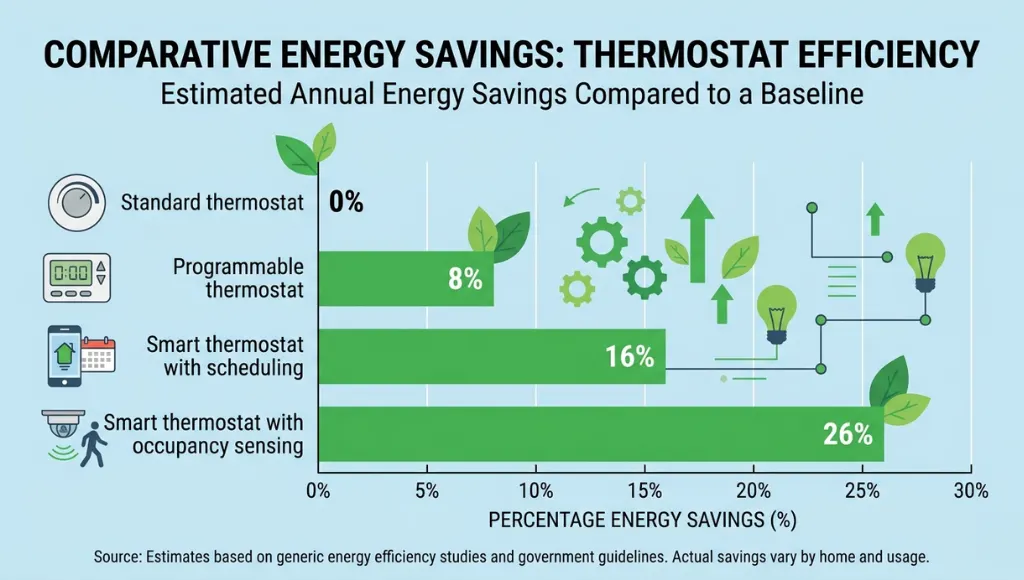
Most households can expect to reduce their heating and cooling costs by 8% to 26% after installing a smart thermostat, depending on their current habits, home size, and climate. Homes with irregular schedules or poor manual thermostat habits see the largest gains. Homes already using strict schedules will see smaller but still meaningful improvements.
The EPA estimates that using a programmable or smart thermostat correctly saves approximately 8% on heating and cooling bills annually (EPA, 2025). For the average U.S. household spending around $1,000 per year on HVAC, that is $80 in savings from conservative usage alone.
Smart thermostats consistently outperform that baseline because they actually use the schedule, unlike programmable devices that most homeowners never properly configure. Ecobee’s analysis of over four million thermostat users found that homes using smart scheduling and occupancy sensing saved an average of 26% on heating and cooling compared to homes running a constant setpoint (Ecobee, 2024).
What I’ve seen work consistently in real households: the combination of geofencing and occupancy sensing delivers the strongest results. If the thermostat knows you have left and adjusts before you hit the end of the street, it captures savings that a fixed schedule simply cannot replicate.
Being honest about limitations: if you already maintain strict manual thermostat discipline and your household schedule is highly predictable, your incremental savings will be smaller than the averages suggest. Smart thermostats deliver the highest ROI for households with variable schedules or poor existing habits.
Common Smart Thermostat Mistakes to Avoid
Mistake 1: Skipping the Compatibility Check
Not every smart thermostat works with every HVAC system. Older systems, heat pumps, high-voltage systems, and multi-stage configurations require specific models or adapters. Both Ecobee and Google Nest provide online compatibility checkers on their product pages. Use them before purchasing. Returning a thermostat after cutting wires is a frustrating and preventable experience.
Mistake 2: Ignoring Sensor Placement
A thermostat measures temperature only at its own location. If that location is a cold hallway or near a drafty window, the rest of your home may never reach the desired temperature. Take advantage of remote sensors where available, and install the base unit in a location that accurately reflects how the home is used throughout the day.
Mistake 3: Relying on Auto-Learning Without Reviewing the Schedule
Auto-learning is a powerful feature, but it learns what you do rather than what you should do. If your schedule is irregular during the initial two-week learning phase, the device may build a suboptimal routine. After the learning period, open the app and review the schedule it created. Adjust any settings that do not match your actual preferences before assuming the device is optimized.
Mistake 4: Not Checking for Utility Rebates
Many utility companies offer rebates ranging from $25 to $100 for installing a qualifying smart thermostat. Ecobee and Honeywell both participate in utility rebate programs across numerous regions. Check your utility provider’s website or use Ecobee’s built-in rebate finder before purchasing, as the rebate can reduce your net cost by 20% to 40%, significantly improving the payback period.
Frequently Asked Questions About Smart Thermostats
Conclusion
A smart thermostat is one of the most cost-effective smart home upgrades available in 2026, delivering 8% to 26% energy savings, remote control convenience, and seamless integration with your broader home automation setup. Installation is straightforward, payback periods are realistic, and the three leading models from Ecobee, Google Nest, and Honeywell cover every type of household.
Here are three things worth carrying away from this guide:
1. A smart thermostat learns your routine and adjusts heating and cooling automatically, saving most households 8% to 26% on their HVAC costs without requiring any change in daily behavior.
2. The Ecobee SmartThermostat Premium, Google Nest Thermostat 4th Generation, and Honeywell Home T9 are the three leading models in 2026, each suited to a different type of home and ecosystem. Run the compatibility check before choosing.
3. Utility rebates of $25 to $100 are available in many regions and can meaningfully reduce your net cost. Check before you buy.
Understanding what is a smart thermostat is the first step. The second is choosing the right model for your home and making the switch. Start with the compatibility checker on the Ecobee or Nest website, confirm your utility’s rebate availability, and proceed from there.