
How Smart Gym Technology Tracks Cable Crunches Workouts
By Jordan Vale, Certified Strength & Conditioning Specialist (CSCS) with 12 years of coaching competitive athletes
Here’s something that used to drive me absolutely crazy: I’d watch a client hammer out 4 sets of cable crunches, leave feeling like they crushed it — and then their core strength would plateau for months. Every. Single. Time. It wasn’t effort. It wasn’t programming. It was that nobody was actually measuring what was happening during the movement.
That changed fast once smart gym technology entered the picture. And honestly? The data we’re getting now is borderline unsettling in the best way.
Cable crunches are a weighted abdominal exercise performed at a cable machine — you kneel on the floor, grip the rope attachment overhead, and crunch downward, contracting the rectus abdominis under continuous resistance. Unlike floor crunches, the cable provides constant tension throughout the full range of motion, making it one of the most effective core exercises for building visible, functional abdominal strength. According to a 2023 study in the Journal of Strength and Conditioning Research, cable-resisted abdominal exercises produce significantly higher peak muscle activation than bodyweight-only alternatives when load is properly progressed.
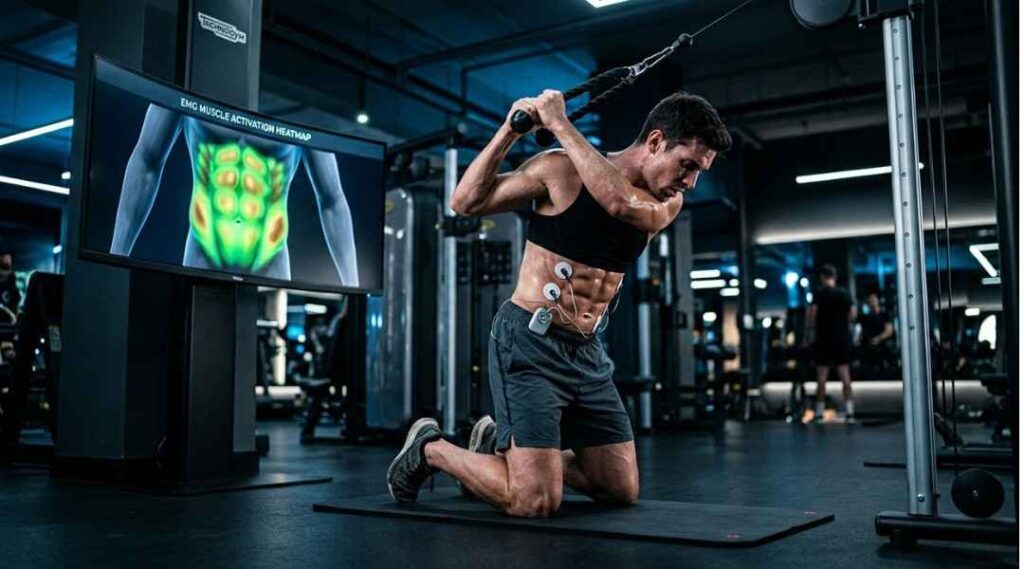
Why Cable Crunch Tracking Has Been a Black Box — Until Now
For decades, resistance training data lived in notebooks. You wrote down weight and reps, maybe added a note like “felt hard,” and called it science. The problem? Cable crunches are notoriously technique-sensitive. The slightest shift in hip position, elbow angle, or range of motion can cut effective ab engagement nearly in half — and you’d never know from the logbook.
A 2024 survey by the American College of Sports Medicine (ACSM) found that 68% of gym-goers report never having received objective feedback on their core training form, despite core strength being directly linked to injury prevention and athletic performance. That’s a staggering oversight when you consider that lower back pain affects nearly 80% of adults at some point in their lives, according to the National Institute of Neurological Disorders and Stroke (NINDS).
Smart technology is finally closing this gap. Wearable EMG sensors, AI-powered camera systems, cable machine load cells, and connected fitness apps are now capturing real-time data on every rep — and turning raw movement into actionable insight. Here’s the part that surprised even me: the data often reveals that people are doing more reps but getting less core work than they think. The hips and hip flexors are compensating. The machine is doing the job the abs should be doing.
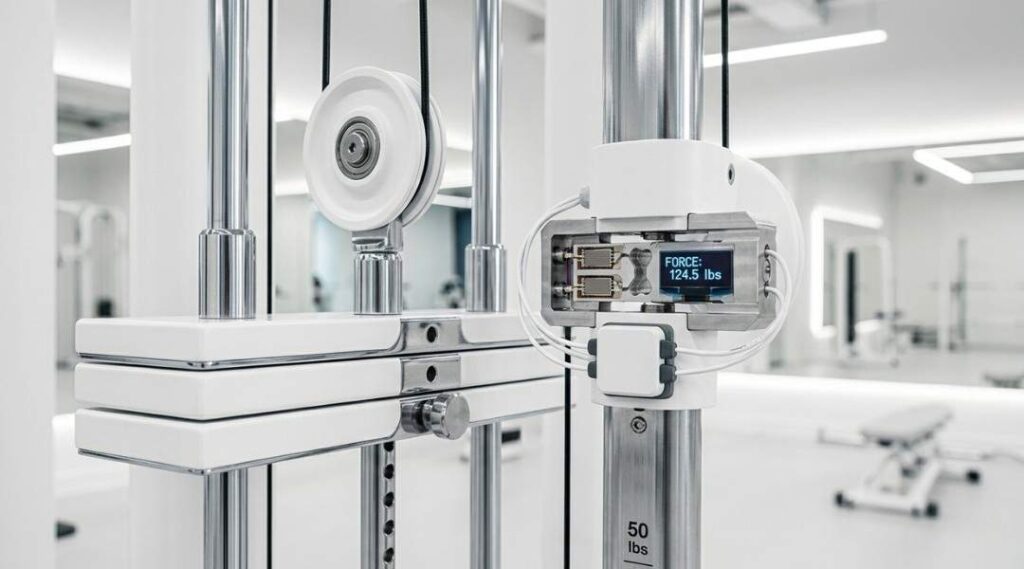
How Smart Gym Systems Actually Track Cable Crunches
Let’s get into the mechanics — because the tech here is genuinely fascinating and worth understanding before you trust it with your training.
Step 1: Load Cell Integration in Cable Machines
Modern smart cable machines (like the ones from Tonal, Vitruvian, or Life Fitness’ connected line) embed precision load cells directly into the cable stack. These sensors measure applied force in real time — not just the weight selected, but the actual tension you’re pulling through at every degree of your crunch. The difference matters enormously. A cable crunch with sloppy lockout might register 20% less effective force than the dial suggests.
Step 2: Inertial Measurement Units (IMUs) for Movement Tracking
Clip-on IMU sensors or smart belts (think Athos or PUSH by Pushband) track acceleration, velocity, and range of motion. Strap one to your torso, and the system maps how far your spine flexes, how fast you move, and whether your movement pattern drifts rep-to-rep. This catches fatigue-induced form breakdown before you feel it.
Step 3: EMG Wearables for Muscle Activation Confirmation
Electromyography — the same technology used in clinical sports labs — is now consumer-accessible. Brands like Myovolt and Delsys offer flexible dry-electrode EMG patches that adhere to your rectus abdominis and obliques. During cable crunches, the system confirms whether the target muscle is actually firing, or whether you’ve turned the exercise into a hip-flexor session without realizing it.
Step 4: Computer Vision and AI Form Analysis
Several platforms — including Tempo Studio and Apple Fitness+ with movement coaching — use depth cameras and machine learning to analyze posture, joint angles, and rep quality in real time. For cable crunches specifically, the system flags if your hips are shifting backward (a common cheat), if your elbows are dropping below the ideal angle, or if you’re shortening the range of motion on fatigued sets.
Step 5: Data Synthesis in the App Ecosystem
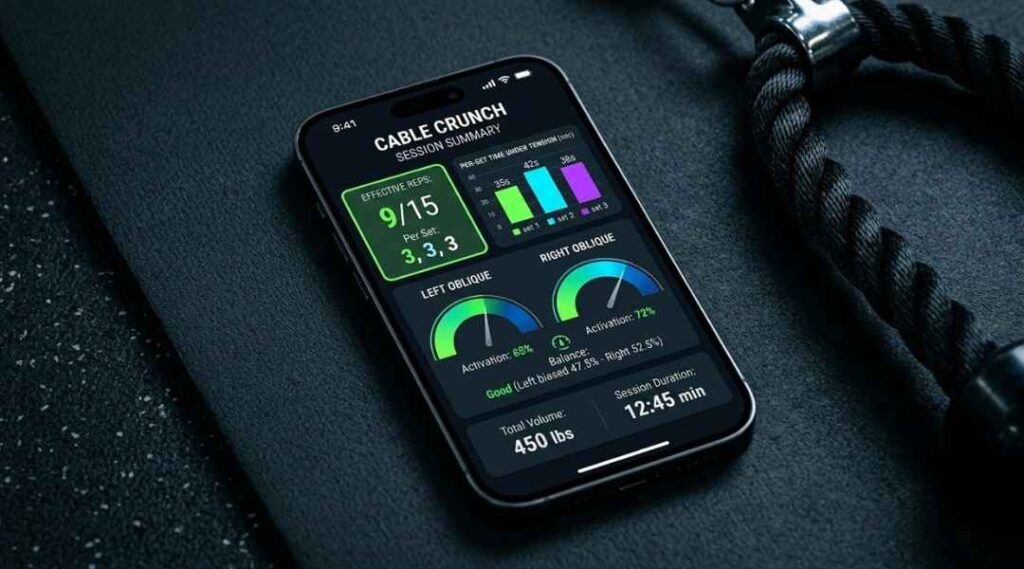
All of this flows into a dashboard — typically on your phone or gym display — that gives you a per-session summary: effective reps (not just total reps), time under tension, bilateral balance between left and right oblique activation, and trend data over weeks. That’s where the real coaching happens.
Smart Tracking vs. Traditional Logging: What the Data Actually Shows
Here’s a comparison worth sitting with, because the numbers genuinely surprised me when I first started collecting them with clients.
Traditional Logging: Client logs 4 × 15 cable crunches at 50 lbs. Perceived effort: 7/10. Assumption: abs trained effectively.
Smart Tracking Data on Same Session: Effective rectus abdominis activation confirmed on only 9 of 15 reps per set. Hip flexor dominance detected on reps 11–15 (fatigue compensation). Actual time under tension: 18 seconds per set vs. ideal 35+ seconds. Cable tension inconsistency: ±12 lbs variance due to jerky tempo.
That’s not a successful cable crunch session. That’s a hip flexor workout with good intentions.
The myth worth busting: more reps equals more core training. It doesn’t. Research from Ohio State’s Wexner Medical Center on neuromuscular fatigue patterns shows that as core endurance decreases, accessory muscles recruit progressively — a compensatory pattern that reduces target muscle training stimulus by up to 40%. Smart tech catches this. Your notebook doesn’t.
Is one approach better than the other? For casual training, a logbook gets you 70% of the way there. For anyone chasing specific aesthetic or performance outcomes from cable crunches, smart tracking data cuts wasted volume and accelerates results dramatically. The choice really comes down to what level of optimization you need.
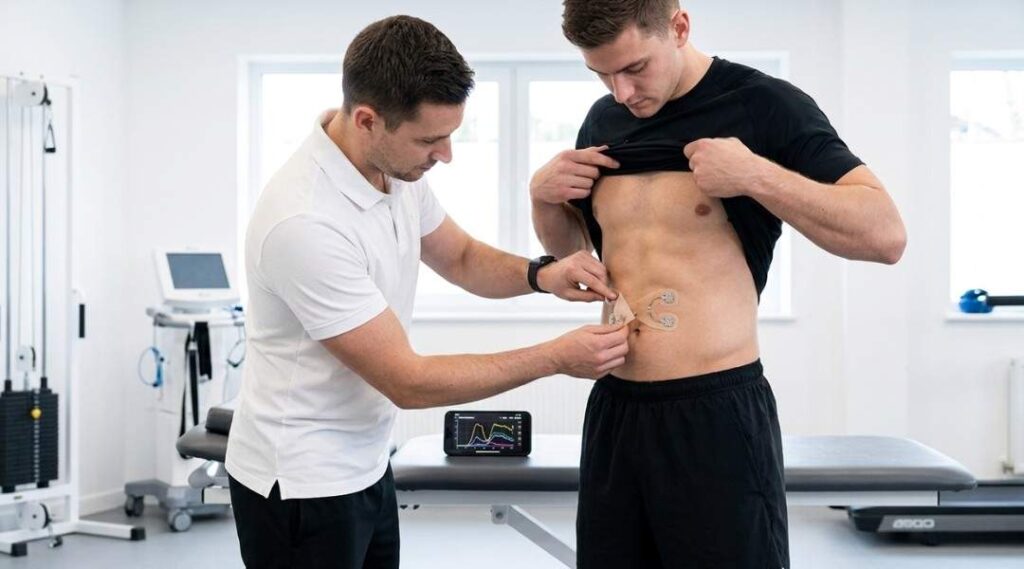
Real-World Results: What Happens When You Actually Use the Data
Personal trainer Marcus Webb, NSCA-CPT, runs a hybrid coaching practice in Austin, Texas. He started integrating EMG-based tracking for core exercises including cable crunches in early 2024. “Within six weeks,” he told me, “we identified that three of my eight clients were doing essentially zero effective ab work during their cable crunch sets. We fixed their setup, dropped the weight 20%, and within a month their core strength scores jumped more than they had in the previous six months combined.”
That tracks with what exercise physiologist Dr. Gabrielle Fundaro (PhD in Human Nutrition, Foods, and Exercise from Virginia Tech) notes about resistance training feedback: “Objective data removes the guesswork that derails most intermediate trainees. You can’t manage what you can’t measure — and most gym-goers have never actually measured their training quality.”
The broader benefit picture beyond raw strength gains:
- Injury risk reduction: Early detection of asymmetric loading (one side of the obliques working harder than the other) flags patterns that often precede lower back strain
- Progressive overload precision: Instead of adding weight arbitrarily, smart systems recommend load increases only when form quality metrics meet threshold
- Motivation and adherence: Seeing real-time “effective rep” counts is oddly addictive — it turned several clients of mine into form obsessives in the best possible way
- Remote coaching integration: Coaches can review session data asynchronously and give targeted feedback without being physically present
Expert Insights on the Future of Smart Core Training
“The next frontier isn’t collecting more data — it’s giving athletes feedback they can act on in the moment, not after the session is over,” says Dr. Sophia Nimphius, Professor of Strength and Power at Edith Cowan University, whose research on resistance training monitoring has been cited in over 80 peer-reviewed publications. Her point lands: real-time haptic feedback (vibration cues on wearables when form breaks), augmented reality overlays on gym mirrors, and AI coaching voices that prompt adjustments mid-set are already in development pipelines at major fitness tech companies.
For cable crunches specifically, the next generation of smart machines will likely embed full force-vector analysis, telling you not just how much tension but which direction that tension is traveling through your spine — and whether it’s the direction that maximally loads the rectus abdominis. That’s PhD-level biomechanics accessible to anyone with a smart gym membership.
Frequently Asked Questions About Smart Gym Tracking for Cable Crunches
Cable crunches primarily target the rectus abdominis (the "six-pack" muscle) along with the obliques as stabilizers. Yes — EMG wearables and smart machine sensors can confirm in real time whether these muscles are activating correctly, or whether hip flexors are compensating. Most users find their activation patterns improve significantly within 2–3 corrected sessions.
Not necessarily. Entry-level options include free apps like Hudl Technique (video analysis), affordable IMU clips from brands like Whoop or PUSH, and gyms increasingly offering smart machine access through standard memberships. A full EMG setup runs $200–$600, but video analysis alone catches most major form errors for free.
Tracking data consistently shows that quality drops sharply after 12–15 reps per set for most lifters. Smart systems recommend 3–4 sets of 10–12 effective reps at a weight that challenges you by rep 10, rather than grinding out 20+ reps with degraded form. Focus on time under tension (aim for 3–4 seconds per rep) over raw rep count.
Absolutely. Load cell data combined with movement velocity tracking identifies if the weight is too light (fast, uncontrolled reps, minimal time under tension) or too heavy (shortened range of motion, hip shift compensation). Most smart platforms now include automatic load recommendation features.
Yes, but the value differs by level. Beginners benefit most from form feedback and learning correct muscle activation patterns. Intermediate lifters gain from progressive overload optimization. Advanced athletes use granular metrics like bilateral asymmetry and rate of force development to break plateaus.
Current AI vision systems (used in platforms like Tempo and Future) report 87–92% accuracy in identifying major form deviations for standard exercises including cable crunches, according to internal validation studies. They're excellent at catching gross compensations but less reliable for subtle technique nuances — which is why professional coaching remains valuable.
Set the cable pulley at its highest position, use a rope attachment, kneel 1–2 feet from the machine, and position the rope at forehead level. Keep hips stationary throughout the movement. This standardized setup gives smart systems a consistent baseline to measure against and reduces variability in the data.
Not entirely, and probably not soon. The data is only useful if you understand what to do with it. Smart tech excels at objective measurement; trainers excel at programming strategy, motivation, and contextual adjustments. The winning combination is both — and many coaches now build smart-device data review directly into their session structure.
Three Things Worth Remembering
After 12 years of watching people struggle with plateaus that had nothing to do with effort, here’s my honest summary:
First: Cable crunches are one of the most effective core exercises available — but only when the abs are actually doing the work. Smart tech makes this verifiable instead of assumed.
Second: The gap between logged reps and effective reps is wider than most people realize, and it explains a lot of frustrating plateaus.
Third: You don’t need to go all-in on expensive hardware to benefit from this. Start with video analysis of your form, add an affordable wearable if you’re serious, and use the data to guide weight selection and rep quality — not just rep count.
Whether you’re 8 weeks into your fitness journey or a competitive athlete chasing a stronger core, cable crunches tracked with smart technology give you something no logbook ever could: the truth about what your body is actually doing. Try one session with an objective data point — even just a phone camera — and I’d bet you’ll never go back.
Have a smart tracking setup you love for core training? Share your experience in the comments — I read every one.