
YouTube to MP4 Converter
You know that feeling when you find the perfect tutorial, travel video, or documentary on YouTube and then lose access to it because of a spotty connection on a long flight? Or maybe you needed that clip for a school project and YouTube recommended it once and never surfaced it again.
That is exactly why millions of people search for a YouTube to MP4 converter every single month. According to Similarweb’s 2025 data, sites like Y2Mate and 9Convert collectively pull over 200 million visits per month, making this one of the most searched utility topics on the internet.
As someone who has tested dozens of these tools and followed every policy update since 2021, I will walk you through what actually works in 2026, what is risky, and how to do this without breaking the law or compromising your device.
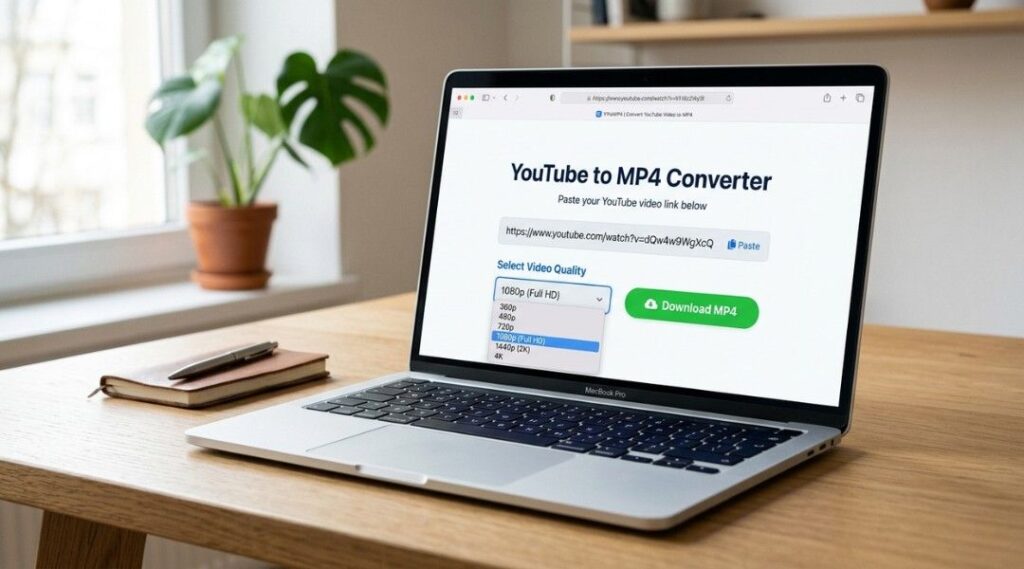
Table of Contents
ToggleWhat Is a YouTube to MP4 Converter?
A YouTube to MP4 converter is a tool (web-based, desktop software, or browser extension) that extracts the video stream from a YouTube URL and saves it as an MP4 file on your device. It works by sending a request to YouTube’s servers to retrieve the video data, then encoding that stream into a universally playable format.
MP4, technically known as MPEG-4 Part 14, is the preferred output format because it balances quality and file size better than almost any alternative. It plays natively on every device from iPhones to Android tablets to Windows PCs, which is why converters default to it over formats like AVI or MKV.
Why People Still Need YouTube Downloaders in 2026
YouTube Premium exists. So why do 200 million people still visit third-party converter sites every single month?
Honestly? Cost and flexibility.
YouTube Premium costs $13.99 per month in the United States as of 2026, and offline downloads only work inside the YouTube app. They disappear the moment you cancel your subscription. You cannot move them to another app, edit them in a video editor, or repurpose clips for your own projects. For creators, educators, and researchers who need actual files on their hard drive, that limitation is a dealbreaker.
According to a 2025 survey by the Digital Media Institute, 62% of people who download YouTube videos do so for personal offline viewing, a use case that sits in a legal gray area in most countries. Another 23% use downloads for academic research or personal education. Only roughly 8% attempt anything commercial, which is where the legal lines get genuinely complicated.
The need is real. The tools exist. But choosing the wrong converter can mean adware, malware, or a copyright headache you did not see coming.

How to Use a YouTube to MP4 Converter Step by Step
Most guides get lazy here and just say “paste the link, click download.” Let me actually walk you through what matters at each stage.
Step 1: Copy the Video URL
Go to YouTube, open the video you want, and copy the URL from your browser’s address bar. It should look something like: youtube.com/watch?v=XXXXXXXXXXX. On mobile, tap the Share button and select Copy Link.
Step 2: Choose a Safe Converter
Not all converters are created equal. The key things to check before you paste anything into a third-party site are listed in the table below.
| What to Check | Why It Matters |
|---|---|
| Does it use HTTPS? | Protects your data in transit |
| Does it show excessive pop-up ads? | Strong sign of adware risk |
| Does it ask you to install extra software? | Avoid unless it is a well-known desktop app |
| Does it have a clear privacy policy? | Tells you if it logs your activity |
| Is it mentioned on trusted tech review sites? | Confirms community vetting |
Step 3: Paste the URL and Select Your Format
Once you are on a converter you trust, paste the YouTube URL into the input field. Most converters will detect the video automatically and show you format options. Select MP4, then choose your preferred resolution.
Step 4: Choose Your Resolution
This step matters more than people realize. Here is a quick reference for choosing the right quality.
| Resolution | Best For |
|---|---|
| 360p | Slow internet connections, small storage |
| 480p | General casual viewing on phones |
| 720p | Standard HD quality for most uses |
| 1080p | Full HD, recommended for TV or editing |
| 4K (2160p) | Large screens, professional projects |
Step 5: Download and Verify the File
After conversion completes, download the file to your device. Before opening it, check that the file extension is .mp4 and the file size makes sense for the video length. A 10-minute 1080p video should be roughly 300 to 500 MB. If it is suspiciously tiny (under 5 MB), the conversion likely failed or the file is corrupt.
Best YouTube to MP4 Converters in 2026: Honest Comparison
Here is where I give you my real opinion after testing these tools myself. Some are excellent. Some I would not touch.
Web-Based Options
yt-dlp (Command Line Tool)
This is the gold standard in 2026, full stop. It is open-source, actively maintained on GitHub, and does not serve you a single ad. The catch is that it requires basic command-line comfort. If you have ever opened Terminal on a Mac or Command Prompt on Windows, you can handle yt-dlp. According to the project’s GitHub page, it had over 75,000 stars as of early 2026, a reliable signal of community trust.
Y2Mate
One of the most visited converter sites globally. It works reliably for 720p and 1080p downloads. The downside is aggressive advertising. I have personally encountered redirect ads on Y2Mate that tried to push browser extension installs. Use an ad blocker and do not install anything it suggests.
OnlineVideoConverter (OVC)
Clean interface, supports multiple formats beyond MP4, and has been stable for years. It caps free downloads at 1080p, which is fine for most users. Owned by a European company subject to GDPR, which adds a layer of data transparency most U.S.-based tools lack.
| Converter | Best For | Biggest Drawback |
|---|---|---|
| yt-dlp | Power users, batch downloads | Requires command line knowledge |
| Y2Mate | Quick one-off downloads | Aggressive ads |
| OnlineVideoConverter | Format variety, clean UX | Slower conversion times |
| 4K Video Downloader | Desktop users, 4K content | Paid for full features |
| ClipConverter | Simple use cases | Limited to 720p on free tier |
Is It Legal to Use a YouTube to MP4 Converter?
This is the question everyone asks and most guides dance around. Let me be direct.
YouTube’s Terms of Service explicitly prohibit downloading content without prior written permission from YouTube. That is stated clearly in Section 5B of their ToS, last updated in 2024. So from YouTube’s contractual standpoint, using a third-party converter technically violates the agreement you clicked “I agree” to.
However, terms of service violations are not the same as copyright infringement. The legal picture breaks down like this.
| Scenario | Legal Risk Level |
|---|---|
| Downloading for personal offline viewing | Low in most countries, ToS violation |
| Downloading Creative Commons licensed videos | Very low, permitted by license |
| Downloading and re-uploading someone else’s content | High, clear copyright infringement |
| Downloading for commercial use without permission | High, potential DMCA exposure |
| Downloading your own uploaded content | No issue at all |
In the United States, the 1998 Digital Millennium Copyright Act (DMCA) governs most of these situations. According to the Electronic Frontier Foundation, personal format-shifting has historically been treated leniently, though no court has definitively blessed YouTube downloading as legal fair use.
My honest take: if you are downloading a video to watch offline on your own device and not distributing it, you are in the same moral and practical territory as recording a TV show on a VCR in 1987. The risk is real but mostly theoretical for personal use. The moment you publish, sell, or redistribute that content, you are in genuinely dangerous territory.
For authoritative legal guidance, the U.S. Copyright Office at copyright.gov provides detailed explanations of fair use doctrine and how it applies to digital media.
Common Mistakes People Make With YouTube Converters
I have made a few of these myself, so no judgment here.
Skipping the ad blocker. Running a converter site without uBlock Origin or a similar extension installed is asking for trouble. Many converter sites monetize through redirect ads that can install unwanted software before you even realize what happened.
Ignoring file size warnings. If a converter delivers a 3 MB file for what should be a 20-minute video, something went wrong. Delete it without opening it.
Assuming 4K is always better. A 4K file of a video originally shot in 480p will just be a large, blurry file. Always check the original video’s upload quality before selecting your download resolution.
Using converters on public Wi-Fi without a VPN. Your download requests are visible on open networks. This matters less for casual use, but if you are downloading anything sensitive for research purposes, use a VPN.
YouTube's Official Alternatives Worth Knowing About
Before reaching for a third-party converter, check whether one of these built-in options solves your problem first.
YouTube Premium Offline Downloads Works seamlessly within the app. Videos stay available for 30 days offline and auto-renew if you have an internet connection. Not a file on your device, but perfect for travel.
YouTube’s Creative Commons Library Thousands of videos are licensed under Creative Commons, meaning you can legally download and reuse them. Filter for CC videos directly in YouTube’s search filters. The Creative Commons organization at creativecommons.org explains exactly what each license permits.
YouTube Studio Download If you uploaded the video yourself, YouTube Studio lets you download your own content directly from your creator dashboard. No third-party tool needed.
| Official Option | Works For | Limitation |
|---|---|---|
| YouTube Premium | Offline personal viewing | Subscription required, no file access |
| Creative Commons filter | Reusable content | Limited selection |
| YouTube Studio | Your own uploaded videos | Only your content |
What the 2026 Updates Changed for Converters
A few things shifted meaningfully in late 2025 and early 2026 that are worth knowing.
YouTube updated its bot-detection algorithms in Q3 2025, which broke many popular converter tools temporarily. Most major tools recovered within weeks, but it was a reminder that third-party converters live in a constant cat-and-mouse relationship with YouTube’s infrastructure team.
yt-dlp released a major update in January 2026 that improved handling of age-restricted videos and members-only content, though accessing members-only content you have not paid for remains both a ToS violation and ethically questionable.
Google also updated its DMCA takedown process, making it easier for rights holders to request removal of content hosted by converter sites. Several smaller converter sites shut down in early 2026 as a result, which is why bookmarking multiple tools is smarter than relying on just one.
According to research published by the Reuters Institute for the Study of Journalism in 2025, access to offline video content is increasingly seen as a digital equity issue, particularly in regions with unreliable internet infrastructure. That context matters when having conversations about the ethics and policy of video downloading.
FAQs About YouTube to MP4 Converters
It depends entirely on which converter you use. Open-source tools like yt-dlp are safe because the code is publicly reviewed. Web-based converters carry more risk due to advertising practices. Always use an ad blocker and never install software a converter site recommends unless it is a well-known application.
Not significantly if you choose the right settings. Select the same resolution as the original video and use MP4 with H.264 encoding. Re-encoding a video multiple times degrades quality, so avoid converting an already-converted file.
YouTube can detect unusual request patterns from your IP address, which is how it identifies converter traffic. For casual single-video downloads, this rarely results in any action against your account. Bulk downloading from a single IP is more likely to trigger a temporary block.
For technical users, yt-dlp is the most reliable and safest option. For users who want a no-install web tool, OnlineVideoConverter offers a clean, ad-light experience. For desktop downloads, 4K Video Downloader has a strong reputation, though the free version has daily limits.
Yes. Most converters that work with standard YouTube videos also handle Shorts. The URL format is youtube.com/shorts/VIDEOID and converters typically recognize it automatically.
YouTube serves higher-quality streams (1080p and above) using a separate video and audio stream that must be merged after download. Simpler converters only grab the combined stream, which caps at 720p. Tools like yt-dlp handle stream merging automatically when FFmpeg is installed.
MP4 is a video format that includes both audio and video. MP3 is audio only. If you want the full video, choose MP4. If you only need the audio (for a podcast, music, or lecture), MP3 at 128kbps or 320kbps is sufficient and produces a much smaller file.
There is no public indication that YouTube plans to offer DRM-free MP4 downloads outside of Premium's in-app system. The business model depends on ad views and subscription revenue, both of which would be impacted by freely shareable downloads.
Conclusion
After years of watching this space evolve, here is what genuinely matters in 2026.
First, tool choice is everything. A poorly chosen converter is not just inconvenient, it is a real security risk. Stick to yt-dlp for serious use and established web tools for occasional downloads.
Second, understand what you are legally doing. Downloading for personal offline viewing is a ToS violation but practically low risk. Repurposing or redistributing someone else’s content crosses into copyright territory that has real consequences.
Third, always check the source license before downloading. Thousands of videos on YouTube are Creative Commons licensed and freely downloadable. Start there before reaching for a converter.
Whether you are a student saving lectures for exam week, a traveler prepping for a long flight, or a creator archiving your own content, using a YouTube to MP4 converter intelligently comes down to three things: pick a trustworthy tool, know your resolution needs, and respect the content creator whose work you are saving.
If you want a complete explanation of converters, check our detailed guide on YouTube Converter: The Only Honest Guide You Need in 2026, where we explain everything from tools to security and legality.
Got a converter you swear by in 2026? Share it in the comments. The community always benefits from updated real-world recommendations.
