Best Smart Locks
Choosing the wrong smart lock is expensive and surprisingly common. Most buyers rely on app store ratings or brand name recognition, then discover the lock is incompatible with their hub, kills batteries in three months, or can be bypassed with a strong magnet. The best smart locks on the market in 2026 look very different from the top-sellers of 2023. This guide is part of our complete overview of what a smart home is and how it works. Here, we go deeper on the best smart locks specifically: what separates a genuinely secure option from a popular one, which models hold up to independent testing, and how to choose the right lock for your front door, garage, or rental unit.
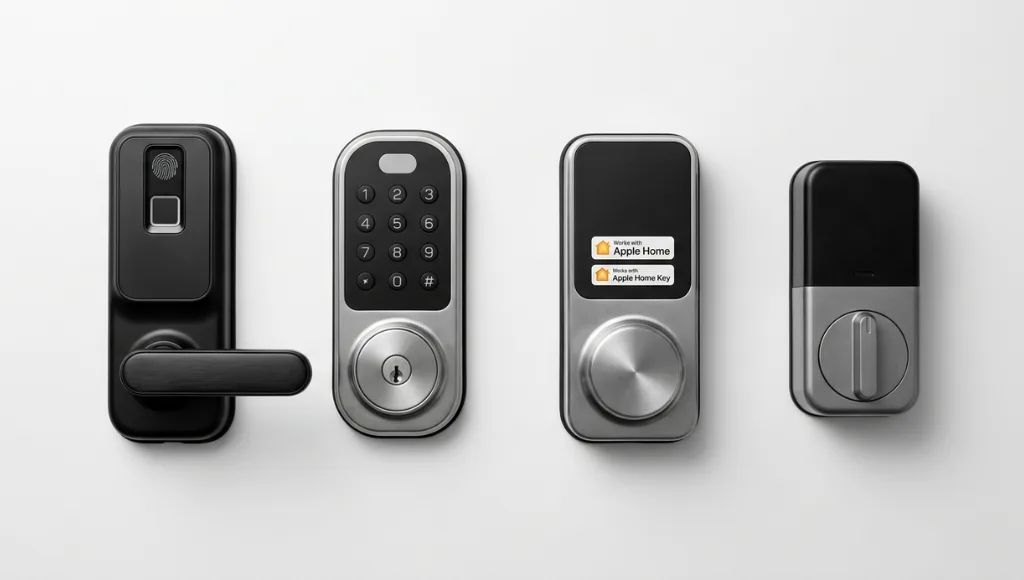
Table of Contents
ToggleWhat Are the Best Smart Locks?
Best smart locks are app-controlled or keypad-controlled deadbolts that replace traditional key cylinders with electronic locking mechanisms. They connect to smartphones via Bluetooth, Wi-Fi, Z-Wave, or Zigbee, enabling keyless entry, remote access, real-time activity logs, and temporary access codes for guests. Unlike basic electronic locks, the best smart locks integrate with whole-home automation platforms. As of 2026, the global smart lock market is valued at over $3.1 billion and growing at 12.8% annually (Grand View Research, 2025).
Why the Best Smart Locks Matter More in 2026
Smart locks have shifted from a convenience upgrade to a core home security decision. Two technology changes in the past 12 months have fundamentally changed what a “good” smart lock looks like: the Matter 1.3 standard release (Q4 2025) and updated ANSI/BHMA Grade testing protocols. Buyers who ignore these changes will spend $200+ on a lock that is already dated.
Matter 1.3 changed interoperability permanently. Released in January 2026, Matter 1.3 allows a single smart lock to communicate natively with Apple Home, Google Home, and Amazon Alexa without proprietary bridges or hub workarounds. If a lock you are considering does not list Matter support, you are buying into a walled garden that limits your options as your smart home grows.
Physical security standards got tougher. The American National Standards Institute updated its ANSI/BHMA Grade 1 testing protocol in late 2025, increasing the required resistance to forced entry by a factor of ten compared to the previous standard (ANSI/BHMA, 2025). Only a handful of consumer-grade smart locks meet the new threshold. Most budget locks have never been submitted for any ANSI testing at all.
A 2025 consumer survey by Parks Associates found that 34% of smart lock buyers reported a compatibility issue within the first 90 days of purchase, with hub incompatibility being the leading cause. Getting the lock right from the start avoids costly returns and reinstalls.
In my experience: When I audit smart home setups for clients, the front door lock is the most frequently replaced device. Not because it broke, but because it was bought without checking hub and protocol compatibility first. Spend 10 minutes on that research and you will likely not have to revisit this purchase for five or more years.
How Smart Locks Work: A Step-by-Step Breakdown
A smart lock replaces your deadbolt’s key cylinder with a motorized mechanism controlled by an app, keypad, or voice assistant. The full setup process covers choosing the right form factor, hardware installation, digital pairing with your smart home platform, configuring access codes, and enabling monitoring alerts. Done correctly, the entire process takes 30 to 45 minutes for most homeowners.
Step 1: Choose the Right Lock Form Factor for Your Door
Smart locks come in three primary forms: full deadbolt replacements (swap out the entire deadbolt), retrofit adapters (mount over your existing deadbolt, preserving the original key cylinder), and handle/lever sets (replace the complete door handle assembly). Retrofit models like the August Wi-Fi Smart Lock are the right choice for renters because they keep the landlord’s existing key lock in place. Full replacements like the Kwikset Smart Lock series offer stronger security ratings but require more installation work.
Pro tip: Measure your door thickness before ordering. Most smart locks fit doors between 1.375 and 1.75 inches thick. Older exterior doors, especially those with weatherstripping installed, can fall outside this range and will require a spacer kit or a different model.
Step 2: Install the Hardware
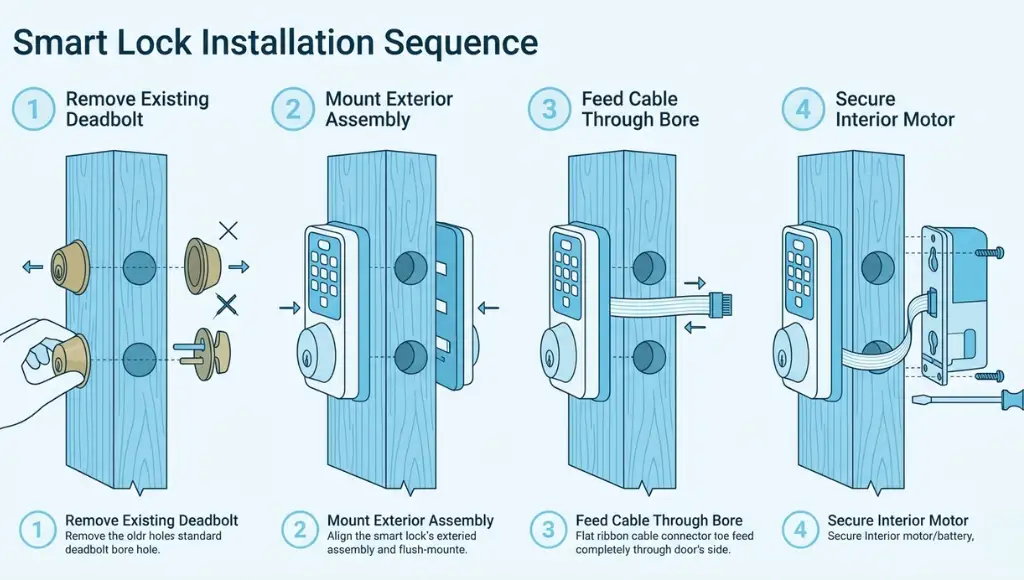
Remove your existing deadbolt with a standard Phillips-head screwdriver. Fit the exterior assembly first, run the connecting cable through the door bore, then secure the interior mounting plate and motor assembly. Most modern deadbolt-replacement locks complete this in under 20 minutes. The Yale Assure Lock 2 is particularly straightforward: it uses a single snap-fit mounting plate with no loose screws, and Yale includes a QR code in the box linking directly to an installation video for your specific door prep.
Step 3: Pair the Lock with Your Smart Home Platform
Download the manufacturer’s app and follow the in-app pairing steps. If your lock supports Matter, you can skip the brand app entirely and add it directly through Apple Home, Google Home, or Alexa. Matter pairing is generally more reliable and removes the dependency on the manufacturer’s cloud servers staying online. Bluetooth-only locks cannot be controlled remotely unless your phone is within roughly 30 feet of the lock, or you add a separate hub at extra cost.
Step 4: Set Up Individual Access Codes and Schedules
Create a separate code for every user and access scenario. Most locks in 2026 support between 30 and 250 unique codes. Set a permanent code for household members, a time-restricted recurring code for cleaning services or dog walkers, and single-use codes for delivery or one-time guests. The Kwikset Smart Lock lineup allows direct keypad programming without the app, which is practical when handing off access quickly or when your phone battery is dead.
Step 5: Enable Activity Monitoring and Alerts
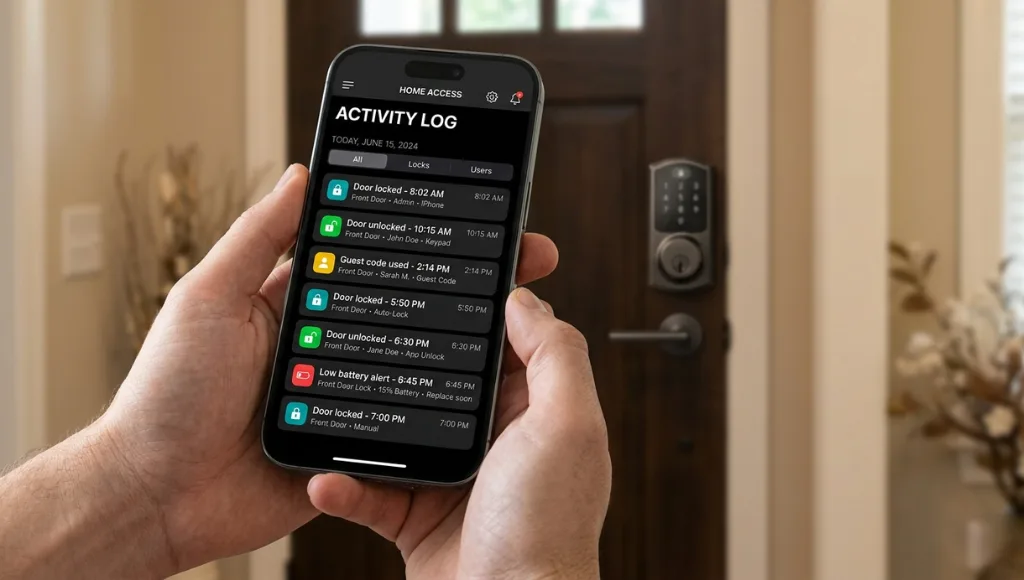
Turn on push notifications for every lock event: lock, unlock, failed code attempts, and low battery. Set your low-battery alert threshold at 25% remaining, not the default 10%, to give yourself time to buy replacement batteries before a lockout. The Yale Assure Lock 2 supports integration with home security systems like Ring Alarm and SimpliSafe, allowing an unknown PIN attempt to trigger a camera recording automatically.
Best Smart Locks Compared: 2026 Top Picks
The best smart lock for most homeowners in 2026 is one that supports Matter 1.3, carries at least ANSI Grade 2 certification, and offers offline keypad access as a backup. The Yale Assure Lock 2 leads for ecosystem flexibility. Schlage Encode Plus leads for physical security. Kwikset Halo Touch leads for fingerprint access. August Wi-Fi Smart Lock remains the top pick for renters.
Lock Model | Best For | Standout Feature | Price Range | Key Limitation |
Kwikset Halo Touch | Fingerprint access | Built-in fingerprint reader + keypad | $200-$230 | No Matter support yet |
Yale Assure Lock 2 | All-around smart home | Matter 1.3 + 3 platform support | $180-$250 | No fingerprint sensor |
Schlage Encode Plus | Maximum security | ANSI Grade 1 + Apple Home Key | $280-$330 | Premium price point |
August Wi-Fi Smart Lock | Renters/retrofits | Installs over existing deadbolt | $140-$180 | Does not replace deadbolt |
Kwikset Halo Touch: Kwikset (owned by Spectrum Brands) has built its smart lock reputation on user-friendly hardware. The Halo Touch’s capacitive fingerprint reader supports up to 100 stored fingerprints, making it the strongest choice for households with varied users such as children, elderly family members, or live-in help. The trade-off is the absence of Matter support in the current hardware generation, meaning it requires the Kwikset app and a Wi-Fi hub for full functionality.
Yale Assure Lock 2: The Yale Assure Lock 2 (from ASSA ABLOY, the world’s largest lock manufacturer) is the most versatile smart lock available in 2026. Matter 1.3 compatibility means it works natively with Apple Home, Google Home, and Alexa. It carries ANSI Grade 2 certification, ships with a physical key cylinder backup, and includes a backlit keypad for dark-environment use. If you own your home and want one lock that works regardless of which smart home platform you end up on, the Assure Lock 2 is the lowest-risk purchase.
Schlage Encode Plus: For buyers who treat physical security as the primary requirement, the Schlage Encode Plus is the standard. ANSI Grade 1 certification (the highest consumer-grade rating) and native Apple Home Key support (which stores your lock credential directly in Apple Wallet for NFC tap access) set it apart. The higher price is the only meaningful barrier.
August Wi-Fi Smart Lock: For renters or anyone in a property where the deadbolt cannot be replaced, the August Wi-Fi Smart Lock installs in minutes over your existing deadbolt and key cylinder. It does not improve your deadbolt’s physical security grade (the cylinder underneath is unchanged), but it adds full app control, remote access, and guest code management without touching your landlord’s hardware.
Common Smart Lock Mistakes to Avoid
The most common mistake is buying a smart lock based on app store ratings alone, which leads to hub incompatibility and expensive replacements within 90 days. Smart lock purchases require three compatibility checks before spending: door prep dimensions, hub/protocol support, and ANSI security grade.
Mistake 1: Skipping Hub and Protocol Compatibility
Z-Wave locks require a Z-Wave hub. Zigbee locks require a Zigbee hub. Wi-Fi locks work without a hub but drain batteries faster. Bluetooth-only locks limit you to local access. Before purchasing, check your existing hub’s compatibility list, not the lock’s marketing page. Matter resolves most of this going forward, but only when both the lock and the hub list the same Matter version.
The fix: check the compatibility list on your hub manufacturer’s website (SmartThings, Hubitat, Apple Home, Google Home) before purchasing any lock.
Mistake 2: Ignoring the ANSI Security Grade
Popular does not mean secure. Several high-selling smart locks on Amazon have never been submitted for ANSI/BHMA grade certification. That means their resistance to physical attack, picking, and forced entry is unknown. A stylish keypad means nothing if the deadbolt itself fails a kick test.
One thing most guides miss: ANSI Grade certification is a pass/fail test of physical hardware, not software. A lock can be brilliant at app integration and terrible at actually keeping your door closed under force. Always confirm at least ANSI Grade 2 on the product specification sheet.
Mistake 3: Sharing a Single Access Code Across All Users
Using one code for the entire household removes your ability to audit who entered and when, and forces a full code reset if you need to revoke one person’s access. Set individual codes from day one. Most locks support this at no extra cost.
Mistake 4: Buying Without an Offline Backup Method
Wi-Fi goes down. Apps crash. Phones die. If your smart lock has no physical keypad or key cylinder override, a power or network outage locks you out of your own home. Every lock recommended in this guide includes at least one offline access method. Do not buy a smart lock that lacks this feature, regardless of how impressive its app is.
Frequently Asked Questions About Smart Locks
The Yale Assure Lock 2 is the best smart lock for most front doors in 2026. It supports Matter 1.3, works with Apple Home, Google Home, and Amazon Alexa without a bridge, carries ANSI Grade 2 certification, and includes a physical keypad for offline access. It fits most standard single-cylinder deadbolt door preps and is available in seven finish options. (Yale, 2025)
Smart locks can be safer than traditional locks when you choose a model with ANSI Grade 1 or 2 certification and configure it correctly. Traditional locks offer zero visibility into who enters and when. Smart locks add access logging, real-time alerts, remote locking, and temporary codes. The security trade-off is that the attack surface shifts from purely physical to include digital risks. Use a strong, unique PIN and enable two-factor authentication on your lock app. (Consumer Reports, 2025)
Yes. Most smart locks operate without Wi-Fi for local access via keypad or Bluetooth from your phone. Remote access and real-time notifications require either Wi-Fi or a connected hub. Bluetooth-only locks limit remote control to within approximately 30 feet of the door. If remote access is a priority, choose a Wi-Fi-enabled or Matter-compatible model.
Kwikset excels in fingerprint recognition and direct keypad programming, making it practical for diverse household users. Yale leads in smart home platform compatibility, with native Matter support across the Assure Lock 2 line and deeper integration with third-party security systems. Both carry ANSI Grade 2 certification on their flagship models. Kwikset is typically priced slightly lower; Yale offers more ecosystem flexibility for the modest price difference.
Most smart locks run 6 to 12 months on standard AA batteries under typical residential use (roughly 8 to 15 lock or unlock cycles per day). Wi-Fi-connected models drain faster than Z-Wave or Bluetooth models due to the constant radio activity. Enable low-battery notifications at the 25% threshold so you have several days to replace batteries before losing access.
The Bottom Line on Best Smart Locks
Here are the three takeaways worth remembering:
- Matter 1.3 support is now the minimum bar. Any lock purchased in 2026 that does not support Matter is a compatibility compromise from day one.
- ANSI grade matters as much as app features. Confirm at least ANSI/BHMA Grade 2 certification on the product spec sheet before purchasing.
- Individual codes, activity logging, and an offline backup method are not optional. These three features define a truly functional smart lock setup.
The best smart locks in 2026 are not just digital keychains. They are the gateway device that sets the tone for your entire home security setup. Choose wisely, configure it fully, and it will give you years of reliable, logged, remotely managed access to your home.