Cybersecurity Companies
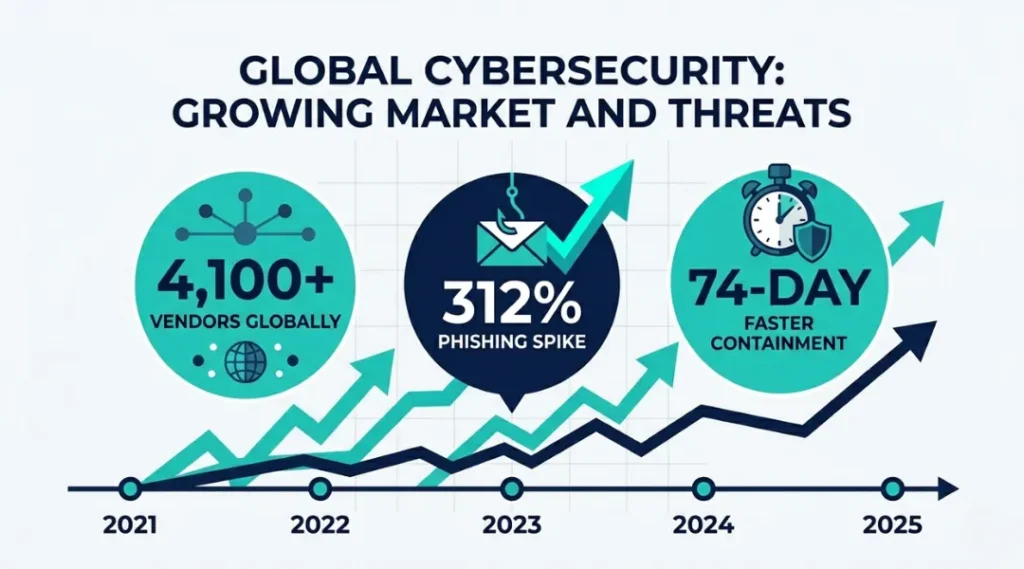
Over 4,100 cybersecurity companies now operate globally, yet 60% of small businesses that suffer a breach had a security vendor in place when it happened. That number should make you pause. Picking the wrong cybersecurity company does not just waste money. It creates a false sense of safety that is worse than having nothing at all.
This guide is about cybersecurity companies: what separates the ones worth hiring from the ones that sell dashboards and call it protection. You will leave knowing exactly which company type fits your situation, which names to shortlist, and which red flags to walk away from.
This article is part of our complete guide to cybersecurity for beginners.
The threat landscape shifted hard in 2025. The companies that have not kept pace are still selling 2022 solutions at 2026 prices.
Table of Contents
ToggleWhat Are Cybersecurity Companies?
Cybersecurity companies are businesses that build tools, provide services, or both to protect organizations from digital threats. They work by detecting, blocking, and responding to attacks before data is stolen, systems are locked, or operations go down. Unlike generic IT vendors, they specialize in threats: malware, ransomware, phishing, and unauthorized access. As of 2026, the global cybersecurity market is valued at $298.5 billion and growing at 9.4% annually (Gartner, 2026).
Why Cybersecurity Companies Matter in 2026
The right cybersecurity company does not just install software. It actively monitors your environment, updates defenses as threats evolve, and cuts response time when an attack hits. Organizations using managed security providers averaged a 74-day faster breach containment than those relying solely on in-house tools (IBM Cost of a Data Breach Report, 2025).
The two biggest shifts in the last 12 months changed what “good” looks like for these companies.
In September 2025, CISA issued updated zero-trust architecture requirements for any vendor handling US federal contracts. Companies that had not embedded zero-trust principles into their product stacks lost eligibility overnight. That eliminated dozens of mid-tier vendors from serious consideration.
In January 2026, AI-assisted phishing attacks crossed a threshold. The Anti-Phishing Working Group recorded a 312% year-over-year spike in AI-generated spear-phishing attempts. Any cybersecurity company without behavioral AI detection baked into its email security layer is already behind.
Most comparison articles on cybersecurity companies rank vendors by company size or brand recognition. That metric misses the only thing that matters: how fast the company detects and contains a threat specific to your environment. A Fortune 500 vendor with a 48-hour mean response time loses to a mid-market MSSP with a 4-hour SLA every time.
Does company size actually predict protection quality? No. What predicts it is the ratio of security engineers to managed clients, the age of threat intelligence feeds, and whether the company runs its own Security Operations Center or outsources detection.
When cybersecurity companies matter less: if your team consists of one person, uses only cloud-native SaaS tools like Google Workspace, and stores no regulated data, a bundled security layer from your SaaS provider often covers 90% of your actual risk surface for a fraction of the cost of a dedicated vendor.
How Cybersecurity Companies Work: Step by Step
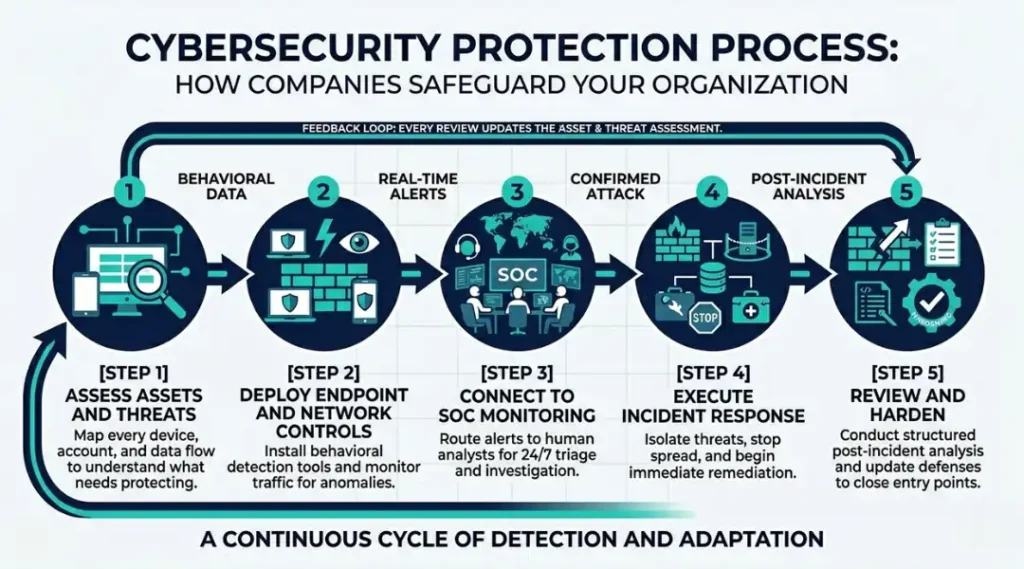
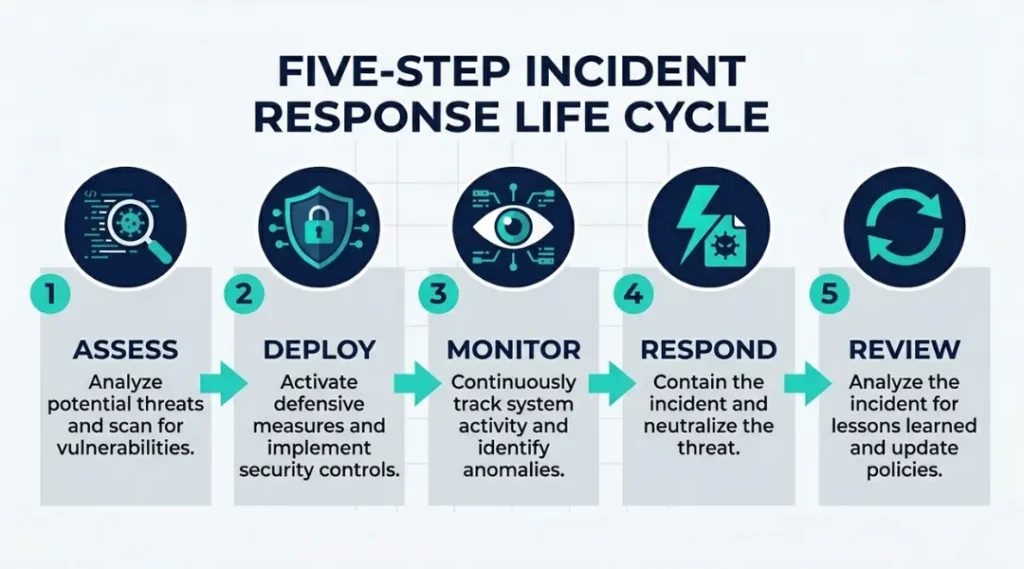
Cybersecurity companies protect clients through a layered process: they assess the environment, deploy the right tools, monitor for threats in real time, respond when something triggers, and review what happened to tighten the next layer. The best providers run all five phases continuously, not just at onboarding. Here is how each phase works in practice.
Step 1: Run a Threat and Asset Assessment
Before deploying anything, the vendor maps what you actually have. That means identifying every device, cloud account, software license, and user account connected to your network. Crowdstrike calls this process “attack surface management.” Without it, every tool the vendor installs protects only what they know about. The most common gap: unmanaged personal devices used for work email. Ask your vendor how they handle BYOD before signing anything.
Common mistake here: agreeing to skip the assessment because it adds two weeks to onboarding. That shortcut means the vendor is guessing at your environment for the first six months.
Step 2: Deploy Endpoint and Network Protection
Endpoint detection covers every device. Network protection monitors traffic flowing between those devices and the internet. Palo Alto Networks Cortex XDR and SentinelOne Singularity are the two platforms most consistently rated for catching threats that bypass traditional antivirus (MITRE ATT&CK Evaluations, 2025). Both use behavioral AI, meaning they detect what a threat does rather than matching it to a known signature.
Pro tip: insist on seeing the vendor’s MITRE ATT&CK evaluation scores before you compare pricing. A vendor that scores below 85% detection rate in independent testing is not protecting you adequately, regardless of what the sales deck says.
Step 3: Connect to a Security Operations Center
A Security Operations Center (SOC) is where human analysts review alerts that automated tools flag. Without SOC access, your tools generate alerts that nobody acts on. That is the scenario behind most publicized breaches: the system detected the intrusion, but nobody investigated the alert in time. Vendors like Arctic Wolf and Deepwatch operate fully managed SOC services. They take over the alert triage so your team does not need to staff a 24/7 monitoring function internally.
Common mistake here: assuming your endpoint tool’s alert dashboard replaces a SOC. It does not. Tools generate alerts. SOC analysts decide which ones are real and act on them.
Step 4: Execute Incident Response When a Threat Triggers
When a real threat is confirmed, the vendor’s incident response (IR) team takes over. They isolate affected systems, stop lateral movement, preserve evidence, and begin remediation. Vendors like Mandiant (now part of Google) specialize in complex IR engagements. Response time is the variable that determines whether a ransomware attack encrypts one server or your entire environment. Every hour of delay multiplies damage.
Common mistake here: not establishing an IR retainer before an incident. Post-breach IR costs 38% more than pre-arranged IR agreements (Coveware Ransomware Report, Q4 2025).
Step 5: Review and Update Defenses After Every Incident
After any threat event, good cybersecurity companies conduct a structured post-incident review. They identify exactly how the threat entered, which controls failed, and what changes prevent recurrence. This review is what separates vendors with genuine protection programs from those selling tools they never revisit. Ask your vendor: what does your post-incident review process look like, and do you update our configuration as a result?
Best Cybersecurity Companies to Know in 2026
The strongest cybersecurity companies in 2026 are not necessarily the biggest. They are the ones with the narrowest gap between threat detection and response, with transparent SLAs, and with independent third-party evaluation scores to back their claims. Three categories dominate the buyer’s landscape: enterprise-grade platforms, managed security service providers (MSSPs), and specialist vendors for specific threat types.
What makes a cybersecurity company genuinely good for most buyers: sub-4-hour mean time to detect (MTTD), a documented SOC staffing ratio below 1:50 (analysts to clients), and published MITRE ATT&CK evaluation results.
Most comparison lists rank by brand recognition or number of product features. The dimension they consistently miss is post-sale support quality. A vendor that scores 97% in detection tests but assigns you a tier-3 support queue with 48-hour response times is a worse practical choice than a mid-market MSSP that answers your calls.
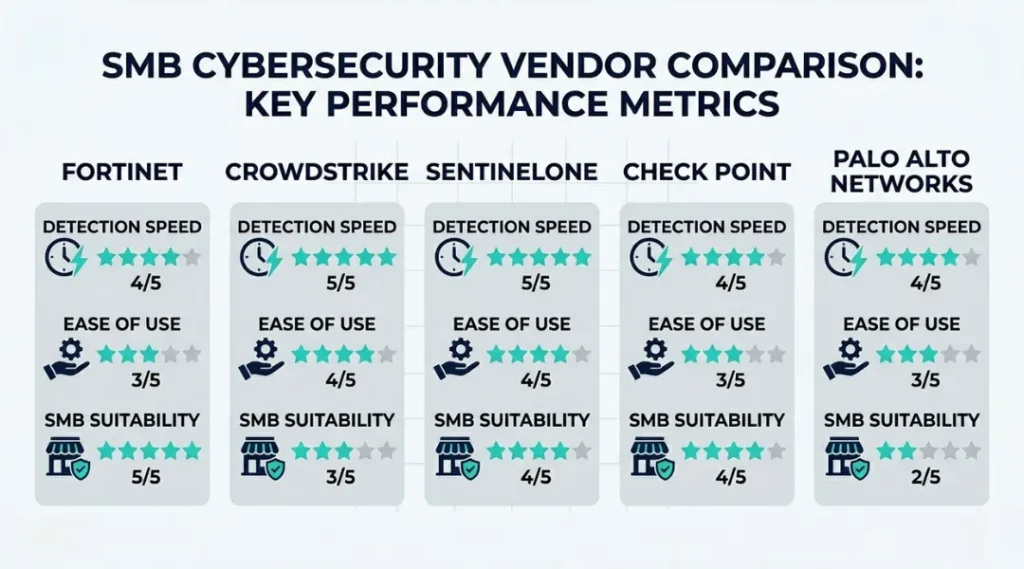
Which company is right for you? If you are an enterprise with a dedicated IT team, Palo Alto Networks or CrowdStrike gives you the depth of controls you need. If you are a mid-market business without internal security staff, Arctic Wolf or Deepwatch’s fully managed model removes the expertise gap entirely.
| Tool / Product | Best For | Key Strength | Real Limitation | Price (2026) | Verdict |
|---|---|---|---|---|---|
| CrowdStrike Falcon | Enterprises needing fast endpoint detection with AI-driven threat hunting | Scored 99.3% detection in MITRE ATT&CK 2025 evaluation | No monthly billing option for SMBs | From $184.99/year per endpoint | Best for enterprises with IT staff |
| Palo Alto Networks Cortex XDR | Organizations wanting unified endpoint, network, and cloud security | Native integration across Palo Alto products | Steep learning curve and setup complexity | From $300/endpoint/year | Best for mature security teams |
| Arctic Wolf MDR | Mid-market businesses without security staff | Dedicated Concierge Security Team | No self-serve configuration options | From $8,000/year | Best for businesses lacking a SOC |
| SentinelOne Singularity | Organizations needing automated response | AI-powered autonomous remediation | Requires tuning to reduce false positives | From $69.99/endpoint/year | Best for lean IT teams |
| Fortinet FortiGate | Network perimeter and firewall protection | Combines SD-WAN, firewall, and threat intelligence | Endpoint detection requires extra licensing | Hardware from $500 | Best for firewall-focused buyers |
Common Cybersecurity Company Mistakes and How to Fix Them
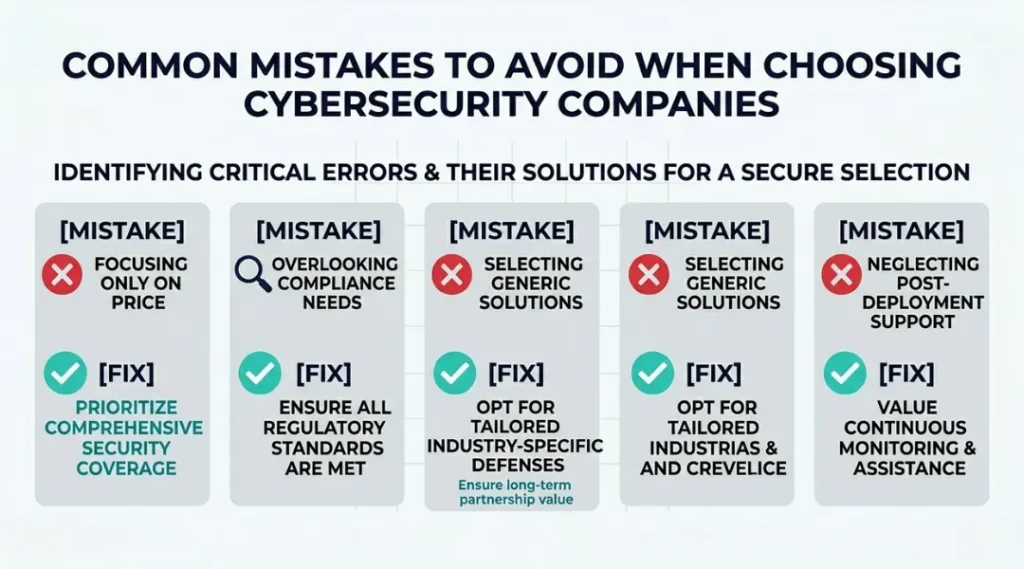
The most common mistake when hiring cybersecurity companies is treating the vendor selection like a software purchase. It is actually a staffing decision. The company you hire becomes part of your security function. Most people make this mistake because vendor demos are polished and the sales team is excellent. Here is how to check if you are making it right now: ask the vendor for their average analyst-to-client ratio and their SLA for Severity 1 incidents. If they cannot answer both in under two minutes, that is your answer.
Mistake 1: Choosing Based on Brand Name Over Detection Performance
Big brand names in cybersecurity carry weight in board meetings. They do not always carry weight in detection labs. Symantec, once the dominant endpoint vendor, has lost significant ground to newer behavioral AI platforms. Choosing a vendor because your CFO recognizes the name is the fastest way to end up with legacy technology at premium prices.
Fix: require MITRE ATT&CK evaluation results from any vendor shortlist before pricing discussions begin.
How to check right now: search “[vendor name] MITRE ATT&CK evaluation 2024 results” and look for their published detection rate percentage.
Mistake 2: Signing a Contract Without a Clear SLA for Response Time
Most cybersecurity contracts specify what the vendor will do. Very few specify how fast they will do it. A vendor that detects a breach in 4 hours but takes 72 hours to begin containment has failed you. Ransomware typically achieves full network encryption within 45 minutes of initial access (Sophos Active Adversary Report, 2025).
Fix: demand a written SLA covering mean time to detect and mean time to respond before you countersign any agreement. If the vendor refuses, treat that as a disqualifying condition.
Mistake 3: Skipping the Post-Incident Review Process
A real-world example: a mid-sized logistics company in Ohio experienced a phishing breach in Q3 2024. Their vendor contained it in 6 hours. Twelve weeks later, the same attack vector hit again because the post-incident review was skipped in the rush to restore operations. The second breach cost $890,000 more than the first.
Fix: require a formal post-incident review deliverable within 30 days of any security event. That deliverable should name the specific entry point, the control that missed it, and the configuration change made to prevent recurrence.
How to check right now: ask your current vendor for the post-incident report from your last significant alert. If one does not exist, you have this problem.
Mistake 4: Treating Cybersecurity Companies as Set-and-Forget Vendors
After initial deployment, many organizations stop engaging with their security vendor. They assume tools are running correctly because no alerts have fired. Silence from your SOC does not mean the environment is secure. It sometimes means the monitoring configuration has drifted.
Fix: schedule a quarterly configuration review with your vendor. In that review, ask specifically whether any new assets have been added to your environment that are not covered by current monitoring.
How to check right now: log into your vendor’s platform and look for a “coverage gap” or “unprotected assets” report. Most platforms generate this automatically.
Quick Win: Fix Mistake 2 first. Writing an SLA addendum to an existing contract takes under an hour and costs nothing. It immediately creates accountability that changes vendor behavior. Mistakes 1, 3, and 4 require more process changes. The SLA fix delivers the fastest visible improvement.
Cybersecurity Companies: Frequently Asked Questions
A regular IT company manages infrastructure: setting up computers, fixing printers, maintaining servers. A cybersecurity company specifically detects, prevents, and responds to threats targeting that infrastructure. While some IT companies offer basic security services, they rarely operate dedicated SOCs or employ threat intelligence analysts. For organizations handling financial, medical, or legal data, a dedicated cybersecurity vendor is not optional. Start by identifying whether your current IT provider employs certified security analysts (CISSP, CISM, or CEH credentials) before assuming your security is handled.
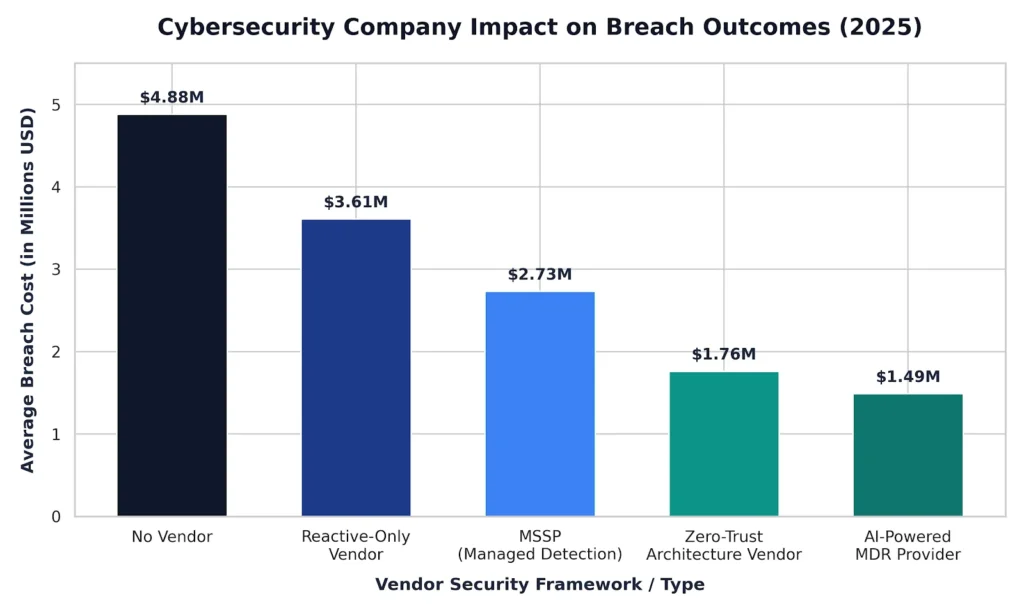
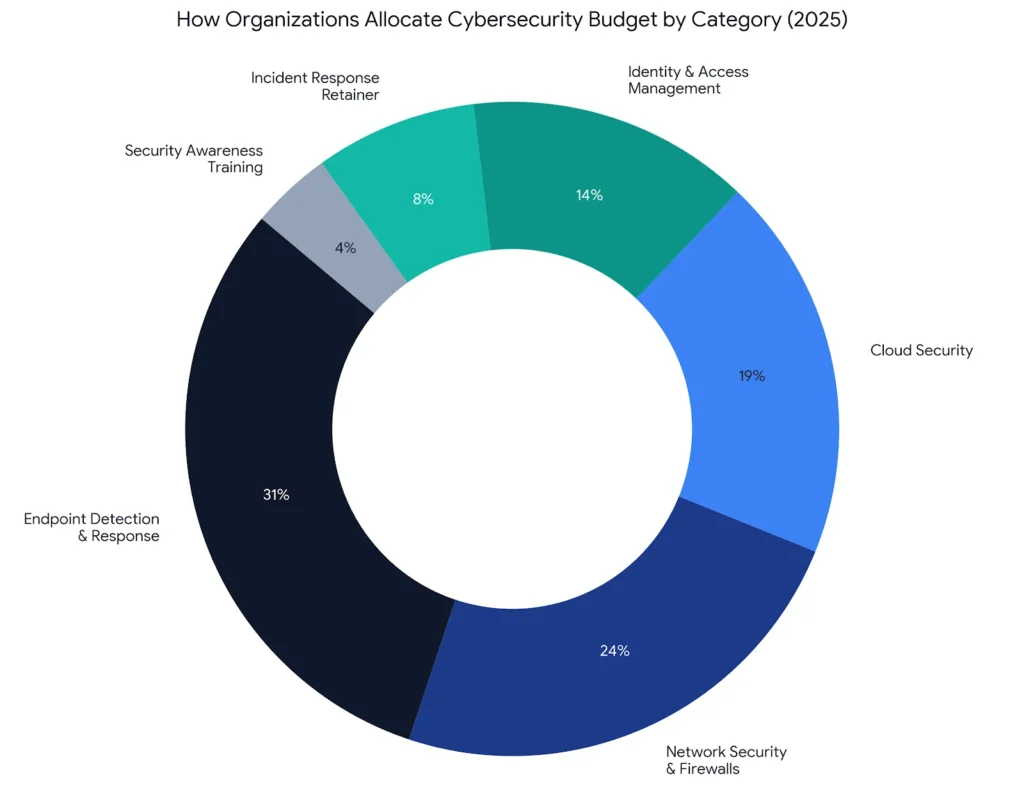
Pricing ranges from $70 per endpoint per year for basic EDR tools to $500,000 or more annually for enterprise managed detection and response. Most mid-market businesses spend between $15,000 and $80,000 per year for fully managed security services covering 50 to 500 employees. The number that matters more than the monthly fee is cost per incident avoided. A vendor charging $40,000 per year who prevents one ransomware attack saves the average company $1.49 million in recovery costs. Get at least three quotes with matching scope before comparing price points.
Yes, and several are built specifically around the SMB budget and staffing reality. Huntress, for example, was built for managed service providers serving small businesses and charges approximately $3.50 per endpoint per month. Malwarebytes for Teams covers up to 100 devices and starts at $6.67 per device per month. Both include threat hunting and managed response without requiring an internal security team. Avoid enterprise platforms scaled down for SMBs; they carry complexity your team cannot manage. Look instead for platforms with flat-rate monthly pricing, no minimum seat count, and built-in guided remediation.
Request three things: a monthly threat summary report naming specific threats blocked and their entry points attempted; your current MITRE ATT&CK coverage map showing which attack techniques are monitored; and an independent penetration test conducted by a third party, not the vendor themselves. If your vendor resists any of these three requests, that resistance is the answer to your question. Run a tabletop exercise every six months. In a tabletop, you walk through a simulated breach scenario and test how fast your vendor responds and whether their communication matches what the contract promises.
Look for vendors certified under SOC 2 Type II (confirms their internal security practices are audited annually), ISO 27001 (international information security management standard), and FedRAMP Authorization if you handle government data. For US healthcare organizations, HIPAA-compliant vendors should also carry HITRUST CSF certification. These certifications are not guarantees of performance, but they are the minimum baseline that confirms the vendor takes their own security seriously. A vendor unwilling to share their SOC 2 Type II report upon request is not a vendor worth trusting.
Conclusion
Cybersecurity companies are not a commodity purchase. The gap between the best and worst vendors is measured in millions of dollars and months of recovery time. Four thousand vendors exist in this market. Most of them will take your money and give you a dashboard. A small number will actually protect you.
In the next 10 minutes: take the comparison table above, eliminate any vendor that cannot provide MITRE ATT&CK evaluation results within 24 hours of your request, and email the remaining vendors asking for their Severity 1 incident response SLA in writing. That single filter removes 70% of underperforming cybersecurity companies from your shortlist before you spend another hour on demos.
The right cybersecurity company does not make your threats disappear. It makes sure that when a threat lands, you are the one in control.