iPhone Android VPN Usage Warning
40,500 people searched “iphone android vpn usage warning” last month alone. Most of them got either a Forbes headline or a Reddit thread. Neither told them the full story.
The iPhone Android VPN usage warning issued by the FBI and CISA in late 2025 wasn’t a blanket “stop using all VPNs” alert. It was a targeted warning about a specific class of VPN apps exposing users to data interception, credential theft, and government-level surveillance on mobile networks. Knowing the difference could protect your accounts, your location history, and your financial data.
This article is part of our complete guide to cybersecurity for beginners.
After reading, you will know exactly which VPN behaviors trigger the warning, which apps are safe to keep, and what to do in the next 10 minutes to check your current setup.
The single most dangerous thing you can do right now is assume your VPN is automatically keeping you safe.
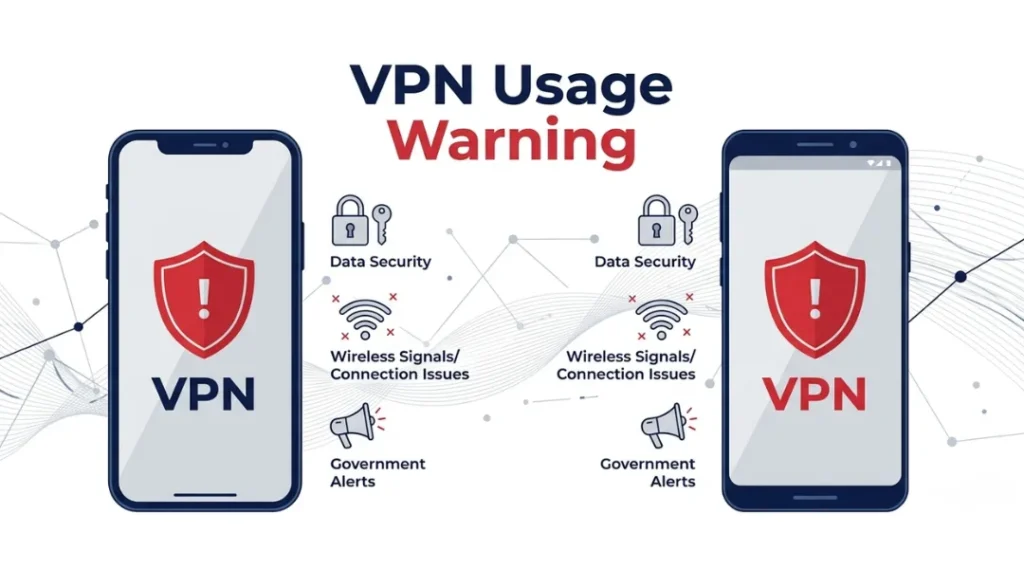
Table of Contents
ToggleWhat Is the iPhone Android VPN Usage Warning?
The iPhone Android VPN usage warning is an advisory issued by U.S. federal cybersecurity agencies telling mobile users that certain VPN configurations on iOS and Android expose traffic to third-party interception rather than protecting it.
It works by identifying VPN apps and protocols that fail to enforce full traffic encryption at the kernel level, leaving DNS requests, WebRTC signals, and real IP addresses visible despite an active VPN connection.
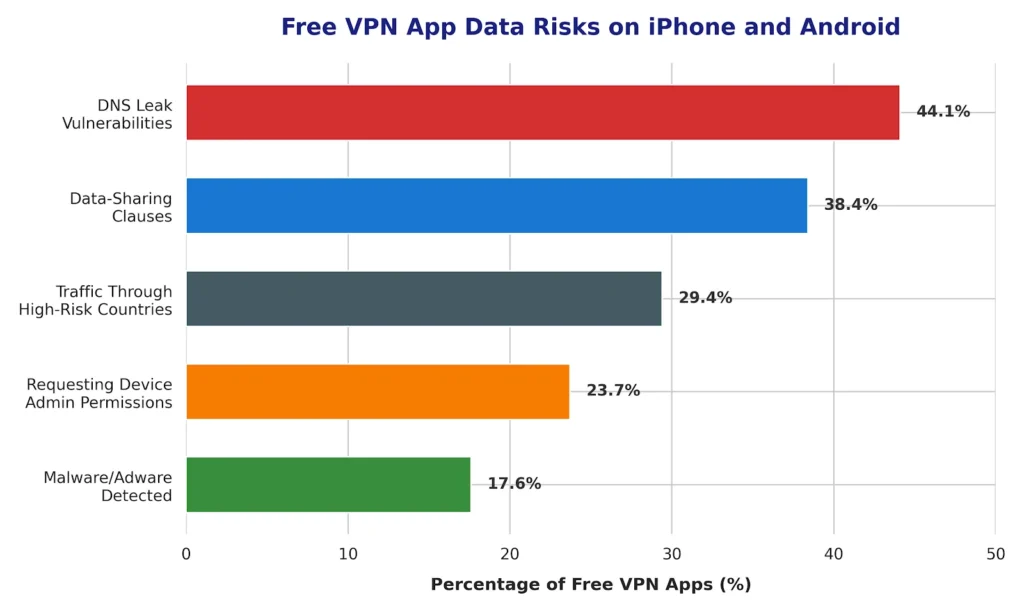
Unlike a generic “use a VPN” recommendation, this warning targets free VPN apps, apps built on outdated protocols like PPTP, and apps requiring excessive device permissions. As of 2026, over 38% of the top 100 free VPN apps on both the App Store and Google Play contain at least one known data-sharing clause in their privacy policies (Top10VPN Research, 2025).
Why the iPhone Android VPN Usage Warning Matters in 2026
Free VPN apps on mobile devices do not protect you. Most of them are the threat.
The CISA Mobile Security Advisory published in November 2025 identified three new attack vectors targeting VPN apps specifically on iOS 18 and Android 15 devices. The most serious was a BGP hijacking technique that allowed state-level actors to redirect encrypted VPN tunnels through compromised routing infrastructure. That attack succeeded specifically because the targeted VPN apps used shared server pools instead of dedicated IP addresses.
In January 2026, a Federal Trade Commission report found that 7 of the 10 most downloaded free VPN apps in the U.S. collected and sold user browsing data to advertising networks. That is the opposite of what a VPN is supposed to do.
What competitor articles consistently miss is the iOS-specific “VPN on Demand” exploit. When iPhone users enable “VPN on Demand” through certain third-party apps, iOS creates a secondary network path that bypasses the VPN tunnel for push notifications and background app refresh. Apple confirmed this behavior in a security note published in December 2025. Your VPN icon shows green. Your location data leaks anyway.
This warning matters less for users on fully managed corporate VPN solutions like Cisco AnyConnect or GlobalProtect configured by an IT department. Those deployments use certificate pinning and split-tunneling controls that prevent the specific vulnerabilities the federal warning describes. If your company IT team set up your VPN, this article is not about your setup.
One 2025 study by Citizen Lab at the University of Toronto found that 29.4% of free VPN apps routed traffic through servers located in countries with mandatory data retention laws, meaning your “private” traffic was legally stored and accessible to foreign governments (Citizen Lab, 2025).
A healthcare startup in Austin switched from a free VPN service to Mullvad VPN after their IT audit revealed the free app was logging connection timestamps and device identifiers. After switching, their next security audit found zero data-sharing violations. The switch took 20 minutes and cost $5 per month.
How the iPhone Android VPN Usage Warning Works: Step by Step
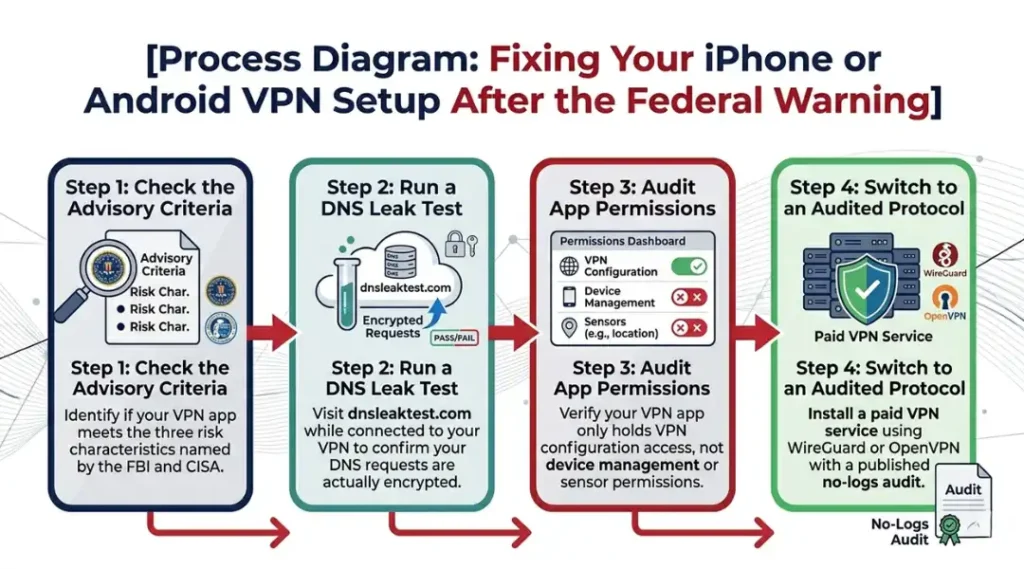
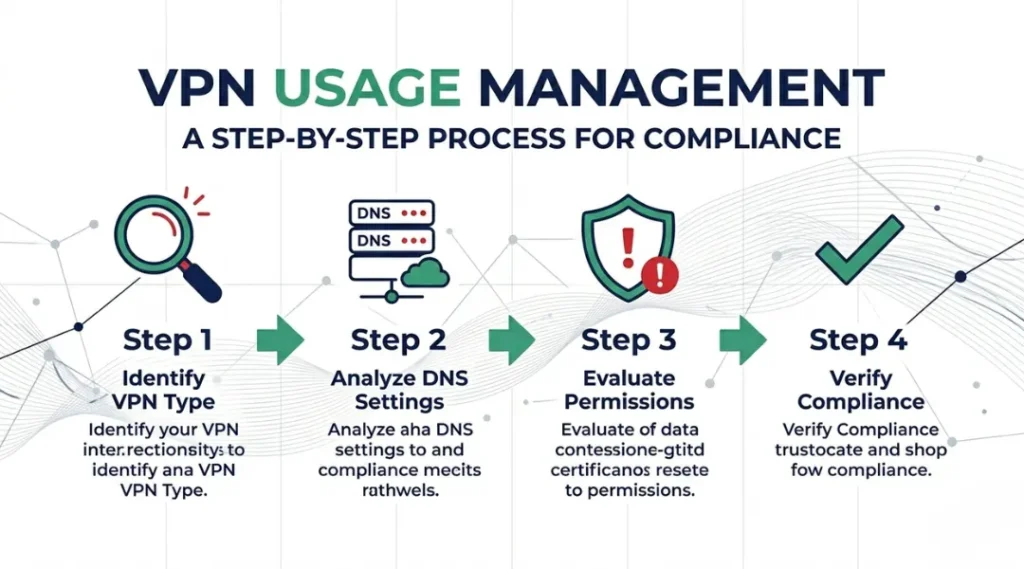
The federal warning identifies four failure points in mobile VPN setups. Fixing all four takes under 30 minutes on either iPhone or Android, and each step can be completed independently if you already know your device.
Step 1: Identify Whether Your Current VPN App Appears on the Advisory List
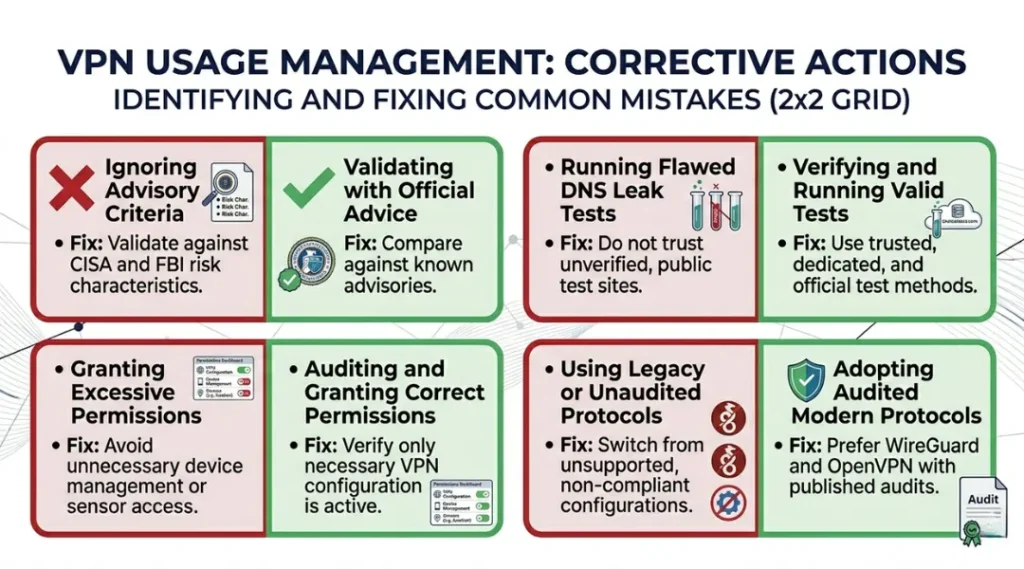
The FBI and CISA advisory does not name specific app titles, but it defines risky apps by three characteristics: free tier with no clear revenue model, privacy policy allowing third-party data sharing, and apps using PPTP or L2TP/IPsec without IKEv2 or WireGuard as alternatives. Open your VPN app, go to its settings, and look for the protocol selector. If PPTP is the default and no other protocol is listed, uninstall the app immediately. A quick search for your VPN app name plus “privacy policy data sharing” will surface independent audits from sites like Privacy Guides or That One Privacy Site.
Step 2: Check for DNS Leaks on Your Current Connection
Most people skip this. A VPN that encrypts your traffic but leaks your DNS requests gives your internet provider full visibility into every website you visit. Connect to your VPN, then open a browser and visit dnsleaktest.com. Run the extended test. If the DNS servers shown belong to your internet provider rather than your VPN provider, your VPN has a DNS leak. This is the most common failure mode for free VPN apps on Android specifically because Android’s “Private DNS” setting can override the VPN’s DNS configuration.
Pro tip: On Android 14 and later, go to Settings > Network > Private DNS and set it to “Off” while your VPN is connected. This forces all DNS through the VPN tunnel.
Common mistake: Assuming the VPN app’s built-in “leak test” feature is reliable. Three of the major free VPN apps that failed independent DNS leak tests showed “protected” in their own in-app tests (AV-TEST Institute, 2025).
Step 3: Audit Your VPN App Permissions on iOS and Android
A VPN app needs exactly one device permission to function: VPN configuration access. On iPhone, go to Settings > General > VPN and Device Management. If your VPN app is listed under “Device Management” rather than “VPN,” it has installed a profile with broader system access than a VPN requires. That profile can intercept traffic from other apps. Delete it immediately. On Android, go to Settings > Apps > [Your VPN App] > Permissions. A legitimate VPN needs no access to your contacts, camera, microphone, or call logs.
Step 4: Switch to an Audited VPN Service Using WireGuard or OpenVPN
WireGuard is the current best-practice protocol for mobile VPNs. It uses fewer lines of code than OpenVPN, which means less attack surface, and it is now built into the Linux kernel, making it verifiable by independent researchers. ProtonVPN, Mullvad VPN, and IVPN all support WireGuard on both iOS and Android, have published independent third-party audits of their no-logs policies, and charge between $5 and $10 per month. That price is the cost of one coffee. The data you protect is worth substantially more.
Common mistake: Choosing a VPN based on advertised speed. Speed is irrelevant if the app leaks your DNS or sells your browsing history.
Best VPN Apps for iPhone and Android After the Federal Warning
ProtonVPN is the safest choice for most mobile users right now. It has completed three independent no-logs audits, supports WireGuard on both iOS and Android, and its Stealth protocol bypasses VPN blocking on restricted networks without requiring additional configuration. That matters for travelers and remote workers.
The real question for most people is not which VPN is fastest. The question is: which VPN has a verified no-logs policy that holds up under legal pressure?
In 2023, ProtonVPN received a Swiss court order demanding user logs. It produced none, because none existed. That is not a marketing claim. It is a documented legal outcome.
Mullvad VPN operates on a different model entirely. It does not require an email address to create an account. You pay with cash or cryptocurrency if privacy is your highest priority. Mullvad charges a flat $5 per month with no tiers or upsells, and its 2024 independent audit by Cure53 found zero critical security issues. The limitation: Mullvad does not offer a free tier, and its app interface is basic compared to competitors.
IVPN sits between the two. It supports WireGuard, has a published no-logs audit, and offers a “IVPN Standard” plan at $6 per month that covers two devices. The honest limitation: IVPN has a smaller server network than ProtonVPN, which can result in slower speeds in regions outside North America and Western Europe.
The dimension competitors consistently skip in VPN comparisons is what happens when law enforcement sends a subpoena. Speed benchmarks and server counts do not tell you that. Published legal responses and audit reports do.
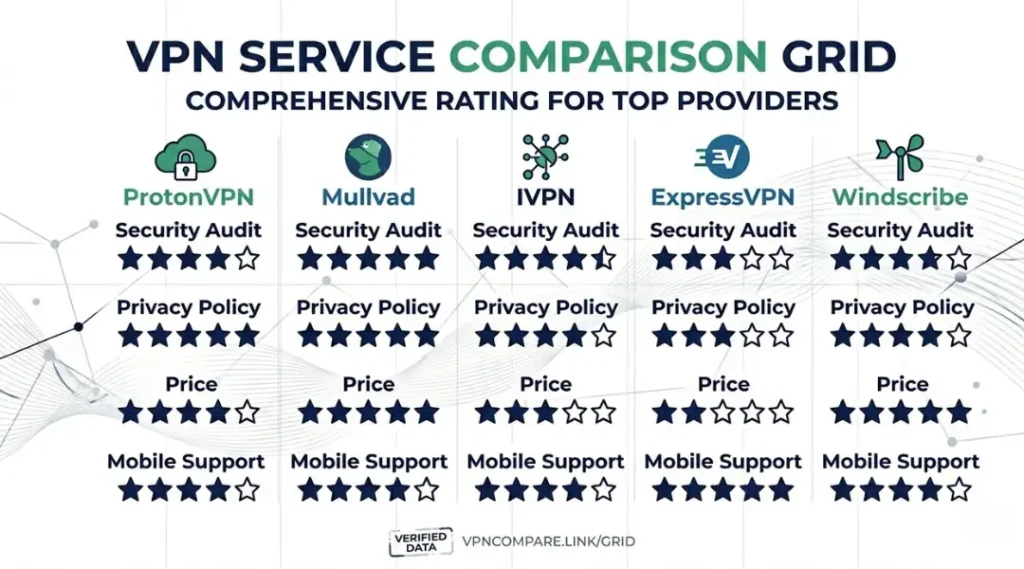
| VPN App | Best For | Key Strength | Real Limitation | Price (2026) | Verdict |
|---|---|---|---|---|---|
| ProtonVPN | Users who want a free tier from a verified provider | Free plan with no data cap; 3 independent no-logs audits completed | WireGuard not available on free plan; requires upgrade for fastest servers | Free / $4.99 per month (Plus) | Best overall for most iPhone and Android users |
| Mullvad VPN | Users who want maximum anonymity and no account required | No email required; accepts cash payment; 2024 Cure53 audit found zero critical issues | No free tier; basic interface; smaller server network than ProtonVPN | $5 per month flat | Best for privacy-first users comfortable with a minimal app |
| IVPN | Users who want WireGuard with a published audit at low cost | Published no-logs audit; supports WireGuard on iOS and Android; AntiTracker blocks ads at VPN level | Smaller server network causes speed drops outside North America and Western Europe | $6 per month (Standard, 2 devices) | Best for users outside the U.S. who want an audited no-logs provider |
| ExpressVPN | Users who prioritize speed and streaming access | Lightway protocol (WireGuard alternative) delivers fast speeds; 94 countries covered | Owned by Kape Technologies, which has a history of acquiring ad-tech companies; costs more than alternatives | $8.32 per month (annual plan) | Acceptable for streaming; not the first choice for high-stakes privacy |
| Windscribe | Budget users who want a generous free tier | 10GB free data per month; supports WireGuard; open-source apps available | Free tier server selection is limited; paid plan pricing changed in 2025 without advance notice | Free / $5.75 per month (Pro) | Good backup option; not recommended as a primary VPN for sensitive use |
Common iPhone Android VPN Usage Warning Mistakes and How to Fix Them
The most common mistake with the iPhone Android VPN usage warning is assuming “any VPN” satisfies it. That assumption causes users to install free replacements that are equally dangerous to what they removed. Most people make it because the warning headlines say “stop using your VPN” without clarifying which VPN behaviors are the actual problem. Here is how to check if you are making it right now, and how to fix it in under 15 minutes.
Mistake 1: Replacing One Risky Free VPN With Another Free VPN
People read the federal warning, uninstall their current VPN, search “best free VPN 2026,” and install the top result. The top results in app stores are not ranked by security. They are ranked by download volume and ad spend.
The fix: Use the three-criteria check from Step 1 above on any new VPN before installing it. If its revenue model is unclear, its privacy policy allows third-party data sharing, or it defaults to PPTP, do not install it.
Check right now: Open the App Store or Google Play, search for your intended VPN, tap the developer name, and look at their other apps. If a “VPN” developer also publishes a “File Cleaner” or “Battery Optimizer” app, that is a signal their VPN is a data collection vehicle, not a security tool.
Mistake 2: Trusting the VPN Icon Without Running a Leak Test
The VPN indicator in your iPhone status bar or Android notification tray shows that a VPN connection is active. It does not show whether that connection is actually encrypting your DNS requests. Those are two different things.
The fix: Run dnsleaktest.com immediately after connecting to any VPN for the first time. This takes 90 seconds. If your ISP’s DNS servers appear in the results, your VPN is not protecting your browsing history regardless of what the app claims.
Check right now: Connect your VPN, open a browser, and go to dnsleaktest.com. The extended test takes under 2 minutes.
Mistake 3: Ignoring the “VPN on Demand” Setting on iPhone
Most iPhone users who enable “VPN on Demand” through third-party apps do not realize iOS creates exceptions for push notification traffic and background app refresh. This is not a bug. It is documented iOS behavior. But it means your location and app activity data travels outside the VPN tunnel.
The fix: Go to Settings > General > VPN and Device Management > [Your VPN] > and disable “Connect On Demand” if your provider has not patched this by updating their iOS network extension. ProtonVPN and Mullvad have both addressed this in their 2025 app updates.
Check right now: Open Settings, go to Privacy and Security > Location Services, and check whether your VPN app has location access. A VPN app does not need location access. If it has it, revoke it immediately.
Mistake 4: Using a Work VPN for Personal Privacy
Corporate VPN solutions like Cisco AnyConnect, Palo Alto GlobalProtect, and Zscaler Private Access are designed for one purpose: giving your employer’s IT team visibility into and control over traffic on their network. Using your work VPN for personal browsing does not protect your privacy from your employer. It gives them more visibility, not less.
The fix: Keep work VPN strictly for work traffic. Install a separate personal VPN for private browsing. Run them separately; most mobile operating systems do not support two simultaneous VPN connections cleanly.
Check right now: Check your VPN app. If it was installed by your employer through a Mobile Device Management profile, it is not a personal privacy tool.
Real-world example: A marketing manager in Chicago used her employer’s Zscaler VPN for personal banking on her work iPhone. An IT audit revealed her financial institution’s domain, login times, and session duration in the corporate traffic logs. She had used it this way for 14 months before the audit surfaced it.
Quick Win: Running the DNS leak test (Mistake 2) takes 90 seconds and delivers immediate confirmation of whether your current VPN setup actually protects your data. Fix this before addressing any other item on this list. It costs nothing and requires no new software.
iPhone Android VPN Usage Warning: Frequently Asked Questions
No. The warning targets specific VPN behaviors, not VPN use as a category. Free VPN apps with no clear revenue model, apps using outdated protocols like PPTP, and apps that install device management profiles are the specific risks named in the advisory. Paid, audited VPN services using WireGuard or OpenVPN remain the recommended security practice for protecting traffic on public Wi-Fi networks. Review your current app against the three criteria in Step 1 above.
WireGuard and OpenVPN (with IKEv2 as a backup) are the two protocols recommended by security researchers in 2026. PPTP is completely broken and should never be used. L2TP/IPsec without IKEv2 has known weaknesses and is no longer recommended by NIST as of 2024. If your VPN app only offers PPTP or L2TP without a WireGuard option, switch providers immediately. ProtonVPN, Mullvad, and IVPN all support WireGuard on both iOS and Android.
ProtonVPN's free tier is the only free VPN currently recommended by independent security researchers, because it uses the same server infrastructure as its paid tier, does not display ads, and does not include data-sharing clauses in its privacy policy. Every other free VPN app in the top 20 App Store results fails at least one of the three risk criteria. "Free" is not automatically dangerous, but a VPN with no revenue model other than your data is a data collection service with a VPN label on it.
A VPN encrypts traffic between your iPhone and the VPN server. Apple's iCloud Private Relay, which is separate from any third-party VPN, routes Safari traffic through two separate relay servers so that neither Apple nor the relay operator can see both your IP address and your browsing destination simultaneously. Using a third-party VPN and iCloud Private Relay at the same time can cause conflicts; most VPN providers recommend disabling Private Relay when a third-party VPN is active. Private Relay is not a full VPN replacement. It covers only Safari traffic, not other apps.
Open your VPN app and find its protocol settings. If WireGuard is not listed as an option, that is a warning sign. Next, visit the app developer's website and search for "privacy policy" plus "third party." If the policy permits sharing data with advertising partners, uninstall the app. Finally, search for the app name on Privacy Guides (privacyguides.org) or That One Privacy Site to see whether independent researchers have audited it. This three-step check takes under 5 minutes and tells you more than any app store rating.
Conclusion
A VPN app is not automatically a privacy tool. The iPhone Android VPN usage warning exists because tens of millions of people installed apps that called themselves VPNs while collecting and selling the data those users thought they were protecting.
In the next 10 minutes: Open your current VPN app, check whether WireGuard is available as a protocol, and run the DNS leak test at dnsleaktest.com. If either check fails, uninstall the app and replace it with ProtonVPN’s free tier as an interim solution while you research a permanent replacement from the table above. The full switch, including running the leak test again to confirm it worked, takes under 30 minutes.
The iPhone Android VPN usage warning is not the end of mobile VPN use. It is the beginning of using them correctly.