
Best AI Writing Tools for Bloggers: 7 Tools Compared in 2026
Writing a good blog post takes more than putting words together. You need to research topics, understand your audience, create an outline, write useful content, edit mistakes, and optimise the article for search engines. Doing everything manually can take several hours.
This is where AI writing tools can help. They make it easier to brainstorm topics, prepare article outlines, improve sentences, and organise content. Some tools also provide SEO recommendations and help maintain a consistent writing style.
If you want a broader understanding of AI-powered content creation, explore our guide to generative AI tools for creators.
But which are the best AI writing tools for bloggers in 2026? This guide compares seven popular options, explains what each tool does best, and helps you choose one based on your blogging needs and budget.

Table of Contents
ToggleWhat Are AI Writing Tools for Bloggers?
AI writing tools are software applications that use artificial intelligence to help people create, edit, and improve written content.
Bloggers can use them for different writing tasks, including:
Generating blog topic ideas and article outlines.
Creating first drafts and introductory paragraphs.
Rewriting sentences for better readability.
Checking grammar, spelling, and tone.
Preparing SEO titles and meta descriptions.
Summarising research and organising information.
Creating social media captions from existing articles.
These tools are useful for both beginners and experienced content writers. However, they should support your writing process rather than replace your knowledge, experience, and original ideas.
7 Best AI Writing Tools for Bloggers in 2026
Not every AI writing tool serves the same purpose. Some are better for general writing, while others focus on editing, brand consistency, or SEO optimisation.
Here are seven tools worth considering.
1. ChatGPT: Best Overall AI Writing Assistant
ChatGPT is a flexible AI writing assistant that helps bloggers throughout the content creation process. You can use it to brainstorm topics, prepare outlines, develop article sections, rewrite paragraphs, and generate content ideas.
One useful advantage is that you can continue refining your draft through a conversation instead of starting again every time.
Key features:
Blog topic and keyword-related brainstorming.
Article outlines and section development.
Content rewriting and summarisation.
Headline and meta description suggestions.
Content editing and readability improvements.
Research assistance and idea development.
How bloggers can use it:
Suppose you want to write an article about smartphone battery maintenance. You can ask ChatGPT to suggest article angles, organise the headings, explain technical terms in simple language, and review your draft for missing information.
You can also provide your preferred writing style and audience details to get more relevant results.
Limitations: ChatGPT can produce incorrect information or generic paragraphs. Always verify technical facts, statistics, product details, and external references before publishing.
Best for: Beginners, freelance writers, niche bloggers, and content creators who need an all-purpose writing assistant.
Website: https://chatgpt.com/
2. Jasper: Best for Brand Voice and Consistent Content
Jasper is an AI-powered marketing content platform designed for businesses, marketing teams, and professional content creators.
Its Brand Voice feature allows users to provide writing samples so the platform can understand their preferred tone, style, and language. Jasper also provides brand knowledge and audience context through its Jasper IQ features.
This can be useful when you manage multiple blogs or create content for different clients.
Key features:
Brand Voice customisation.
Brand knowledge and audience context.
Blog and marketing content generation.
Content planning and creation workflows.
Consistent messaging across content formats.
How bloggers can use it:
A blogger who publishes articles across several categories can create different brand voice instructions for each audience. This helps maintain a consistent writing style across articles.
Limitations: Jasper may be more than a beginner needs. Review subscription costs and available features before choosing a plan.
Best for: Professional bloggers, agencies, and marketing teams that regularly publish branded content.
Website: https://www.jasper.ai/
3. Grammarly: Best for Grammar and Content Editing
Writing an article is only one part of blogging. Editing is equally important because grammar mistakes, unclear sentences, and inconsistent tone can reduce the quality of your content.
Grammarly helps bloggers improve their writing through grammar suggestions, clarity recommendations, tone adjustments, and AI-powered rewriting.
Its newer Docs writing environment also brings AI assistance into the document editing process.
Key features:
Grammar and spelling corrections.
Sentence clarity improvements.
Tone and word choice suggestions.
AI-assisted rewriting and paraphrasing.
Content feedback and editing support.
Plagiarism checking in eligible plans.
How bloggers can use it:
After preparing an article draft, paste or open the content in Grammarly. Review the suggested corrections, improve difficult sentences, and make the article easier to understand.
Limitations: Grammarly is primarily an editing and writing improvement tool. It does not replace proper keyword research, content strategy, or a dedicated SEO platform.
Best for: Bloggers who already write their own articles and want to improve grammar, clarity, and readability.
Website: https://www.grammarly.com/
4. Writesonic: Best for AI Article Creation
Writesonic provides AI-powered content creation capabilities alongside its broader AI search visibility platform.
Its AI Article Writer documentation describes long-form article generation with options such as tone customisation, internal linking, source citations, FAQs, and calls to action. Access to individual features depends on the selected plan.
The platform has also expanded beyond traditional AI writing into SEO and AI search visibility, so check which features are included before subscribing.
Key features:
Long-form AI article generation.
Writing tone customisation.
Internal linking assistance.
Source citations and references.
FAQ and call-to-action generation.
SEO and AI search visibility features.
How bloggers can use it:
If you need to prepare a first draft for a product comparison or informational article, you can use the article writer to develop the structure and initial content. Review every claim and add your own examples before publishing.
Limitations: AI-generated articles can still contain generic explanations and inaccurate information. Some advanced capabilities are plan-dependent.
Best for: Bloggers and content teams that want structured long-form content creation and SEO-related workflows.
Website: https://writesonic.com/
5. Surfer: Best for SEO Content Optimisation
Surfer is particularly useful for bloggers who want to improve their content optimisation process.
Rather than focusing only on generating paragraphs, Surfer provides tools to analyse search competitors, identify content gaps, build outlines, and improve existing articles.
Its Content Editor and related optimisation features help writers identify relevant topics and missing information.
Key features:
SEO content optimisation.
Competitor content analysis.
Article outline generation.
Content gap identification.
Suggested relevant terms and topics.
Internal linking assistance.
How bloggers can use it:
Imagine you have already written an article about cloud storage. You can use Surfer to review the content against relevant search competitors and identify topics or subheadings that deserve more attention.
You can then update the article with genuinely useful information rather than adding keywords unnecessarily.
Limitations: Following every optimisation suggestion does not guarantee higher Google rankings. Focus on relevance and reader value instead of chasing a tool-generated score.
Best for: SEO bloggers, content strategists, and website owners who regularly optimise existing articles.
Website: https://surferseo.com/
6. Google Gemini: Best for Writing Inside Google Docs
Google Gemini can assist bloggers who already use Google Workspace for writing and organising documents.
With eligible Google Workspace or Google AI access, Gemini in Google Docs can help draft, refine, rewrite, shorten, expand, and summarise content.
It can also use relevant information from connected Google Workspace sources when those features are available.
Key features:
Blog draft creation and refinement.
Sentence rewriting and summarisation.
Tone adjustments.
Content expansion and shortening.
Context from supported Google Workspace files.
Writing assistance directly inside Google Docs.
How bloggers can use it:
If you write your articles in Google Docs, Gemini can help refine a paragraph without moving your draft into another application. You can ask it to make a section shorter, explain a technical topic more simply, or improve the introduction.
Limitations: Feature availability depends on your account and subscription. Gemini is not a substitute for dedicated SEO research or independent fact-checking.
Best for: Bloggers who use Google Docs as their primary writing workspace.
Website: https://gemini.google.com/
7. Notion AI: Best for Blog Planning and Content Organisation
Notion AI is useful for bloggers who need more than a writing assistant. It combines AI assistance with Notion’s workspace for organising notes, research, article ideas, and publishing plans.
You can use it to brainstorm topics, create outlines, summarise notes, and improve existing content.
Key features:
Blog idea generation.
Article outline creation.
Writing and rewriting assistance.
Research note summarisation.
Content calendar organisation.
AI assistance within workspace pages.
How bloggers can use it:
Create a content calendar in Notion and organise your upcoming articles by topic, status, and publishing date. Use Notion AI to turn research notes into a draft outline and improve individual sections as you write.
Limitations: It may not provide all the specialised SEO features that dedicated content optimisation platforms offer. AI features and usage depend on the plan.
Best for: Bloggers, small content teams, and website owners who want to manage research and writing in one workspace.
Website: https://www.notion.com/product/ai
AI Writing Tools Comparison: Which One Should You Choose?
The following comparison highlights the main purpose of each tool.
| AI tool | Best use | Ideal user |
|---|---|---|
| ChatGPT | General blog writing | Beginners and all-purpose bloggers |
| Jasper | Brand voice and marketing content | Professional bloggers and agencies |
| Grammarly | Grammar and editing | Writers and editors |
| Writesonic | Long-form article creation | Content teams |
| Surfer | SEO optimisation | SEO bloggers |
| Google Gemini | Writing in Google Docs | Google Workspace users |
| Notion AI | Planning and organising content | Bloggers and small teams |
There is no single tool that is perfect for every blogger. Your choice should depend on the tasks you perform regularly.
How to Choose the Best AI Writing Tool for Your Blog
Before purchasing an AI writing subscription, understand what you actually need.
1. Identify Your Writing Requirements
Start by listing your regular blogging activities.
For example, if you spend most of your time developing article ideas and outlines, a general AI assistant may be enough. If editing takes longer, choose a tool with strong grammar and clarity features.
2. Check the Free Plan and Subscription Limits
Many AI writing tools offer limited free access or trial options. These are useful for testing the interface and understanding the output quality.
Before paying, check:
Monthly usage limits.
Available AI models and features.
Word or credit restrictions.
Number of projects or users.
Export and integration options.
Do not choose a subscription based only on its advertised monthly price.
3. Look for SEO Features
If organic traffic is important to your blog, check whether the tool supports your content optimisation workflow.
Useful capabilities include outline suggestions, competitor analysis, keyword research integrations, content gap identification, and internal linking assistance.
Remember that AI writing and SEO optimisation are different tasks.
4. Protect Your Writing Style
Your blog should have a recognisable voice. Avoid publishing every AI-generated paragraph without editing it.
Provide your writing samples, audience information, preferred tone, and examples when possible. Review the final content to make sure it sounds natural and reflects your perspective.
5. Verify Privacy and Usage Terms
Before uploading unpublished articles, client documents, or confidential information, review the platform’s privacy settings, data handling policies, and content usage terms.
Also check the commercial-use conditions if you create content for clients.
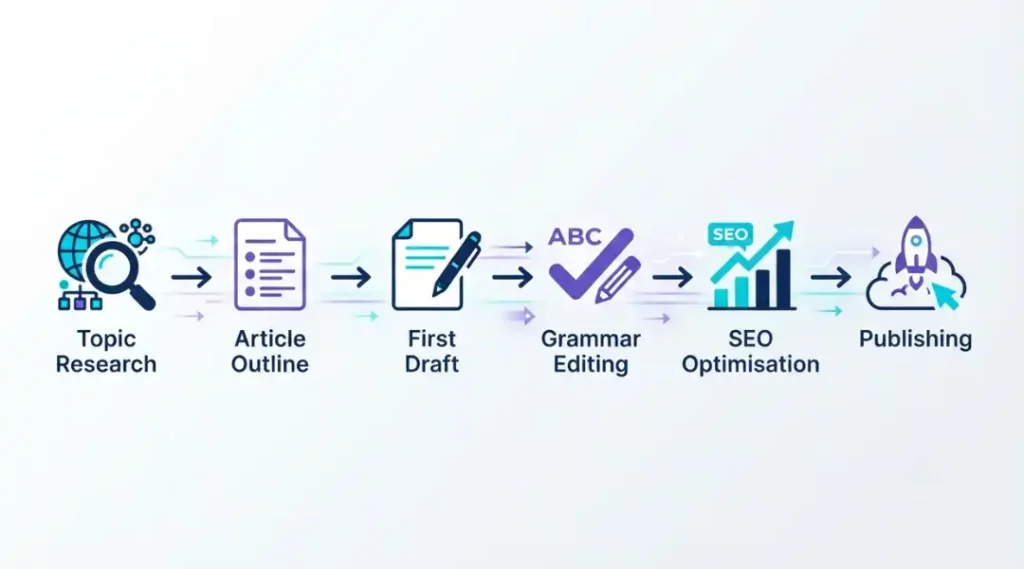
A Simple AI Blog Writing Workflow
You do not need seven subscriptions to publish better blog posts. A small combination of tools can cover most writing requirements.
Here is a practical workflow:
Step 1: Research the topic
Understand the search intent, target audience, and questions readers want answered. Collect information from official websites and trustworthy sources.
Step 2: Prepare the outline
Use ChatGPT or Gemini to develop an article structure. Review the headings and remove sections that do not answer the reader’s question.
Step 3: Create the first draft
Use your preferred AI assistant to help develop the article section by section. Include examples, useful explanations, and original insights.
Step 4: Edit the content
Review the draft using Grammarly or your preferred editor. Remove repetitive sentences and correct unclear explanations.
Step 5: Optimise for SEO
Use Surfer or another suitable SEO platform to identify missing topics and content gaps. Add only relevant information that improves the article.
Step 6: Fact-check and publish
Verify product details, statistics, quotes, external links, and technical claims. Add appropriate internal links, images, metadata, and structured data before publishing.
This workflow makes AI a useful writing partner while keeping editorial decisions in human hands.
Can AI-Written Blog Posts Rank on Google?
Yes. Content created with AI assistance can appear in Google Search. However, using AI does not automatically improve search rankings.
Google’s guidance focuses on helpful, reliable, people-first content. Automatically generating large quantities of pages without adding value can violate its scaled content abuse policies.
To create useful AI-assisted blog posts:
Add original information and practical examples.
Verify facts using reliable sources.
Explain the topic more clearly than a generic AI response.
Demonstrate genuine subject knowledge.
Avoid publishing repetitive or mass-produced articles.
Make sure the content satisfies the reader’s search intent.
The important point is not whether you used AI. It is whether the finished article genuinely helps the reader.
Frequently Asked Questions
ChatGPT, Jasper, Grammarly, Writesonic, Surfer, Google Gemini, and Notion AI are useful options. The best choice depends on whether you need article generation, editing, SEO optimisation, or content organisation.
ChatGPT and Google Gemini are good starting points for general writing assistance. Grammarly also offers writing support with free-plan limitations. Check the current plans because usage limits and included features can change.
Yes. AI tools can generate complete first drafts, including introductions, headings, and conclusions. However, you should review the article, verify information, add original insights, and improve the writing before publishing.
ChatGPT can help with article outlines, keyword variations, title suggestions, meta descriptions, and content improvements. However, it does not guarantee search rankings or replace dedicated keyword research and SEO analysis.
No. Most individual bloggers can start with one general AI assistant and one editing tool. Add a specialised SEO platform only when your publishing workflow requires it.
AI can automate parts of the writing process, but original experience, personal opinions, expert knowledge, and audience understanding remain important. Bloggers who use AI thoughtfully can save time while maintaining their unique perspective.
Final Thoughts
The best AI writing tools for bloggers are the ones that solve real problems in your content workflow. ChatGPT is a flexible starting point, Grammarly helps improve writing quality, and Surfer supports SEO optimisation. Jasper, Writesonic, Gemini, and Notion AI offer additional capabilities for different publishing needs.
Start with one tool, test it on a real article, and measure how much time it saves. Most importantly, bring your own knowledge and ideas into every article. That is what makes your blog valuable to readers.