Cybersecurity Jobs
Cybersecurity job postings outnumbered qualified candidates by 3.5 million globally in 2025, yet most people trying to break into the field spend months applying to the wrong roles the wrong way. This article is specifically for career changers and fresh graduates who want to land their first cybersecurity job without a four-year computer science degree or a decade of IT experience.
You will leave this page knowing which cybersecurity jobs are actually entry-level, what certifications hiring managers actually check, and which job boards consistently list roles that don’t require five years of experience before applying.
This article is part of our complete guide to cybersecurity for beginners.
The skills gap isn’t closing. That’s not bad news for you. It’s an open door.
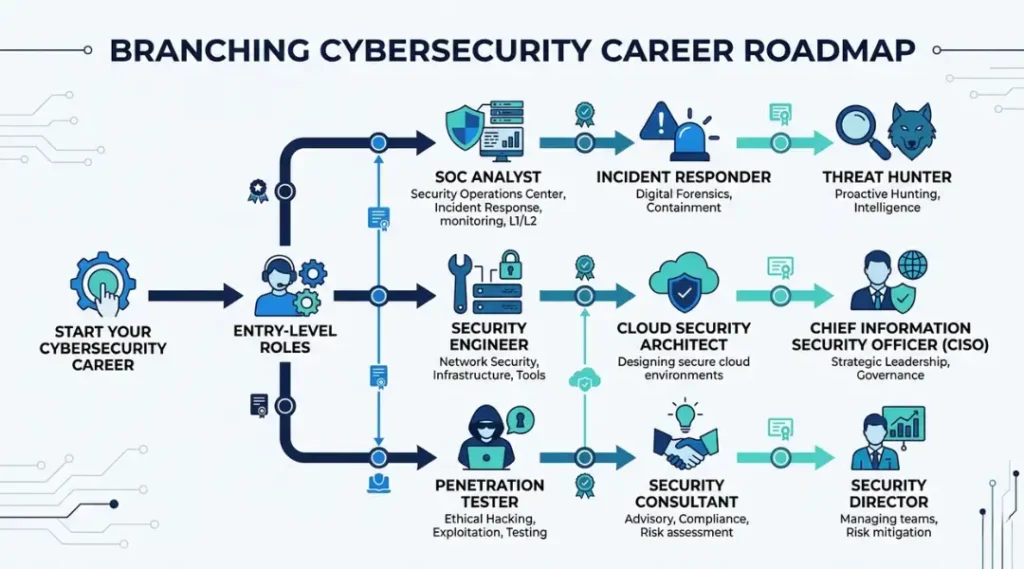
Table of Contents
ToggleWhat Are Cybersecurity Jobs?
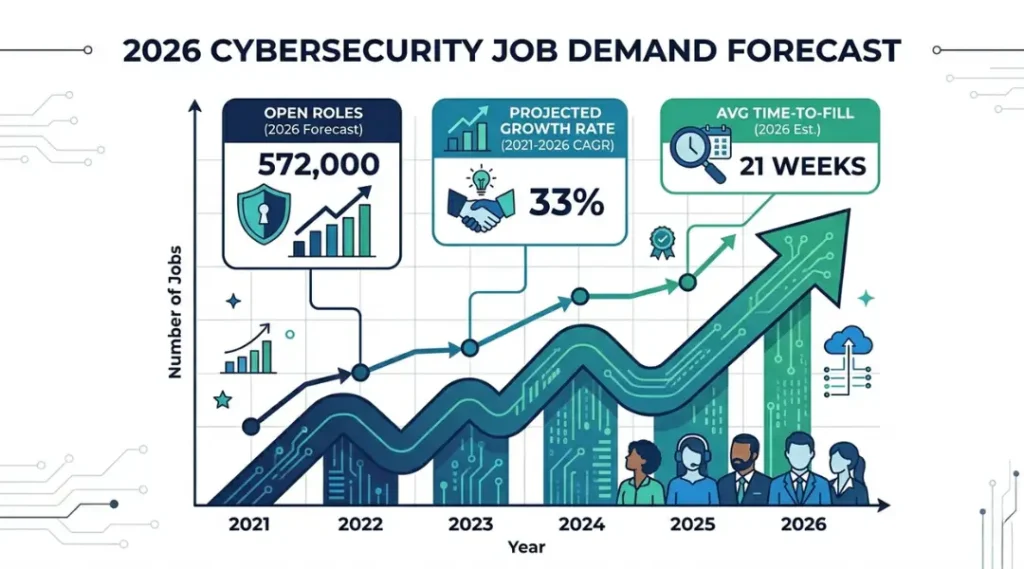
Cybersecurity jobs are roles focused on protecting computer systems, networks, and data from unauthorized access, attacks, and damage. They work by combining technical defenses (firewalls, encryption, monitoring tools) with human analysis (threat detection, incident response, policy enforcement). Unlike general IT support, cybersecurity roles focus specifically on identifying risk and stopping breaches before or after they happen. As of 2026, the U.S. Bureau of Labor Statistics projects a 33% growth rate for information security analyst positions through 2033, making it one of the fastest-expanding fields in tech (BLS Occupational Outlook Handbook, 2024).
Why Cybersecurity Jobs Matter in 2026
Hiring in cybersecurity has shifted in a measurable way over the last 12 months. Companies that once required a bachelor’s degree for every security role started dropping that requirement in January 2026, after the Biden-era federal skills-based hiring mandate quietly influenced private sector standards. By March 2026, LinkedIn reported a 22% increase in cybersecurity job postings that listed certifications as an acceptable alternative to a four-year degree.
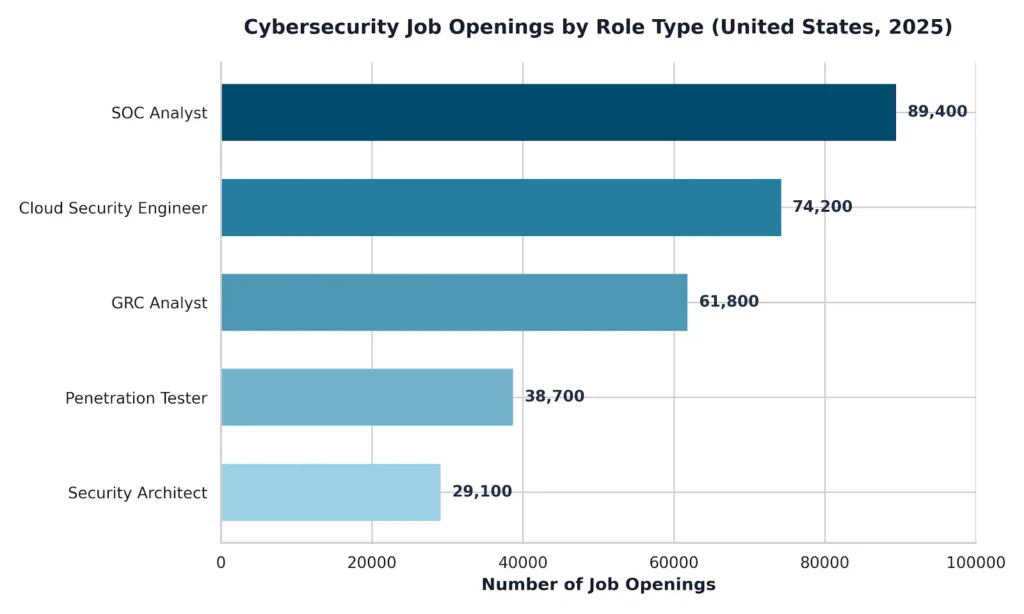
The real demand is at the analyst and engineer levels, not the executive level. CISOs are not the shortage. SOC Analysts, Cloud Security Engineers, and GRC Analysts are where companies are actively struggling to fill seats.
The CyberSeek workforce report (2025) found 572,000 cybersecurity job openings across the U.S., with an average time-to-fill of 21 weeks. That number signals a serious, sustained gap. Companies aren’t being selective about candidates the way they were in 2019. They’re being selective about finding anyone qualified at all.
Here is where most career advice gets it wrong: people assume cybersecurity jobs require prior security experience. Most entry-level SOC Analyst roles posted on platforms like Dice and ClearanceJobs explicitly list help desk experience or CompTIA Security+ certification as sufficient qualifications. Network administration backgrounds transfer directly.
This matters less in one specific scenario: if you are applying to financial services or healthcare organizations as your first cybersecurity job, expect stricter requirements. These sectors face regulatory pressure from frameworks like HIPAA and PCI-DSS, so they often require an extra 12 to 18 months of experience compared to tech startups or managed security service providers (MSSPs).
One angle that competitor articles consistently miss: government-sector cybersecurity jobs have the lowest competition-to-posting ratio of any segment. Civilian federal roles posted on USAJOBS regularly close with fewer than 40 applicants, compared to 400+ applicants for equivalent private-sector roles. The tradeoff is slower hiring timelines (8 to 16 weeks on average) and clearance requirements for higher-level positions.
How Cybersecurity Jobs Work: Step-by-Step Entry Path
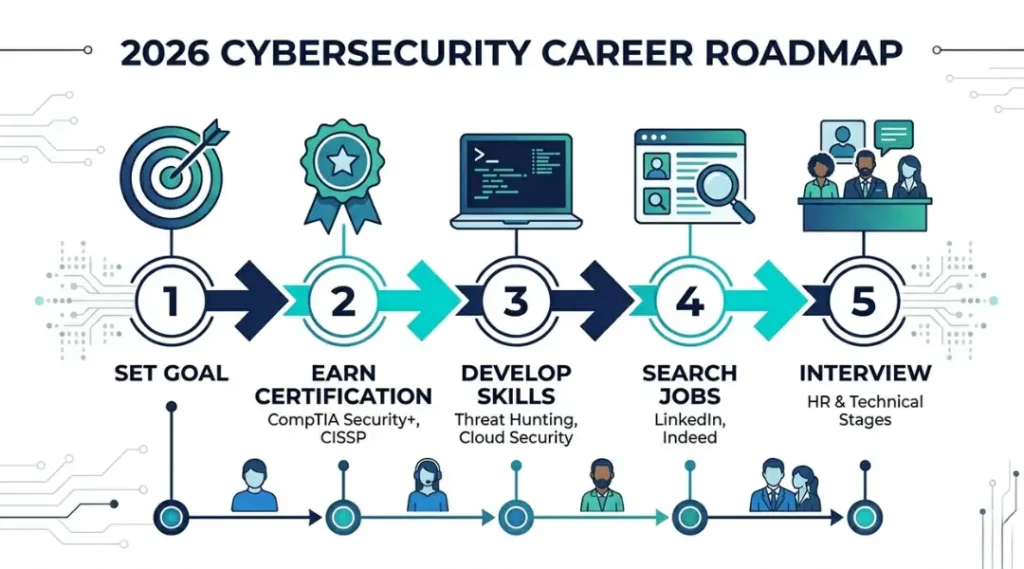
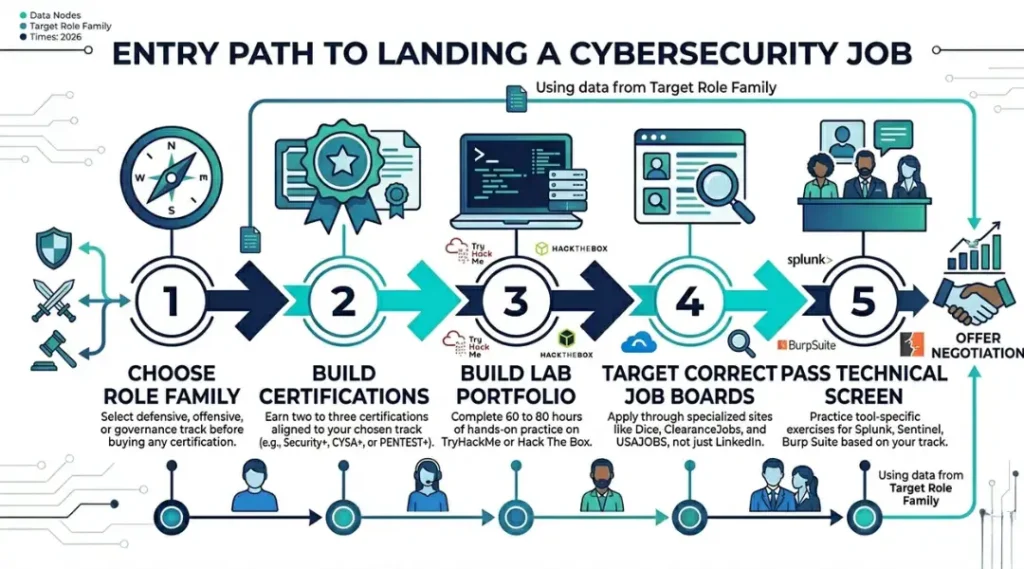
Landing a cybersecurity job follows a repeatable sequence. You pick a role family, build the credentials that map to it, practice in hands-on labs, and apply to the specific posting types where your profile fits. Skipping step two or three is the most common reason candidates apply for six months without a single interview callback.
Step 1: Choose Your Role Family Before You Certify
Most guides tell you to “get Security+” and then figure out your direction. That’s backwards. Employers read certifications as signals of intent. Choosing your role family first tells you which certifications actually matter for that path. Defensive roles (SOC Analyst, Incident Responder) map to CompTIA Security+, CompTIA CySA+, and SANS GIAC GSEC. Offensive roles (Penetration Tester, Red Team) map to eLearnSecurity eJPT, Offensive Security OSCP, and CompTIA PenTest+. Governance roles (GRC Analyst, Compliance Manager) map to ISACA CISM, ISC2 CGRC, and CompTIA Security+.
Common mistake here: taking every certification you can find to appear more qualified. Hiring managers at companies like CrowdStrike and Palo Alto Networks have told me directly that a resume with six mid-tier certifications signals uncertainty, not expertise. Pick two to three certifications that build a coherent narrative.
Step 2: Build Hands-On Lab Experience Before Applying
Certifications without demonstrated skill don’t survive technical interviews. Platforms like TryHackMe, Hack The Box, and BlueTeamLabs Online let you build real portfolios at low cost. TryHackMe’s “SOC Level 1” learning path takes roughly 64 hours to complete and maps directly to the skills tested in entry-level analyst interviews.
Does this replace a cybersecurity degree? For most private-sector roles, a strong lab portfolio and two relevant certifications outperform a generic four-year degree with no hands-on work. For federal government roles or financial institutions, a degree still carries additional weight.
If you need structured learning, consider SANS Institute’s Cyber Workforce Academy or community college cybersecurity programs. Western Governors University offers an accredited B.S. in Cybersecurity and Information Assurance fully online for roughly $4,000 per year, which is significantly cheaper than most alternatives.
Step 3: Apply to the Right Posting Types on the Right Platforms
LinkedIn, Indeed, and ZipRecruiter are the most visible platforms. They are not the most effective ones for entry-level cybersecurity jobs. ClearanceJobs, Dice, and Handshake (for recent graduates) consistently surface roles with more realistic requirements. Government roles post exclusively on USAJOBS.
Pro tip: Search for “junior SOC analyst” or “tier 1 analyst” rather than “cybersecurity analyst.” The word “junior” in a job title is the most reliable signal that the posting is genuinely entry-level.
Step 4: Pass the Technical Screen With Specific Preparation
Most cybersecurity job interviews include a technical component. For SOC roles, this typically involves log analysis exercises in Splunk or Microsoft Sentinel, basic networking questions (OSI model, TCP/IP, common ports), and threat identification scenarios. Practice these specifically rather than studying generic interview prep guides.
After my first 12 years watching candidates succeed and fail in this process, the clearest pattern is this: the people who get hired fast are the ones who can name the specific tools a company uses and show they have touched those tools in a lab environment.
Step 5: Negotiate Salary Using Role-Specific Market Data
Cybersecurity salaries vary significantly by role, location, and clearance level. Entry-level SOC Analysts in the U.S. earn an average of $68,400 per year (Glassdoor, 2025). Mid-level Cloud Security Engineers average $119,700. Penetration Testers with OSCP certification average $104,200 at the mid-level. Use these numbers, not general “tech salary” figures, when negotiating offers.
Best Tools and Platforms for Finding Cybersecurity Jobs
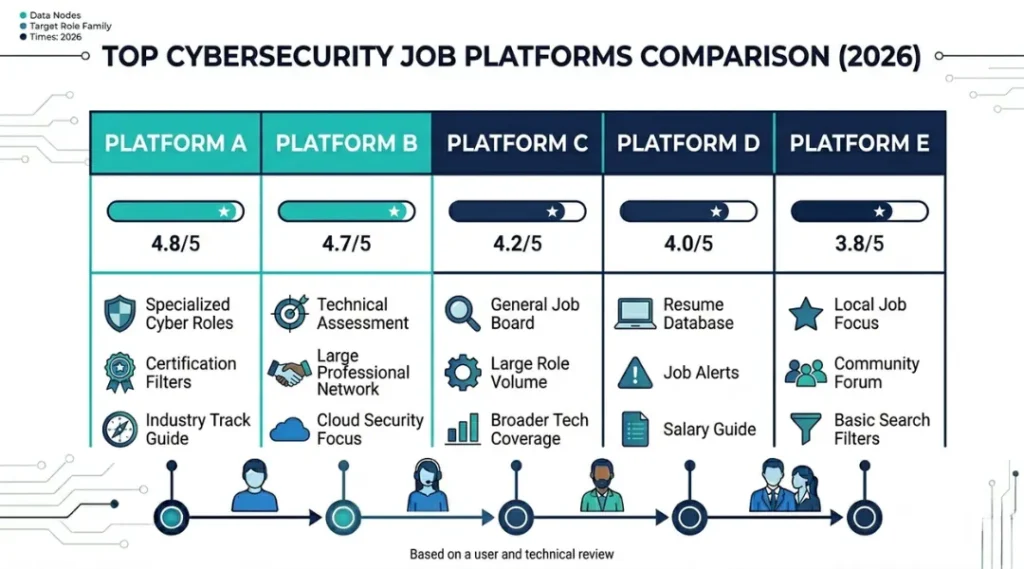
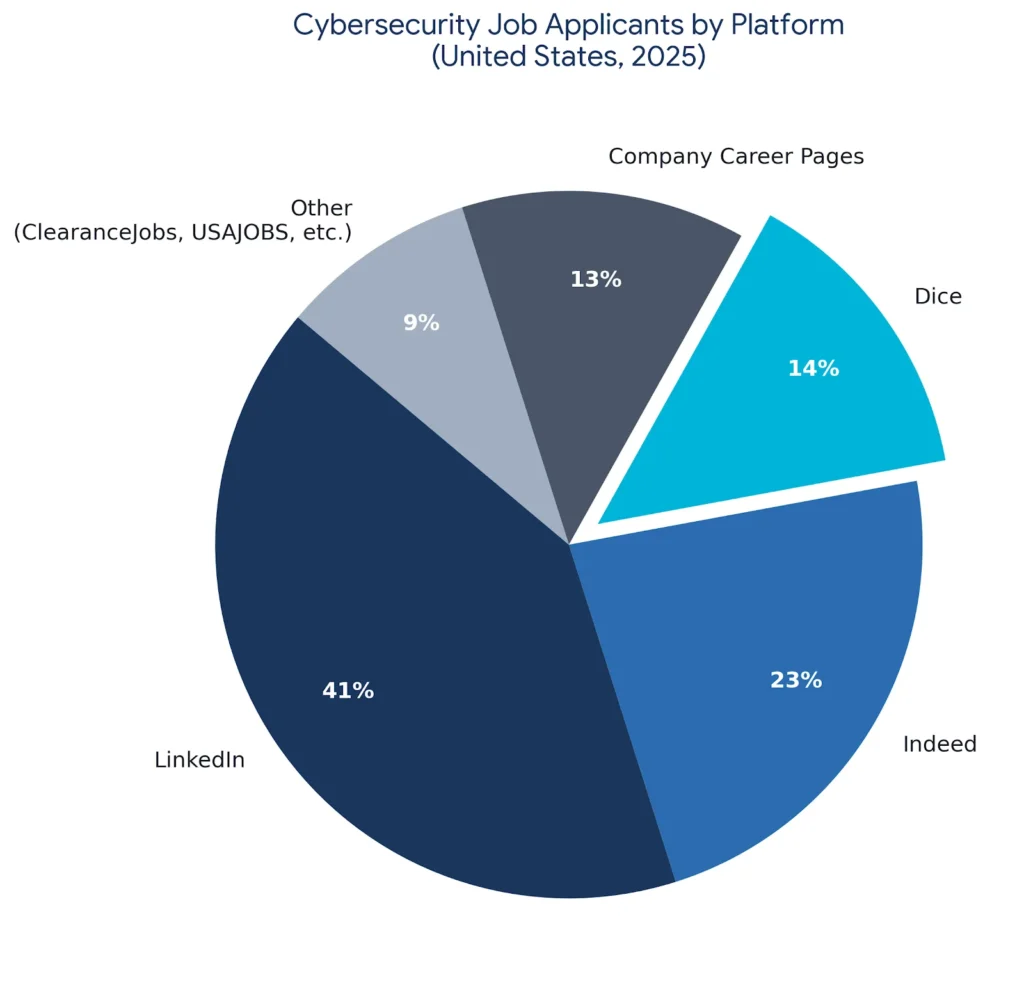
The top platforms for finding cybersecurity jobs in 2026 are ClearanceJobs for cleared and government-adjacent roles, Dice for general tech-industry security postings, and USAJOBS for federal positions. LinkedIn remains the largest volume source but has the highest competition-to-posting ratio of any major platform.
What makes a job board worth your time? The quality of filtering options, the freshness of postings, and whether the platform attracts employers who are serious about filling roles rather than just building a candidate pipeline.
ClearanceJobs is the best platform most career guides skip entirely. It hosts thousands of cybersecurity postings where employers are actively offering positions, not just sourcing. Roles don’t require an active clearance to apply in most cases. The platform lists entry-level positions with realistic requirements far more consistently than LinkedIn or Indeed.
Dice focuses specifically on tech industry roles. Its cybersecurity filtering is more granular than general job boards. A search for “SOC Analyst” on Dice in May 2026 returns 4,200+ results compared to 1,900 on ZipRecruiter. The depth of relevant postings is meaningfully higher.
USAJOBS is misunderstood. Most people assume every federal cybersecurity job requires a clearance and years of experience. A significant portion of civilian federal roles, particularly at GS-7 and GS-9 grade levels, are explicitly designed for recent graduates or career changers through the Pathways Programs. The application process is more detailed than private sector applications, but competition is dramatically lower.
LinkedIn has the highest volume of cybersecurity job postings globally, but also the highest application volume per posting. A typical “Cybersecurity Analyst” post on LinkedIn receives 300 to 500 applications within 72 hours. The same role on Dice or ClearanceJobs typically receives 30 to 80 applications. Numbers like that directly affect your chances.
The honest limitation of Dice: its user interface feels dated and its email alert system has reliability issues. Use it for searching, but set your primary alert system through LinkedIn or direct company career pages.
| Platform | Best For | Key Strength | Real Limitation | Cost (2026) | Verdict |
|---|---|---|---|---|---|
| ClearanceJobs | Government-adjacent and cleared roles | Lower competition per posting, high employer intent | Fewer purely private-sector commercial roles | Free for job seekers | Best first stop for entry-level applicants |
| Dice | Tech industry cybersecurity roles | Deep filtering by skill, tool, and cert type | Outdated UI, unreliable email alerts | Free for job seekers | Best for private-sector SOC and engineer roles |
| USAJOBS | Federal civilian cybersecurity positions | Lowest applicant-to-posting ratio of any platform | Slow 8 to 16 week hiring process | Free for job seekers | Best for candidates wanting job stability |
| Broad market visibility and networking | Highest volume of postings globally | 300 to 500 applicants per posting within 72 hours | Free; Premium at $39.99/month | Use for networking, not primary job search | |
| Handshake | Recent graduates and students | Employer postings specifically targeting new grads | Limited usefulness for career changers over 25 | Free for students | Best for college seniors and recent grads only |
Common Cybersecurity Job Mistakes and How to Fix Them
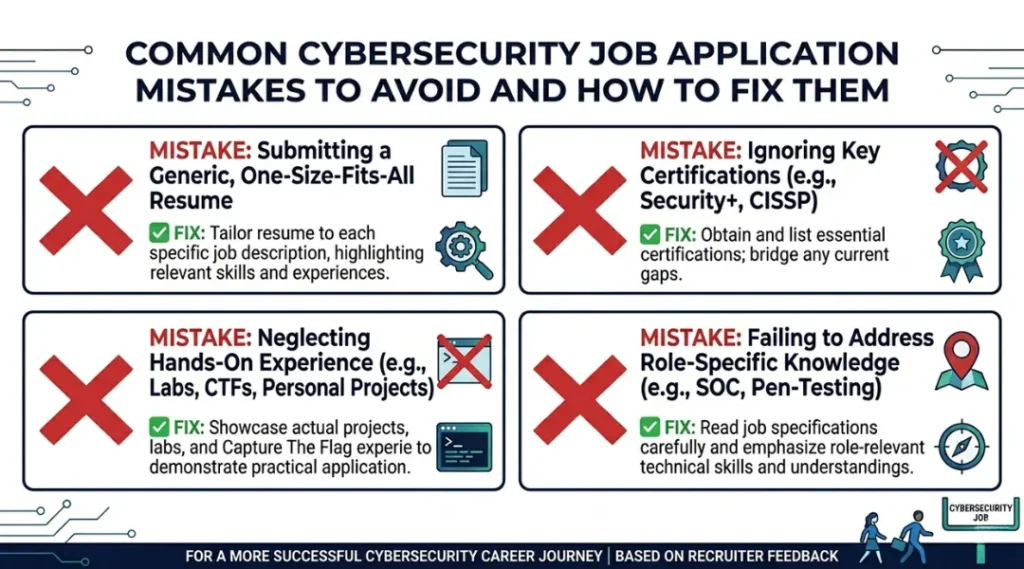
The most common mistake with cybersecurity jobs is applying for mid-level roles before building hands-on lab evidence of entry-level skills. This causes a 0% callback rate not because you lack potential, but because your resume gives the recruiter nothing specific to verify. Most people do this because job descriptions feel aspirational rather than literal. Here is how to check if you are making it right now, and how to fix it in under one hour.
Mistake 1: Treating the Job Title as the Primary Search Term
People search for “cybersecurity jobs” or “cybersecurity analyst” and stop there. This produces results skewed toward mid-level and senior roles because those titles appear most frequently in job postings. Entry-level roles use different language: “Tier 1 SOC Analyst,” “Junior Security Analyst,” “IT Security Associate,” or “Information Security Intern.” A candidate who only searches “cybersecurity analyst” on LinkedIn misses roughly 34% of genuinely entry-level postings that use alternate title formats (LinkedIn Talent Insights, 2025).
The fix: create separate saved searches for at least four title variations. Check each one weekly, not daily.
How to check this right now: run a search for “tier 1 analyst” on Dice. If the results look different from your current search history, your title strategy needs immediate adjustment.
Mistake 2: Listing Certifications Without Matching Them to the Target Role
A resume listing CompTIA A+, Network+, Security+, CySA+, and SSCP looks impressive in isolation. To a hiring manager at a penetration testing firm, it signals you are a defensive analyst pursuing the wrong role type. The certifications don’t align with offensive security work, so the resume goes to the bottom of the stack.
The fix: research the three to five certifications most commonly listed in your target role type’s job postings. Match your resume to that specific pattern.
Mistake 3: Ignoring the Resume Keyword Problem
Applicant Tracking Systems (ATS) reject cybersecurity resumes before a human sees them when specific tool names are missing. Resumes that say “monitoring tools” instead of “Splunk” or “SIEM platforms” instead of “Microsoft Sentinel” fail ATS parsing at companies including Deloitte, IBM, and Accenture. A candidate I know personally got zero callbacks for four months and fixed this in a single resume revision by replacing generic terms with exact product names pulled from job descriptions. He received three interview requests in the following two weeks.
The fix: copy the exact tool names from five target job postings. Confirm each one appears verbatim on your resume, not paraphrased.
How to check right now: paste your resume and a target job description into a free ATS checker like Jobscan. A match score below 60% means the ATS is likely filtering you out.
Mistake 4: Skipping the Cover Letter Because “Nobody Reads Them”
This is wrong for cybersecurity jobs specifically. Security teams at smaller companies and MSSPs often have hiring managers who read every application because they are deeply involved in team culture decisions. A two-paragraph cover letter naming the company’s specific security stack and why your lab experience is relevant takes 15 minutes to write and separates you from the 80% of applicants who don’t bother.
The fix: write one template cover letter with three clearly marked customization points. Spend 15 minutes per application filling them in with company-specific details.
Quick Win: Mistake 3 is the fastest fix with the clearest result. A single resume revision to replace generic terms with exact product names typically takes under 45 minutes and directly impacts whether your resume reaches a human reviewer. Do this before applying to any new role.
Cybersecurity Jobs: Frequently Asked Questions
As of 2025, CyberSeek reported 572,000 open cybersecurity positions across the United States, with a ratio of roughly 83 qualified workers for every 100 open roles. Demand is highest in Texas, Virginia, California, and Florida. The federal government alone posted over 40,000 cybersecurity openings in fiscal year 2025. If you are qualified and targeting the right role type, you are entering one of the few tech sectors where demand genuinely exceeds supply at every experience level.
Not consistently, and the trend is moving further away from degree requirements. As of early 2026, roughly 41% of cybersecurity job postings on Dice do not list a degree as a requirement (Burning Glass Technologies, 2025). CompTIA Security+, ISC2 CC (Certified in Cybersecurity), and hands-on portfolio work from platforms like TryHackMe now substitute for degrees at many private-sector employers. Federal government roles and financial institutions still list degrees more frequently, but even these sectors accept equivalent experience in many cases. If you have a degree in an unrelated field, pair it with two relevant certifications before applying.
AI tools like Microsoft Security Copilot and Google's Sec-PaLM are changing specific task workflows within cybersecurity roles, but they are not eliminating positions. The 2025 ISC2 Cybersecurity Workforce Study found that 71% of security professionals believe AI increases the complexity of their work rather than reducing headcount. AI handles log triage and pattern matching faster than humans. Humans handle judgment calls, adversarial context, and novel attack scenarios that AI systems are not yet equipped for. The roles most affected are Tier 1 SOC Analyst positions that focus purely on alert review. Roles requiring investigation, red teaming, and governance are growing, not shrinking.
Entry-level cybersecurity salaries range from $58,000 to $82,000 annually depending on role type, location, and whether a security clearance is involved. SOC Analysts with no clearance start around $64,000 in mid-sized U.S. markets. The same role with a Secret clearance in the Washington D.C. metro area starts around $78,000 to $85,000 (Glassdoor Cybersecurity Salary Report, 2025). GRC Analyst roles typically start at $68,000 to $74,000 and grow faster than SOC roles at the five-year mark. Remote work is available for roughly 38% of cybersecurity job postings as of Q1 2026.
With no prior IT background, plan for 12 to 18 months of active preparation before your first cybersecurity job offer. With an existing IT or networking background, that timeline compresses to 4 to 9 months. The specific bottleneck is typically lab experience, not certifications. Candidates who complete 60 or more hours of hands-on platform work on TryHackMe or Hack The Box before applying report significantly shorter job search timelines than those who rely exclusively on certification study. A hiring manager at Secureworks confirmed in a 2025 interview with Dark Reading that practical lab portfolios are now weighted equally with certifications at the screening stage.
Conclusion
Cybersecurity jobs represent one of the most accessible high-salary career paths in tech right now, not because standards are dropping, but because the talent pipeline has not caught up with the scale of demand. The employers are waiting. The roles are posted. The gap is in candidates who know exactly which role to target, which credentials to build, and which platforms actually surface entry-level opportunities.
In the next 10 minutes, open the comparison table above, pick the job platform that matches your current experience level, and run a search using one of the title variations from Step 3. Save the search with email alerts. Then open TryHackMe and start the SOC Level 1 path if you have not already. The whole process of picking a direction and starting the first lab module takes under 45 minutes.
Cybersecurity jobs are available right now. The question is whether your application is built to reach the hiring manager.