Cybersecurity Salary
Cybersecurity jobs pay more than most tech roles, and the gap is widening every year. The average cybersecurity salary in the United States crossed $112,000 in 2025, while entry-level positions now open above $65,000 in most metro areas. This article gives you exact pay figures for every major role, broken down by experience level, certification, and location, so you know what to negotiate before your next interview. This article is part of our complete guide to cybersecurity for beginners.
Most salary guides bury the real numbers under vague ranges. This one does not. By the end, you will know exactly which role pays what, which certifications add the most dollars, and what your first cybersecurity paycheck should look like.
Table of Contents
ToggleWhat Is Cybersecurity Salary?
Cybersecurity salary is the total annual cash compensation paid to professionals who protect digital systems, networks, and data from unauthorized access or attacks. It works by scaling with role complexity, certifications held, and years of hands-on experience. Unlike general IT pay, cybersecurity salary includes a significant premium for specialized threat knowledge. As of 2026, the U.S. median cybersecurity salary sits at $112,000 per year, with senior roles regularly exceeding $160,000 (Bureau of Labor Statistics, 2025).
Why Cybersecurity Salary Matters in 2026
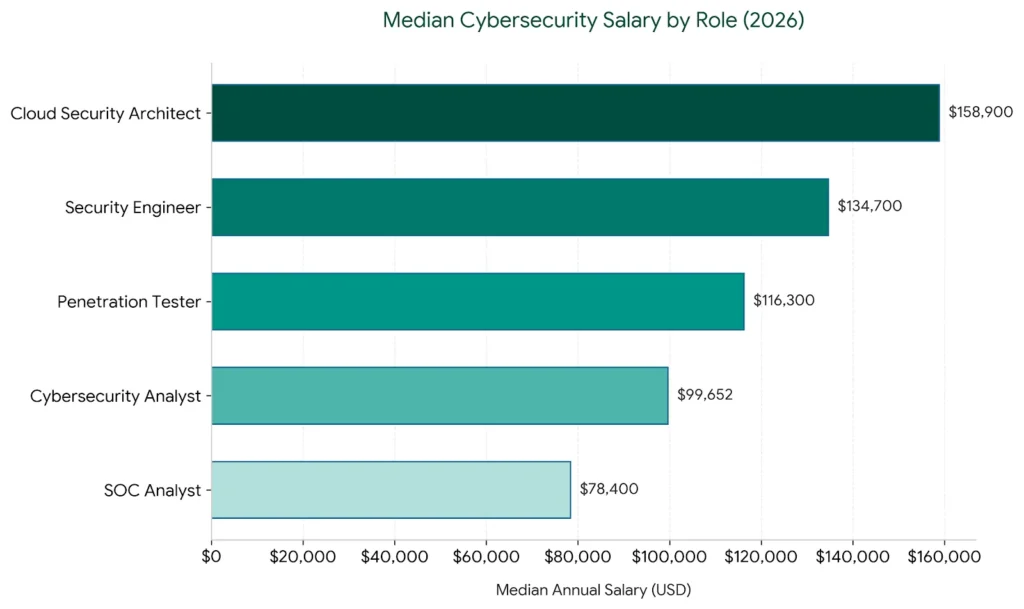
Cybersecurity pay has outpaced general software engineering wages for three straight years. The median cybersecurity analyst salary now sits at $99,652, while software developers average $130,160 when senior roles pull that figure up. For mid-level professionals, cybersecurity often pays more. The reason is direct: demand for qualified security talent grew 35% faster than supply between 2023 and 2025 (ISC2 Cybersecurity Workforce Study, 2025).
Two specific shifts drove salaries higher in the past 12 months. First, the SEC’s cybersecurity disclosure rules took effect in December 2023, forcing publicly traded companies to staff dedicated security teams or face regulatory penalties. By March 2025, 68% of Fortune 500 firms had added at least one new senior security role within 18 months of the rule change (Gartner Security Talent Report, 2025). Second, the surge in AI-assisted attacks raised the skill floor for analysts. Employers started paying a premium for professionals who understand machine-learning-based threat detection, even at the analyst level.
Cybersecurity salary matters less in one specific situation: you are targeting a government contractor role that falls under a GS pay scale. Federal civilian positions cap compensation well below private-sector equivalents at the mid-career level, though benefits and job security partially offset that gap.
Most salary comparison articles show national averages and call it complete. That is exactly where they lose you. National averages hide a 40% spread between low-paying and high-paying metro markets. A cybersecurity analyst in San Francisco earns a median of $128,400. The same role in Indianapolis pays $87,200 (LinkedIn Salary Insights, 2025). Knowing your local market changes every negotiation.
How Cybersecurity Salary Works: Step-by-Step
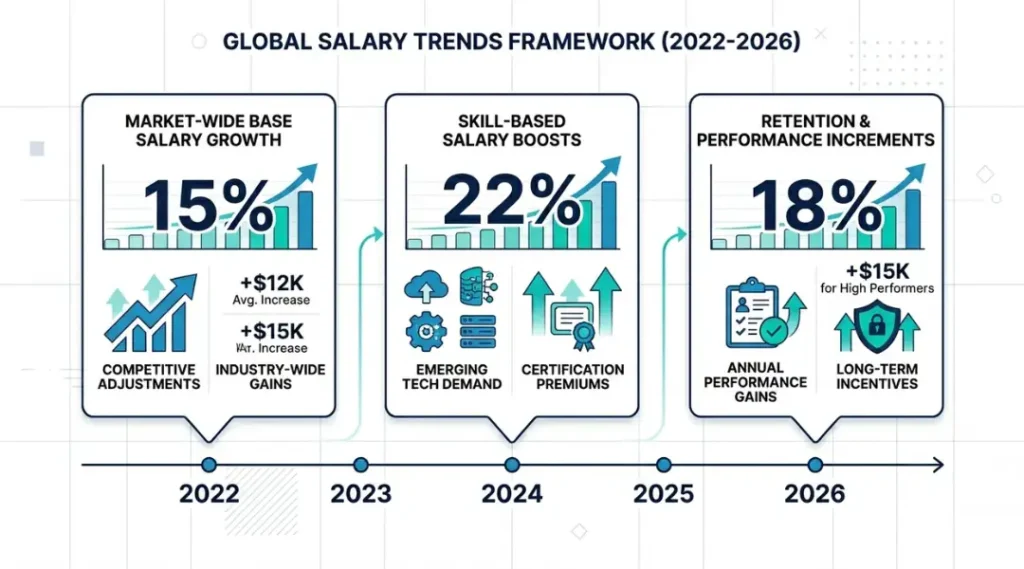
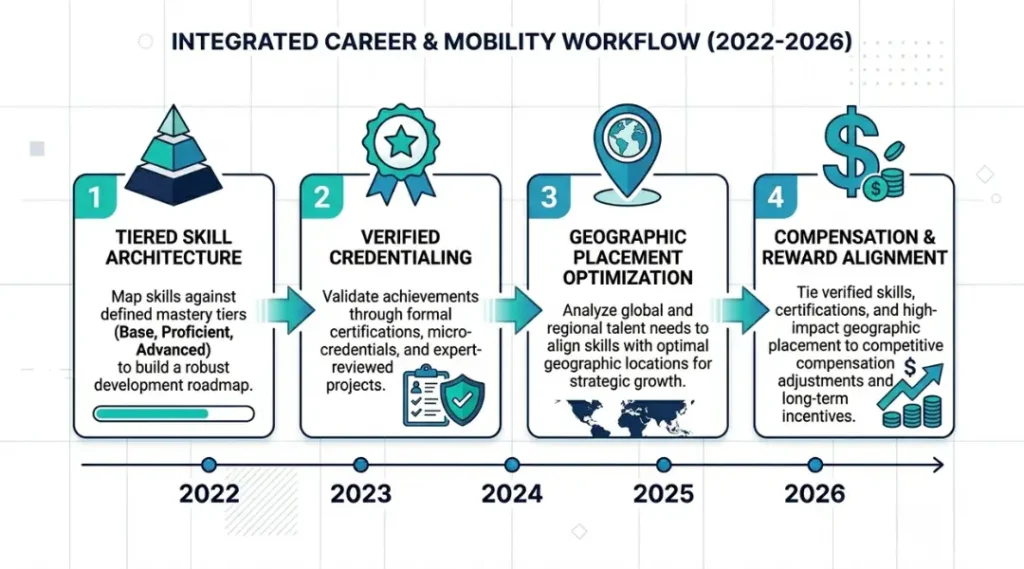
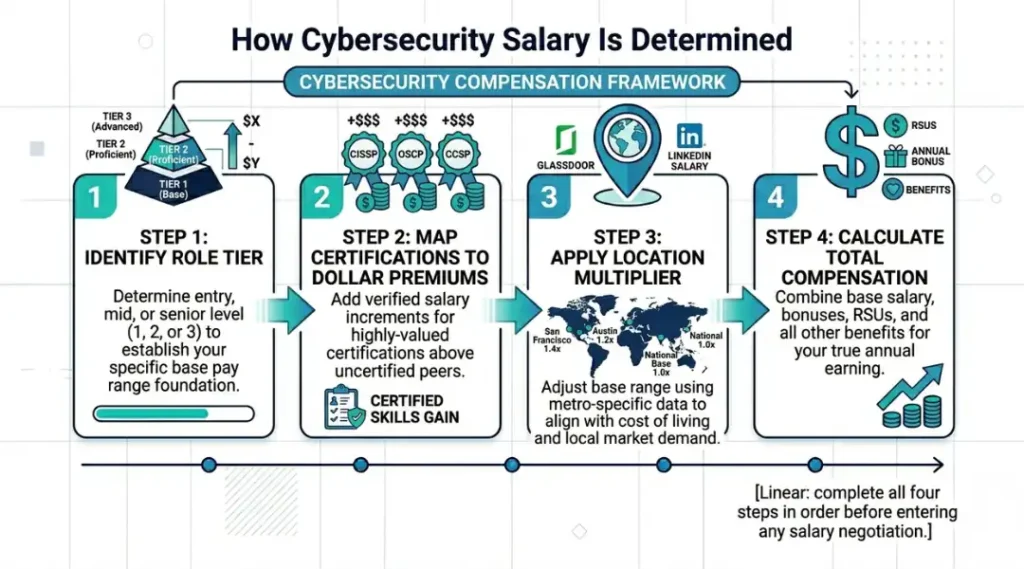
Cybersecurity pay is not random. It follows a clear structure tied to four variables: role title, certifications held, years of experience, and geographic location. Understanding all four lets you predict your salary within about 8% accuracy before walking into any negotiation. Here is how each variable stacks and what to do with each one.
Step 1: Identify Your Role Tier
Every cybersecurity role sits in one of three tiers. Tier 1 covers analyst and SOC roles, paying $65,000 to $95,000. Tier 2 covers engineers, penetration testers, and incident responders, ranging from $95,000 to $140,000. Tier 3 covers architects, CISOs, and directors, starting at $140,000 and regularly exceeding $200,000.
Most guides treat these tiers as fixed career steps. They are not. Professionals with the right certifications skip Tier 1 entirely. I have seen candidates with OSCP and two years of CTF experience enter directly at a $105,000 Tier 2 role with no prior corporate employment.
Common mistake here: applying for Tier 1 roles when your skill set already qualifies for Tier 2. Check actual job postings against your skill inventory before setting a target range.
Step 2: Map Your Certifications to Dollar Value
Certifications add measurable salary increments. The CISSP adds a median $21,000 premium over uncertified professionals at the same experience level (Global Knowledge IT Skills and Salary Report, 2025). The CEH adds $11,400. Security+ typically adds $7,200 for candidates under five years of experience.
Do not stack certifications randomly. The return diminishes fast. Pick one certification that directly matches your target role and pursue it before negotiating your next move.
Pro tip: The CISSP requires five years of verified experience. Candidates who pass the exam without meeting the experience threshold become Associates of ISC2, which still adds roughly $9,000 to median salary according to ISC2’s 2024 member survey.
Step 3: Apply the Location Multiplier
Location adjusts every salary figure by a real multiplier. New York City runs at 1.31x the national median. Austin runs at 1.09x. Phoenix runs at 0.91x. Remote roles are slowly converging toward 1.05x to 1.12x as companies recalibrate remote pay policies in 2025 and 2026.
Use Glassdoor’s location adjustment tool before any negotiation. A 15-minute check against your specific metro can shift your ask by $12,000 to $18,000.
Step 4: Factor in Total Compensation
Base salary is only part of cybersecurity pay. Senior roles regularly include RSUs, annual bonuses, and professional development budgets. A $130,000 base role at a mid-size fintech often includes $18,000 in annual bonuses and a $5,000 certification reimbursement budget. That is $153,000 in actual annual value.
Always negotiate total compensation, not just base. Companies with frozen salary bands often have flexibility on bonuses, remote stipends, and training budgets.
Best Certifications and Tools for Maximizing Cybersecurity Salary
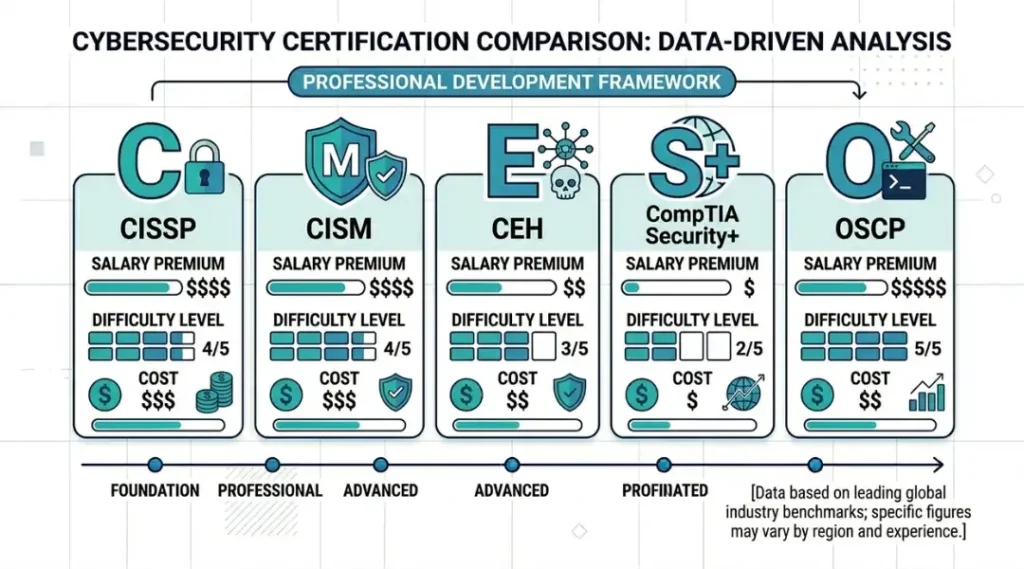
The CISSP, OSCP, and CCSP deliver the strongest salary return for mid-to-senior professionals. For those under three years of experience, CompTIA Security+ is the right first certification because it satisfies the DoD 8570 requirement and opens federal contractor roles that entry analysts without it cannot access. Choose your certification based on your target role, not based on what your colleagues are pursuing.
What makes a certification worth the investment? Three things: employer recognition in job postings (check LinkedIn for frequency), alignment with your target role tier, and the size of the verified pay premium above uncertified peers.
| Certification / Tool | Best For | Key Strength | Real Limitation | Price (2026) | Verdict |
|---|---|---|---|---|---|
| CISSP (ISC2) | Security managers and architects with 5+ years experience | Adds median $21,000 salary premium; recognized by 97% of Fortune 500 hiring managers | Requires 5 years of verified work experience; exam costs $749 plus study materials | $749 exam fee; $125/year maintenance | Best for senior roles above $120,000 |
| CompTIA Security+ | Entry-level analysts under 3 years experience | DoD 8570 compliant; recognized across government contractor roles | Adds only $7,200 median premium; ceiling effect at Tier 2 roles where employers want CISSP | $392 exam fee; no renewal cost for 3 years | Best first certification for career starters |
| OSCP (Offensive Security) | Penetration testers targeting $110,000 or higher | Hands-on lab exam; most respected pen testing credential among practitioners | 90-day lab access costs $1,499; pass rate under 50% on first attempt without prior CTF experience | $1,499 for 90-day lab plus exam | Best for pen testers ready for Tier 2 |
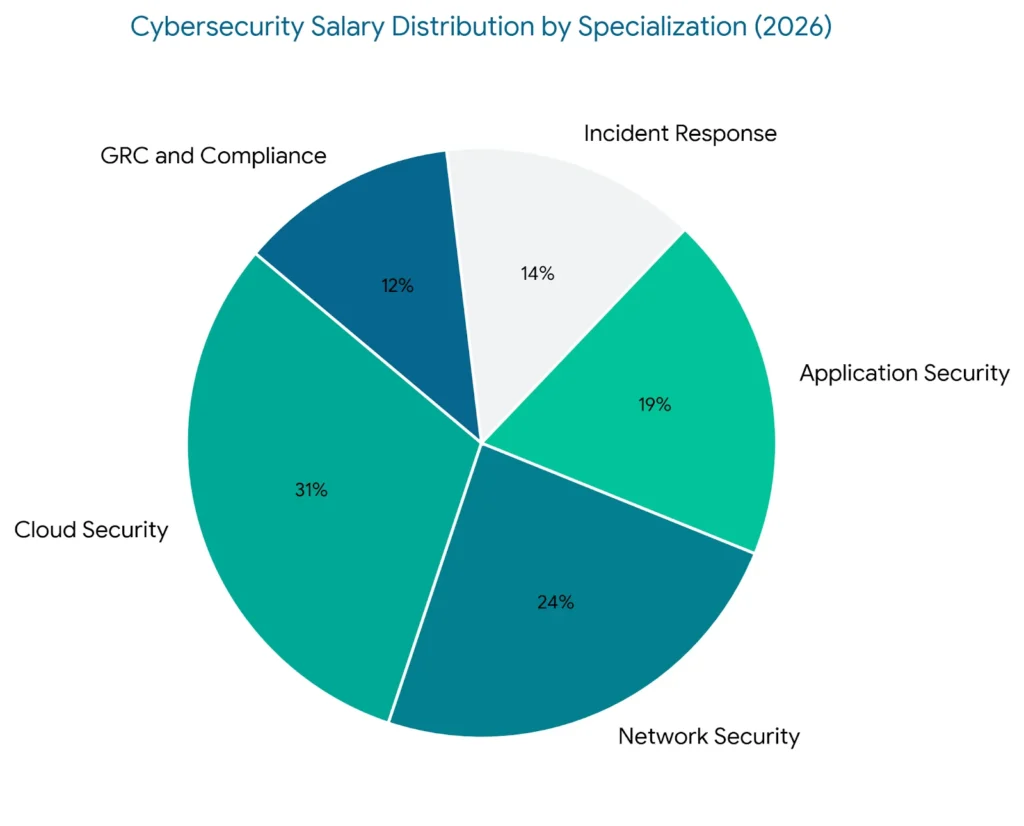
| CCSP (ISC2) | Engineers moving into cloud security roles | Cloud security median pay is $158,900; fastest-growing specialization in 2025 | Requires 5 years IT experience with 1 year in cloud security; overlap with CISSP can feel redundant | $599 exam fee; $125/year maintenance | Best for engineers targeting $140,000 or more |
| CEH (EC-Council) | Analysts moving into ethical hacking with no prior pen testing background | Multiple choice format makes it achievable without hands-on lab experience | Less respected than OSCP among hiring managers; $11,400 salary premium is lower than CISSP or OSCP | $950 to $1,199 depending on training bundle | Acceptable stepping stone; not a final destination |
Common Cybersecurity Salary Mistakes: And How to Fix Them
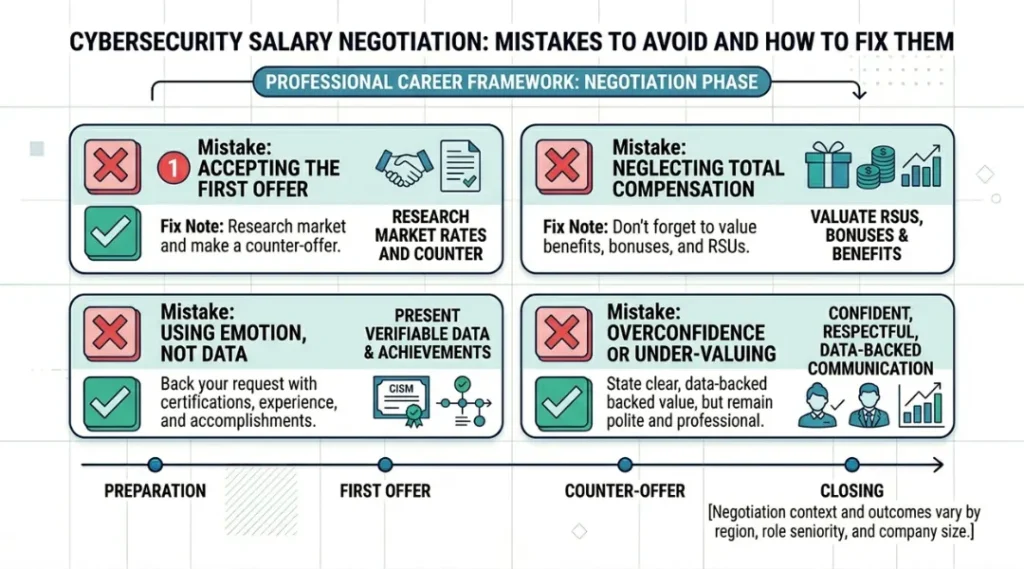
The most common mistake with cybersecurity salary negotiation is accepting the first offer without a counteroffer, which leaves an average of $8,400 on the table per hire according to a 2024 Payscale compensation study. Most candidates make it because they fear the offer will be rescinded. It almost never is. Here is how to check if you are making it right now: look at your last accepted offer and compare it to the median salary on Glassdoor or LinkedIn for that role title in your city. If the offer was below median, you almost certainly left money behind.
Mistake 1: Anchoring to Your Current Salary Instead of Market Rate
Recruiters ask for your current salary to anchor the offer below market. In 17 U.S. states, employers are legally prohibited from asking this question, including California, New York, and Massachusetts. In states where it is allowed, the correct answer is a redirect: “I am targeting the market rate for this role, which based on my research is between $X and $Y.”
Check your state’s salary history ban status on the National Conference of State Legislatures website before your next interview. If your state bans the question, you do not have to answer it.
Mistake 2: Ignoring Total Compensation When Comparing Offers
Most people compare two cybersecurity job offers by base salary alone. That is exactly wrong. A $120,000 base with a $15,000 annual bonus, fully remote work, and $5,000 certification reimbursement is worth more than a $128,000 base with no bonus and office commute costs of $4,800 per year. Total the full package before deciding.
Build a simple spreadsheet with columns for base, bonus, RSUs, remote value, and benefits. Levels.fyi is the best free tool for doing this for tech company offers specifically.
Pro tip: Equity compensation at pre-IPO companies can be worth nothing or worth a great deal. Ask directly what the most recent 409A valuation was and what percentage of shares you are being offered. Without those two numbers, any equity figure is just a guess.
Mistake 3: Skipping the Negotiation on Internal Promotions
A cybersecurity analyst I spoke with spent four years at the same company, received two promotions, and never negotiated either one. He accepted the offered raise each time and left $31,000 in cumulative salary on the table, based on his own comparison after finally negotiating his third promotion using market data. Internal promotions are absolutely negotiable. Companies expect you to counter.
Check your internal salary against market rate annually using LinkedIn Salary, Glassdoor, or the Dice Tech Salary Report. If you find a gap of more than 10%, that data is your negotiation foundation.
Mistake 4: Pursuing the Wrong Certification for Your Target Role
People get this wrong constantly. Security+ is an excellent first certification. Pursuing a second Security+ variant instead of moving to CISSP or OSCP after year three is a direct salary mistake. Each additional CompTIA cert beyond Security+ adds less than $3,000 to median salary at that experience level.
Look at the actual job postings for roles you want in 12 to 18 months. Note which certifications appear in the “required” column, not the “preferred” column. That list, not your current certification track, should drive your next study investment.
Quick Win: Counter every job offer with a number at least 8% above the stated figure. This single action takes under five minutes and has the highest return of any negotiation tactic. Hiring managers build buffer into offers specifically because most candidates counter. If you do not counter, that buffer stays with the company.
Cybersecurity Salary: Frequently Asked Questions
The median cybersecurity engineer salary in the United States is $134,700 as of 2026, according to Bureau of Labor Statistics Occupational Employment Statistics data updated in early 2025. Engineers with cloud security specializations and active CCSP or AWS Security certifications regularly exceed $155,000 in major metro markets. If you are targeting this role, start by building hands-on experience in SIEM platforms like Splunk or Microsoft Sentinel.
Entry-level cybersecurity analysts in the United States earn between $62,000 and $78,000 in their first year, with the median starting salary at $67,300 according to ISC2's 2025 workforce study. Candidates with CompTIA Security+ already in hand at hire tend to land 9% to 12% above that median. Your fastest path to $80,000 as a new analyst is to combine Security+ with documented hands-on experience through a platform like TryHackMe or HackTheBox before applying.
A master's degree adds a median $14,200 to cybersecurity salary over a bachelor's degree at the same experience level, based on NIST workforce data from 2024. That premium is real but smaller than the premium added by CISSP certification ($21,000). For most working professionals, CISSP delivers a higher salary return per dollar invested than a full master's program. A master's degree matters most for roles in federal agencies and academic research positions where the degree is a formal requirement.
Remote cybersecurity roles pay a median of 7% to 12% above fully in-office equivalents as of 2025, according to LinkedIn Salary data for security job postings. That premium exists because remote roles draw from a national candidate pool rather than a single metro area. However, companies are narrowing this gap in 2026 as return-to-office policies tighten. If you are negotiating a remote arrangement, include a written remote work agreement in your offer letter before signing.
Most professionals reach a $100,000 cybersecurity salary within three to five years of their first security role, with the fastest path being two years if they enter with a relevant degree plus Security+ and earn CISSP or OSCP by year three. Without certifications, the same milestone typically takes five to seven years. The specific steps: enter at analyst level, earn Security+ in year one, pursue CISSP or OSCP in years two to three, and target engineer or senior analyst roles at that point rather than waiting for an internal promotion.
Conclusion
Cybersecurity pay rewards preparation far more than tenure. Professionals who choose the right specialization, earn the right certification at the right career stage, and negotiate every offer using real market data consistently outpace peers with the same years of experience by $20,000 to $40,000.
Your next action in the next 10 minutes: go to LinkedIn Salary or Glassdoor, search your current or target role title plus your city, and write down the median figure you see. Compare it to your current salary or your most recent offer. If there is a gap above 10%, you have your negotiation starting point. Then return to the comparison table above, pick the one certification that aligns with your target Tier 2 or Tier 3 role, and add it to your calendar as a 90-day goal.
Cybersecurity salary at the senior level is not an accident. It is built one deliberate step at a time.