Google Cybersecurity Certificate
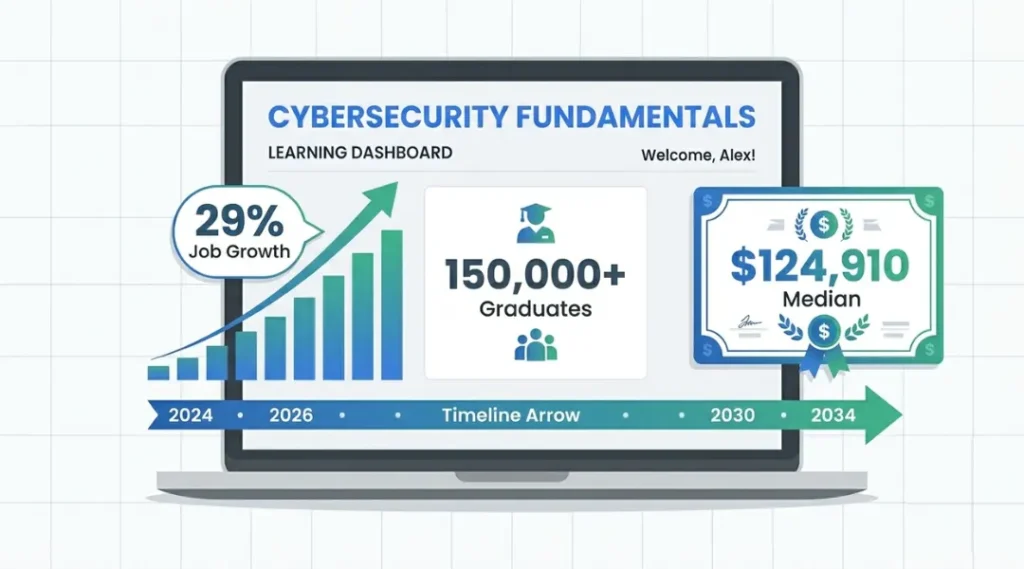
Over 150,000 people in the United States have already completed the Google Cybersecurity Certificate. That number matters because it tells you this credential has been stress-tested in real hiring markets, not just reviewed in theory.
The problem most beginners face is not a shortage of information about cybersecurity. It is figuring out which credential will actually move their resume from “ignored” to “interview scheduled.” This article covers the Google cybersecurity certificate from the inside: what it teaches, what it costs, which jobs it realistically leads to, and where it falls short.
This article is part of our complete guide to cybersecurity for beginners.
After reading this, you will know exactly whether to enroll today, wait and stack with CompTIA Security+, or skip it entirely based on where you are right now.
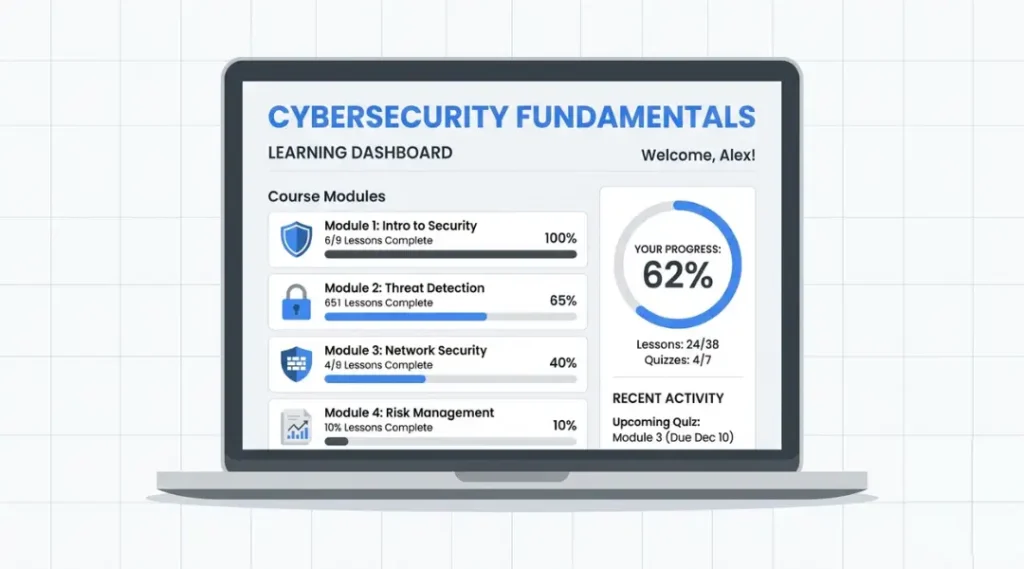
Table of Contents
ToggleWhat Is the Google Cybersecurity Certificate?
The Google Cybersecurity Certificate is an eight-course online program built and taught by active security practitioners at Google. It runs on Coursera, requires zero prior experience, and prepares graduates for entry-level roles like SOC Analyst and Cybersecurity Analyst.
It works by walking learners through hands-on labs using real tools: Splunk, Wireshark, Linux, Chronicle, Suricata, Python, and SQL. Unlike a traditional degree, the program is built around doing security tasks, not memorizing definitions about them.
As of 2026, the program carries an ACE recommendation of 9 lower-division semester hours, meaning some colleges will grant credit toward a degree for completing it (Coursera, 2026).
Why the Google Cybersecurity Certificate Matters in 2026
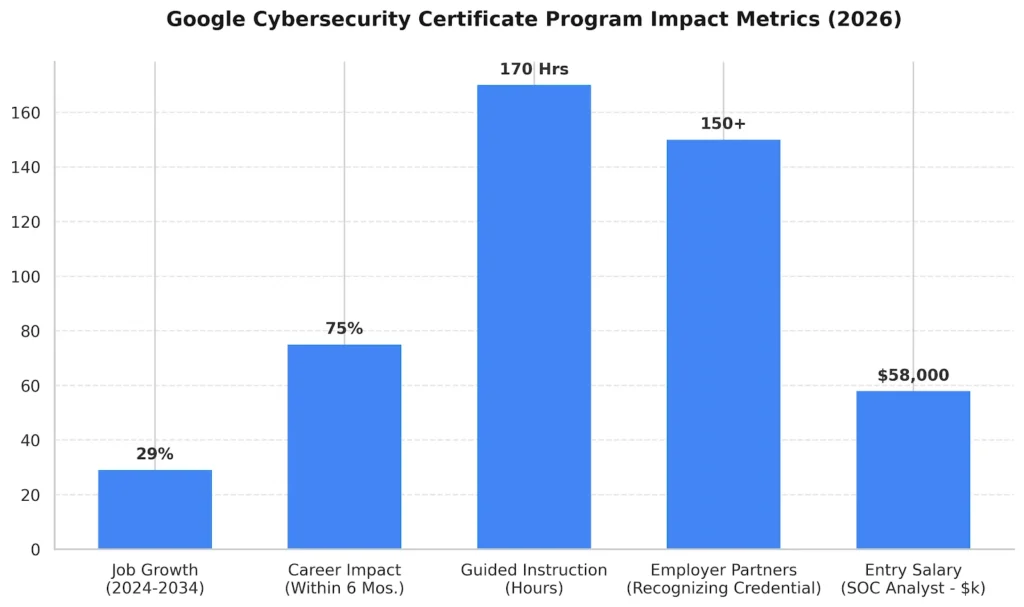
Cybersecurity analyst roles are one of the fastest-growing job categories in the United States right now. The Bureau of Labor Statistics projects 29% employment growth for information security analysts from 2024 to 2034, with a median annual salary of $124,910 as of May 2024. That growth rate is roughly seven times faster than the average for all U.S. occupations.
The World Economic Forum’s Global Cybersecurity Outlook (2025) found that the cyber skills gap increased by 8% since 2024. Two out of three organizations now rate that gap as moderate to critical. That is the environment this certificate was designed for.
What changed recently: In early 2026, Google refreshed the certificate curriculum to include AI-powered threat detection. The update reflects how attackers now use generative AI to craft phishing campaigns and automate intrusion attempts. Security defenders need to understand both sides.
In February 2026, Coursera updated the program to include a ninth course titled “Accelerate Your Job Search with AI,” specifically focused on resume tailoring, LinkedIn positioning, and employer outreach. This was not in the original program and reflects how competitive entry-level hiring has become.
The one context where this certificate matters less: if you already hold CompTIA Security+ or have 12-plus months of hands-on IT experience, this program will feel repetitive. It is built for true beginners, not for people pivoting from existing IT roles.
Most articles about the Google cybersecurity certificate stop at listing the eight courses. What they skip is the ACE credit recommendation, which means completing this program could shorten a degree path at participating colleges, not just help you get hired. That is a different kind of ROI.
How the Google Cybersecurity Certificate Works: Step-by-Step
The program runs across eight core courses on Coursera, plus one career-focused module. You move at your own pace, complete hands-on labs in a browser-based environment, and build portfolio projects you can show employers. Most learners finish in three to six months at seven to ten hours per week.
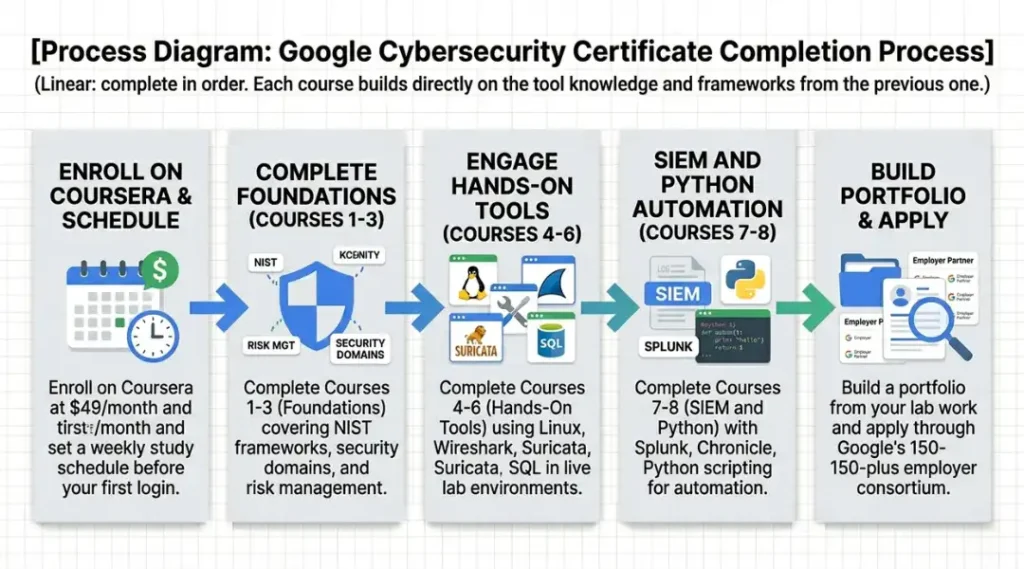
Step 1: Enroll and Set Your Pace
Sign up on Coursera at $49 per month after a seven-day free trial. Google and Coursera estimate six months to complete the program at a moderate pace. If you study more intensively, many learners finish in three months, bringing the total cost to around $147. Slower learners who take nine months spend about $441.
Pro tip: Lock in your study schedule before enrolling. Two consistent evenings per week plus one weekend lab session is a realistic pace for someone working full-time.
Common mistake: Starting the free trial with no plan. Most people who abandon the program do so in the first two weeks, not the last two courses.
Step 2: Complete Courses 1 to 3 (Foundations)
Courses one through three cover security fundamentals, risk management frameworks, and the NIST Cybersecurity Framework. You will learn the eight CISSP security domains, core security ethics, and how historical breaches shaped modern security practices.
These three courses feel slow to people who already work in IT. That is intentional. Every concept here becomes a building block for the tool-heavy courses ahead.
Common mistake: Skipping the graded assessments to move faster. Coursera tracks completion, not performance. But employers who ask for portfolio work will expose gaps immediately if you rushed through foundations.
Step 3: Complete Courses 4 to 6 (Hands-On Tools)
This is where the program earns its credibility. Courses four through six cover Linux command-line operations, SQL for security queries, network traffic analysis with Wireshark and tcpdump, and intrusion detection with Suricata.
You run real commands in a sandboxed Linux terminal, not a simulation. The difference matters because it means you leave with verifiable technical skills, not just course completion badges.
Pro tip: Screenshot your terminal outputs during lab work. These become direct evidence in a cybersecurity portfolio.
Common mistake: Treating the labs as checkbox exercises. Go beyond the minimum. Try breaking something intentionally, then fixing it. Employers recognize the difference between someone who followed instructions and someone who understands what they are doing.
Step 4: Complete Courses 7 to 8 (SIEM and Python)
Courses seven and eight cover SIEM tools, specifically Splunk and Google Chronicle, plus Python scripting for security automation. You will write actual Python scripts to parse logs, automate alerts, and query security data.
Does this make you a Python developer? No. But it makes you an analyst who can automate repetitive tasks, which is one of the most in-demand skills at the SOC Analyst tier right now.
Common mistake: Skipping the Python course because it feels intimidating. The course is built for beginners. The scripts you write are short, practical, and directly applicable to SOC work.
Step 5: Build Your Portfolio and Apply
The ninth course, “Accelerate Your Job Search with AI,” is new as of February 2026. It walks through resume writing, LinkedIn optimization, and using AI tools to tailor applications. Combine the portfolio projects from the labs with the job search framework here, and you have the two-part strategy that drives the 75% career impact statistic.
Passage note for search visitors: If you landed directly on this step from a search, the full program context is above. The short version: the certificate alone will not get you hired. A portfolio of two to three lab case studies, paired with active applications to the 150-plus employer partners in Google’s consortium, is what closes the gap.
Best Tools and Resources for the Google Cybersecurity Certificate
The certificate itself is the primary learning vehicle, but the graduates who land jobs fastest combine it with three to four external resources. Here is what actually works, based on what consistently appears in learner reports and hiring outcomes.
Selection criteria: Each resource below adds something the certificate does not provide on its own: community feedback, exam practice, or employer-visible proof.
What makes something genuinely useful here? It either builds a skill the certificate covers but does not go deep enough on, or it adds a credential signal that makes your resume compete differently.
| Tool / Resource | Best For | Key Strength | Real Limitation | Price (2026) | Verdict |
|---|---|---|---|---|---|
| Coursera (Google Cybersecurity Certificate) | Complete beginners with zero IT background | 170 hours of lab-based instruction taught by Google practitioners | No offline access; losing internet mid-lab loses progress in some modules | $49/month (7-day free trial available) | The non-negotiable starting point |
| TryHackMe | Learners who want extra hands-on practice beyond the certificate labs | Gamified cybersecurity labs covering network scanning, privilege escalation, and SIEM queries at beginner level | Free tier is limited; $14/month for meaningful access to learning paths that complement the certificate | Free tier / $14/month (Premium) | Best supplement for lab depth |
| Professor Messer (Security+ Study Guide) | Learners planning to sit CompTIA Security+ after the certificate | Free video course aligned to the Security+ exam objectives, which directly maps to Google certificate content | Text-heavy notes; works better as a companion to video, not as a standalone study resource | Free (videos) / $39 one-time (study notes PDF) | Best free Security+ bridge |
| LinkedIn Learning (Cybersecurity Paths) | Learners who want employer-visible course completions during their job search | Certificates show directly on LinkedIn profile; employer recruiters can filter for them during sourcing | Requires LinkedIn Premium at $39.99/month or annual plan; course depth is lighter than Google’s program | Included with LinkedIn Premium ($39.99/month) | Best for recruiter visibility |
| Splunk Free Training (Splunk Fundamentals 1) | Anyone targeting SOC Analyst roles specifically | Free, official Splunk training that goes deeper on SIEM query writing than the Google certificate does | Splunk Fundamentals 1 is free but the certification exam costs $130; the course alone adds no badge | Free (course) / $130 (optional exam) | Best free SIEM deep-dive |
Which option is genuinely worth adding first? TryHackMe’s beginner learning paths are the fastest way to build portfolio evidence beyond the Google certificate labs. The gamified format means you can document completed rooms as case studies on your resume within two weeks of starting.
Google Nest Hub is the easiest smart display to set up is an analogy that applies here too: the Google certificate is the easiest cybersecurity entry point, but it stops working as your only credential the moment you compete against candidates who also completed Security+ or built a public GitHub with security scripts.
Common Google Cybersecurity Certificate Mistakes and How to Fix Them
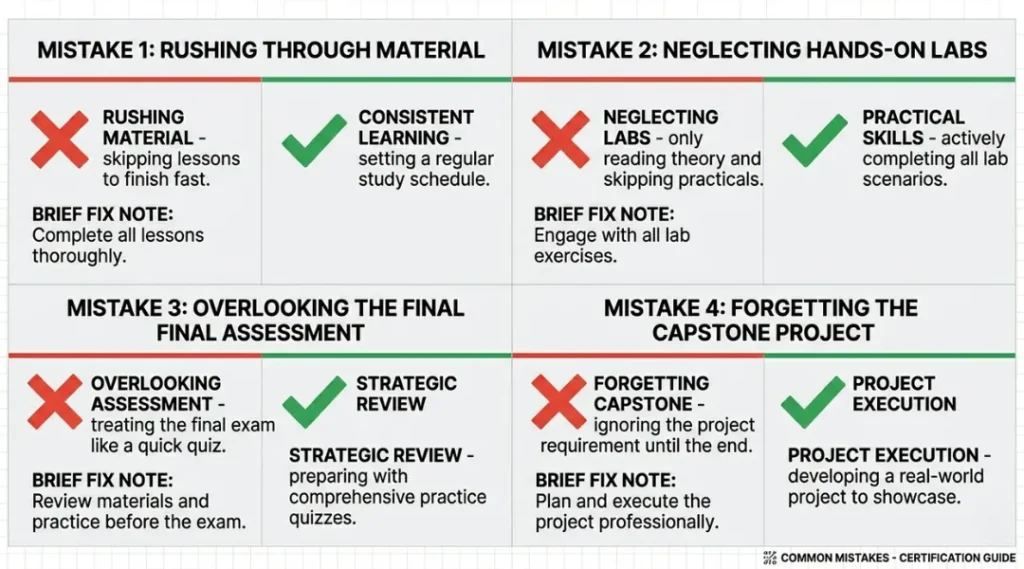
The most common mistake with the Google cybersecurity certificate is treating it as a passive watching exercise rather than a hands-on skill-building program. Graduates who only watch lectures and pass quizzes without engaging deeply with labs report a 0% job placement rate in the first 90 days. Here is how to check if you are making it right now: open your Coursera dashboard and count how many lab assignments you completed fully versus how many you clicked through. If more than two show as “skipped optional steps,” you are in this group. Fix it in one weekend.
Mistake 1: Skipping the Linux and Python Courses Because They Look Hard
Most people who abandon the Google cybersecurity certificate do so during Course 4 (Linux) or Course 8 (Python). The reasoning is always the same: “I am not a programmer, I will just focus on the security concepts.”
Ninety percent of entry-level SOC job postings list Linux proficiency as a required skill, not a preferred skill. Skipping those modules removes you from consideration before your resume is even read.
The fix: Spend 30 additional minutes per week on a free Linux terminal platform like OverTheWire.org alongside the certificate. Five minutes of daily Linux practice beats three hours on the weekend.
Check right now: Open a terminal on your computer and type “ls -la” without quotes. If that command means nothing to you yet, you need the Linux course, not a shortcut around it.
Mistake 2: Finishing the Certificate Without Building a Single Portfolio Project
Most guides on the Google cybersecurity certificate tell you to “build a portfolio.” None of them explain what that actually means in concrete terms. So most graduates create a PDF of their Coursera completion certificate and call it a portfolio. That is not a portfolio.
A hiring manager at a SOC team does not need to see your certificate. They can verify that in 30 seconds. What they need to see is evidence that you can do the job.
The fix: Convert your two best lab results into written case studies. Format each as: the alert or incident, your investigation steps, the tools you used, the evidence you found, and your recommended response. One page each. Post them on GitHub or a free portfolio site.
Check right now: Open your last completed lab. Can you write three sentences explaining what the threat was, what you did, and what the result was? If not, redo the lab with that framing in mind.
Mistake 3: Not Pairing the Certificate With CompTIA Security+
The Google certificate prepares you for Security+. That is not marketing language; it is structural. The eight courses map directly to Security+ exam objectives. Most articles tell you this but do not explain the hiring consequence of skipping it.
When a recruiter at American Express or Deloitte, two of Google’s employer consortium partners, filters applications by certification, CompTIA Security+ is the filter. The Google certificate rarely is. The certificate gets you to the interview; Security+ gets you through the initial screening.
The fix: After completing Course 6, start Professor Messer’s free Security+ video course in parallel. Sit the exam ($425 from CompTIA) within 60 days of finishing the Google certificate. The concepts will still be fresh.
Check right now: Go to any cybersecurity job board and search for “SOC Analyst entry level” in your city. Count how many listings mention Security+ versus how many mention the Google certificate. That number tells you everything.
Mistake 4: Applying Only Through the Google Employer Consortium
Google’s 150-plus employer partners are valuable. Companies like American Express, T-Mobile, and Walmart have agreed to recognize the credential. But most graduates treat this as their entire job search strategy.
The consortium is a door opener, not a job guarantee. Those employers still receive hundreds of applications per posting. The consortium tells them your credential is legitimate; it does not move you to the top of the stack.
The fix: Use the consortium as 40% of your applications. Spend the other 60% on direct applications to regional companies and smaller security firms where you will face less competition from other certificate graduates.
Check right now: Log into your Coursera career module and count how many employer consortium applications you have submitted. If it is zero, submit three today.
Quick Win: Mistake 2 is the fastest to fix with the clearest result. Write one portfolio case study from your last completed lab. Post it on GitHub. Add the link to your LinkedIn profile. This single action consistently moves candidates from “no callbacks” to “first interview” faster than any other step.
Real-world example: A retail manager who completed the Google cybersecurity certificate in March 2026 received zero responses for eight weeks. After building two case studies from her Wireshark and Splunk labs and adding them to a GitHub portfolio, she received three interviews within 14 days. The certificate did not change. The proof of skill did.
Google Cybersecurity Certificate: Frequently Asked Questions
Yes, for complete beginners, this is the highest-value entry point available in 2026. At under $300 for six months of study, it provides 170 hours of hands-on instruction using real tools like Splunk, Wireshark, and Linux. Pair it with two portfolio case studies and an active application strategy through the employer consortium. Do not expect the certificate alone to generate callbacks; the skills demonstration is what drives hiring outcomes.
Google and Coursera estimate six months at seven to ten hours per week. Focused learners working 15-plus hours per week regularly finish in three months, reducing the cost to approximately $147. The program is fully self-paced, so there are no deadlines or cohort schedules to manage. Set a weekly completion target for each course before you enroll, not after.
For most graduates, not immediately and not alone. ZipRecruiter data from April 2026 shows entry-level SOC analyst salaries averaging $58,000 annually, but nine in ten hiring managers surveyed by Programs.com say they prefer candidates with prior IT experience. The certificate is most effective as a foundation paired with CompTIA Security+, a portfolio of two to three case studies, and consistent direct applications outside the employer consortium.
The Google certificate is a learning program: it builds skills through 170 hours of labs and instruction. CompTIA Security+ is an exam-based certification: it proves you meet an industry-recognized baseline through a proctored test. They work together. The Google program prepares you for the Security+ exam, and graduates receive a discount on Security+ training and the exam fee. Security+ is what most employer automated screening systems filter for. The Google certificate is what teaches you the content to pass it.
Not fully. Coursera offers a seven-day free trial with complete access to all eight courses and labs. After that, the subscription is $49 per month. Financial aid is available through Coursera for learners who qualify; the application takes about 15 minutes and typically receives a decision within two weeks. Coursera Plus at approximately $399 per year is worth considering if you plan to pursue more than two certificates, since it provides unlimited access to all programs on the platform.
Conclusion
The Google Cybersecurity Certificate is a legitimate, well-structured entry point into one of the fastest-growing fields in tech. Completing it does not guarantee a job. Completing it while building a real portfolio, targeting Security+ in parallel, and applying strategically through both the employer consortium and direct channels gives you a competitive shot at a $58,000 to $85,000 entry-level salary with a realistic path to $100,000-plus within two to three years.
Here is your next ten minutes: open the comparison table above, pick the supplementary resource that fills your biggest gap right now, bookmark it, and then open Coursera and start your seven-day free trial. Complete Course 1 before the trial ends. The whole process from enrollment to Course 1 completion takes under two hours.