AI Governance News
Over 1,000 AI policy initiatives are now active across 69 countries, according to the OECD AI Policy Observatory, and 2026 is the year that most of them graduate from text to enforcement. If your organization builds, deploys, or integrates artificial intelligence in any commercial capacity, the regulatory ground beneath you shifted significantly in the first half of this year.
This article covers the most consequential ai governance news of 2026: what changed, why it matters to your business, and what you must do before deadlines compress further. You will leave with a clear picture of the EU AI Act enforcement wave, the US federal-state tension reshaping domestic policy, and the enterprise compliance steps that separate prepared organizations from exposed ones. For a full strategic foundation, see the AI Governance pillar.

Table of Contents
ToggleThe EU AI Act Crosses Into Full Enforcement Territory
August 2, 2026 is the single most consequential date in the global AI governance calendar this year. On that date, the EU AI Act’s obligations for general-purpose AI model providers and Article 50 transparency requirements become fully enforceable across every EU member state simultaneously, regardless of where the provider is based.
For most enterprises, this is not an abstract deadline. It means AI systems used for hiring, credit scoring, biometric identification, and decisions affecting fundamental rights now require documented conformity assessments, technical file maintenance, and post-market monitoring before they can legally serve European users or customers.
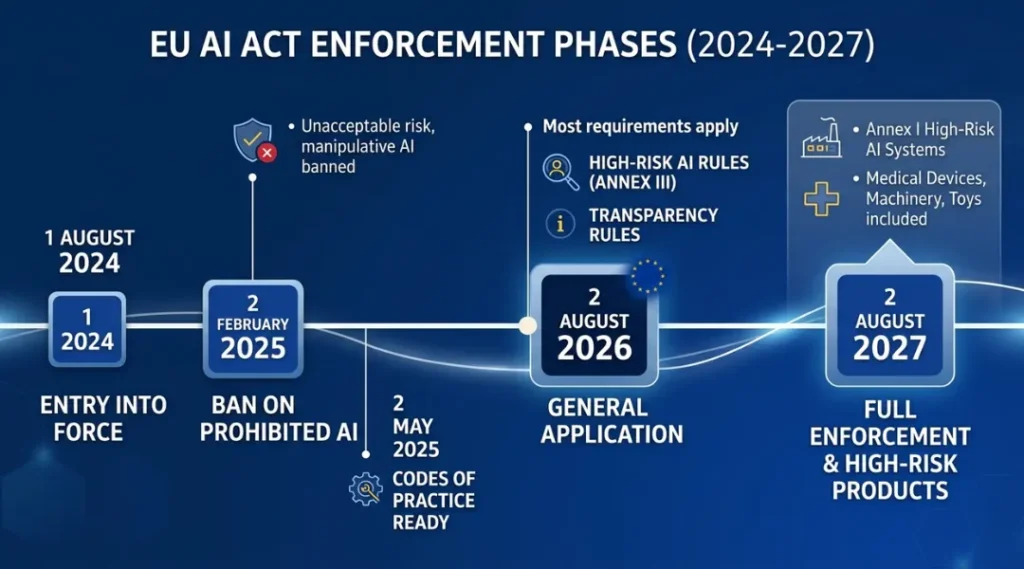
The penalty exposure is not theoretical. Non-compliant organizations face fines reaching 7 percent of global annual revenue for the most serious violations, with penalties for prohibited AI practices reaching up to 35 million euros. A detailed breakdown of EU AI Act 2026 requirements and penalty tiers is available from Secure Privacy, which tracks this regulatory space closely.
One important nuance emerged in late May 2026. A revised EU Omnibus agreement proposed extending high-risk AI system compliance deadlines from August 2026 to mid-2027 for Annex III systems. However, that extension has not yet been formally enacted into law, and compliance experts universally advise treating August 2, 2026 as the operative deadline. The August enforcement date for general-purpose AI models and Article 50 transparency obligations was explicitly not affected by any proposed extension. Organizations banking on a delay are taking a material legal risk.
What Article 50 Requires Right Now
Article 50’s transparency obligations are active and enforceable from August 2, 2026. These include three core requirements. First, any system interacting with humans must disclose that it is an AI system in a clear and timely manner. Second, AI-generated content must carry machine-detectable labels. Third, deepfakes and synthetic media require explicit watermarking. Compliance is not optional for organizations operating in or serving EU markets, and US-based companies are explicitly in scope if they offer AI models to developers building EU-facing applications or operate APIs embedded in EU products.
The Compliance Gap Is Real
Research published by the Cloud Security Alliance in March 2026 found that compliance programs remain nascent at many enterprises despite the approaching enforcement date. Organizations that classified their AI systems into risk tiers, built technical documentation, and implemented human oversight mechanisms before Q2 2026 are in a materially different position than those that deferred. The window for preparation continues to compress.
US AI Governance: A Federal-State Fault Line Deepens
The most significant domestic ai governance news of 2026 is the open conflict between the federal government’s push for centralized AI oversight and individual states advancing their own regulatory frameworks. This tension is now actively shaping compliance strategies across every sector.
In December 2025, President Trump signed an Executive Order directing federal agencies to evaluate whether uniform federal standards should replace or supersede differing state requirements. The administration also established a Department of Justice AI Litigation Task Force, which may challenge state regulations viewed as obstructing innovation. Gunderson Dettmer’s February 2026 analysis provides a detailed breakdown of how this Executive Order affects enterprise compliance planning.
Despite that signal, states are not slowing down.
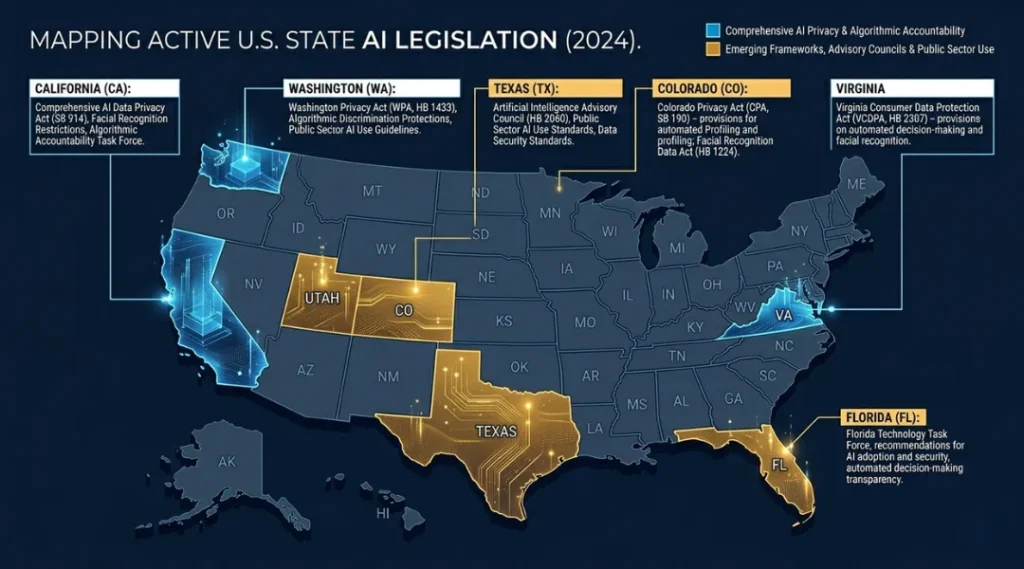
California’s AI Transparency Act and the Generative AI Training Data Transparency Act both took effect January 1, 2026, imposing disclosure and governance requirements around automated decision-making and training data sourcing. Texas enacted the Responsible Artificial Intelligence Governance Act on the same date, reinforcing prohibitions on social scoring, biometric misuse, and discriminatory AI. Colorado’s comprehensive AI legislation governing high-risk systems is scheduled to take effect June 30, 2026. Washington, Florida, Virginia, and Utah all have active AI legislation advancing through state legislatures in parallel. OneTrust’s March 2026 global AI regulation review maps how these state frameworks intersect with privacy programs in practice.
For enterprise compliance teams, the practical consequence is a patchwork of overlapping obligations that cannot be resolved by waiting for federal preemption. Companies operating across multiple states must maintain jurisdiction-by-jurisdiction tracking while the federal-state conflict plays out in courts and regulatory proceedings.
The NIST AI RMF as Operational Standard
Even without binding federal legislation, the NIST AI Risk Management Framework has become the de facto operational standard for AI governance in the US. Federal agencies were required to implement governance frameworks consistent with NIST guidance by December 2024. In February 2026, NIST launched a dedicated initiative to develop standards specifically for autonomous AI agents, systems capable of taking real-world actions without continuous human oversight. This is a direct response to governance gaps exposed when autonomous AI systems created security vulnerabilities at a scale that existing frameworks were not built to address. For organizations building or procuring agentic AI, NIST’s evolving standards are the most important domestic compliance signal to track.
Enterprise AI Governance: The Compliance Steps That Matter Most in 2026
Following the ai governance news is only useful if it drives concrete organizational action. Based on current regulatory requirements across the EU, US federal guidance, and state-level frameworks, four compliance priorities stand out for the remainder of 2026.
1. Complete Your AI System Inventory and Risk Classification
Every active regulatory framework, from the EU AI Act to Colorado’s law to California’s transparency requirements, operates on a risk-based classification system. You cannot comply with rules you have not mapped to specific systems. Organizations should maintain a living inventory of all AI systems in development, deployment, or procurement, classified by risk tier and jurisdiction of use. Systems touching employment, credit, healthcare, education, law enforcement, or biometric data require immediate attention under multiple overlapping frameworks.
2. Build Technical Documentation Before Audit Demands It
The EU AI Act requires providers of high-risk AI systems to maintain technical documentation covering system architecture, training data characteristics, performance metrics, human oversight mechanisms, and risk mitigation measures. This documentation is not a one-time deliverable. It must be kept current throughout the system’s operational life. The time to build this documentation is before an audit notice arrives, not after. Companies that have treated this as a legal checkbox rather than an engineering requirement will face acute operational pressure as enforcement activates.
3. Implement Article 50 Transparency Controls
If your organization operates AI systems that interact with end users, generates synthetic content, or produces AI-modified media in any form, Article 50 compliance requires active technical implementation, not a policy statement. Disclosure mechanisms, content labeling pipelines, and watermarking systems must be operational and auditable. For enterprises with multiple AI-powered products, this is an engineering project, not a compliance memo.
4. Establish Cross-Jurisdictional Monitoring
The pace of AI regulation globally means that a framework valid in Q1 2026 may be superseded or extended by Q3 2026, as the Omnibus extension proposal already demonstrated. Organizations need a designated function, whether internal or through a specialized partner, responsible for tracking regulatory changes across all relevant jurisdictions and translating those changes into updated compliance requirements. Waiting for legal counsel to surface critical developments reactively is no longer sufficient.
Board Governance AI News: Oversight Is Now a Fiduciary Function
One of the most significant shifts in enterprise ai governance news this year is the formalization of board-level AI oversight as a fiduciary responsibility rather than a technology matter delegated entirely to CISOs and engineering teams. Several drivers have converged to produce this shift.
Litigation involving AI companies is accelerating. The DOJ AI Litigation Task Force was established specifically to shape the contours of AI regulation through judicial proceedings. Securities and exchange regulators in multiple jurisdictions are scrutinizing AI-related disclosures in annual reports and investor communications. Enforcement actions at the EU level will produce precedent-setting decisions that governance attorneys across every sector will study.
For boards and executive teams, this means AI governance cannot remain a technical function. Boards need AI-competent directors or advisory relationships capable of interrogating AI risk reports with genuine understanding, not surface-level familiarity. Chief AI Officers and Chief Compliance Officers need clear mandates, authority, and reporting lines that reflect the regulatory seriousness of 2026. The Internet Society’s work on responsible AI governance frameworks offers useful framing on structural governance principles, though enterprise application requires current regulatory mapping alongside foundational principles.
AI governance committees at the board level should be reviewing: risk tier classifications of material AI systems, regulatory change monitoring reports, compliance milestone status against active deadlines, incident reporting procedures and any recent incidents, and third-party AI vendor governance requirements in procurement contracts.
Global AI Governance: The International Picture in Mid-2026
The international dimension of ai governance news cannot be separated from enterprise strategy, particularly for organizations operating across jurisdictions. The OECD tracks over 1,000 AI policy initiatives across 69 countries as of early 2026, and the direction of travel is consistent: tighter obligations, phased enforcement, and increasing convergence on risk-based frameworks modeled on EU approaches.
China has operational algorithmic regulations governing recommendation systems and generative AI, with additional updates anticipated through 2026. Singapore has developed a pioneering governance framework specifically for agentic AI, positioning itself as a jurisdiction of reference for organizations building autonomous systems. Japan established AI safety institutes in parallel with similar bodies in the US and UK. South Korea committed 8.6 trillion won in 2026 to strengthen national AI competitiveness, including governance infrastructure.
The UK picture is more complicated. The UK declined to sign the international AI declaration at the 2023 AI Safety Summit, and a Private Member’s AI Regulation Bill is progressing through the House of Lords in 2026 following its earlier failure to advance in 2024. The UK continues to operate a sector-by-sector approach rather than the horizontal legislation the EU chose. For enterprises serving UK markets, this means governance obligations are distributed across financial conduct, health, employment, and data protection regulators rather than consolidated under a single AI law.

The practical implication for multinational enterprises is that there is no single compliance posture that satisfies all jurisdictions simultaneously, but the EU AI Act’s risk-based architecture increasingly functions as the highest common standard. Organizations building compliance programs around EU requirements tend to find that meeting those obligations either satisfies or substantially overlaps with requirements in other jurisdictions. The reverse approach, building to the least demanding standard and attempting to layer on EU compliance, consistently produces higher remediation costs.
What to Watch in AI Governance News Through Q4 2026
Several regulatory developments will determine the compliance landscape for the remainder of the year.
The EU Omnibus proposal’s formal adoption by the European Parliament and Council is expected by July 2026. If passed, it will extend high-risk AI system Annex III obligations from August 2026 to mid-2027 for many systems, while leaving general-purpose AI and Article 50 enforcement intact. Organizations should monitor this closely and not treat anticipated passage as confirmed.
Colorado’s AI Act takes effect June 30, 2026, making it the most comprehensive US state AI law yet to enter force. Enterprise legal teams serving US customers in regulated sectors should treat this deadline with the same seriousness applied to EU deadlines.
Federal preemption litigation is likely to intensify through Q3 and Q4 as the DOJ AI Litigation Task Force engages with state laws the administration views as obstructing innovation. The outcomes of early judicial proceedings will materially shape what compliance looks like at the state level through 2027.
NIST’s autonomous AI agent standards initiative, launched in February 2026, will produce draft guidance later this year. Organizations building or procuring agentic AI systems should engage with this process through comment periods and monitor draft publications closely.
[Process Diagram: Enterprise AI Governance Compliance Workflow] Step 1: Inventory and Classification – Catalog all active and in-development AI systems; assign risk tiers by jurisdiction and use case. Step 2: Gap Assessment – Map current documentation, oversight mechanisms, and technical controls against applicable regulatory requirements per jurisdiction. Step 3: Remediation and Implementation – Build technical files, implement transparency controls, establish human oversight procedures, and update third-party vendor contracts. Step 4: Monitoring and Maintenance – Assign ongoing regulatory tracking responsibility; schedule periodic compliance reviews against updated requirements. (Linear)
Key Takeaways on AI Governance News in 2026
The regulatory transition underway in 2026 is the most consequential shift in enterprise AI obligations since AI entered commercial deployment at scale. Three things are true simultaneously: enforcement is accelerating, the US federal-state tension creates genuine compliance complexity for domestic operations, and the EU AI Act is establishing the effective global baseline for organizations with any EU-market exposure.
The organizations positioned to navigate this well share common traits. They completed AI system inventories before enforcement deadlines arrived. They built technical documentation as an engineering discipline rather than a legal afterthought. They established board-level governance structures with genuine AI fluency. And they treated regulatory monitoring as a standing function rather than a periodic project.
AI governance news in 2026 is moving fast. The window to act before enforcement consequences materialize is narrower than it was six months ago, and it is narrowing further every week.