AI Transformation Is a Problem of Governance
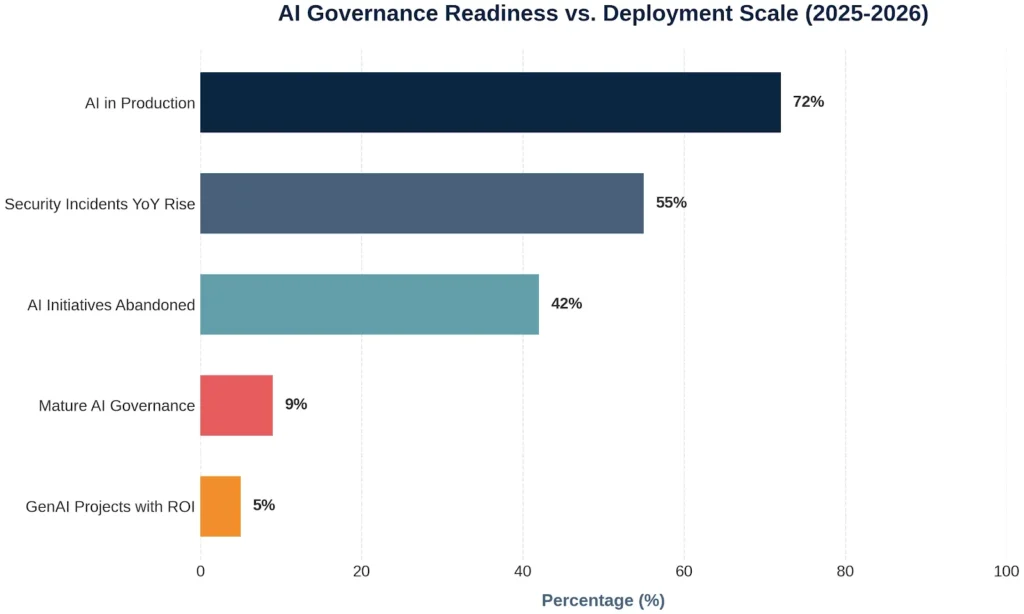
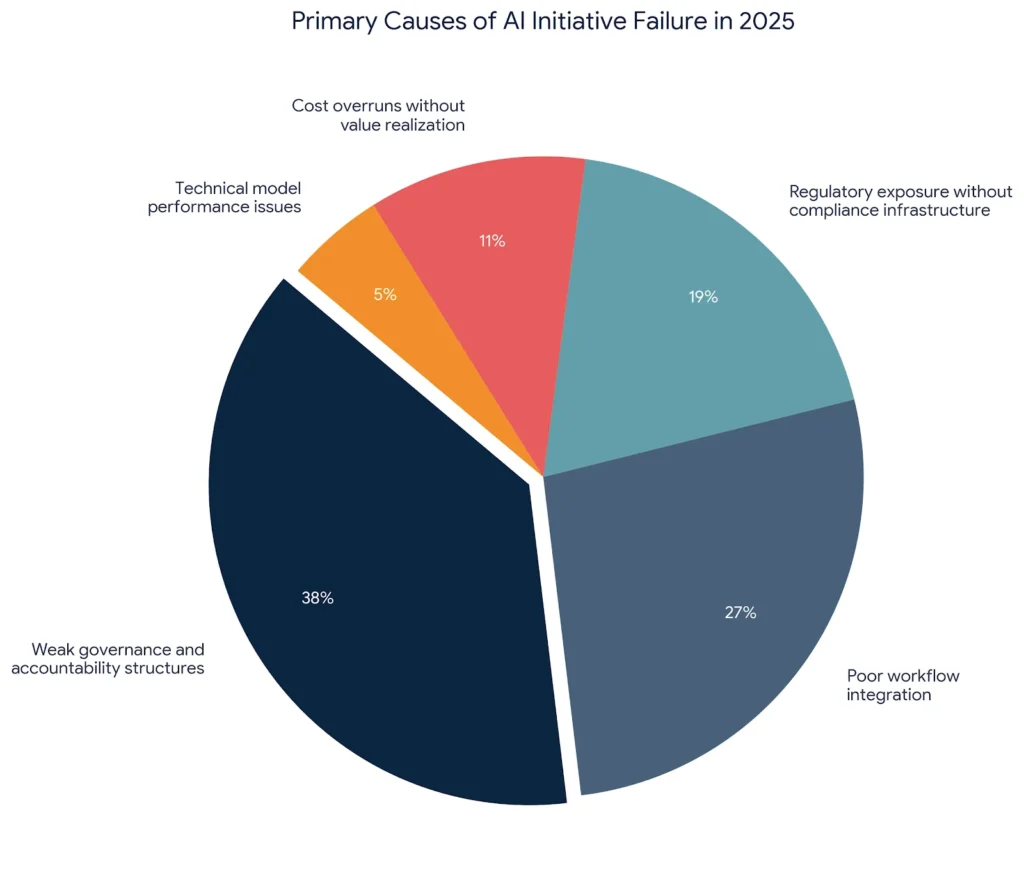
Forty-two percent of companies abandoned most of their AI initiatives in 2025 — up from 17% just one year earlier. That is not a technology crisis. S&P Global’s 2025 survey of more than 1,000 firms identified the drivers consistently: cost overruns without value, regulatory exposure without compliance structures, and no clear owner when something went wrong.
AI transformation is a problem of governance. It is not a problem of models, compute, or data pipelines. The organizations scaling AI successfully in 2026 are not the ones with the best algorithms. They are the ones with the clearest accountability structures.
This article is part of our complete guide to AI governance. After reading it, you will know exactly which governance failures are killing AI projects, how to diagnose whether your organization is running blind, and which specific frameworks close the accountability gap before it becomes a regulatory or financial crisis.
Most enterprises discover the governance problem after the first high-stakes failure. You do not have to wait that long.
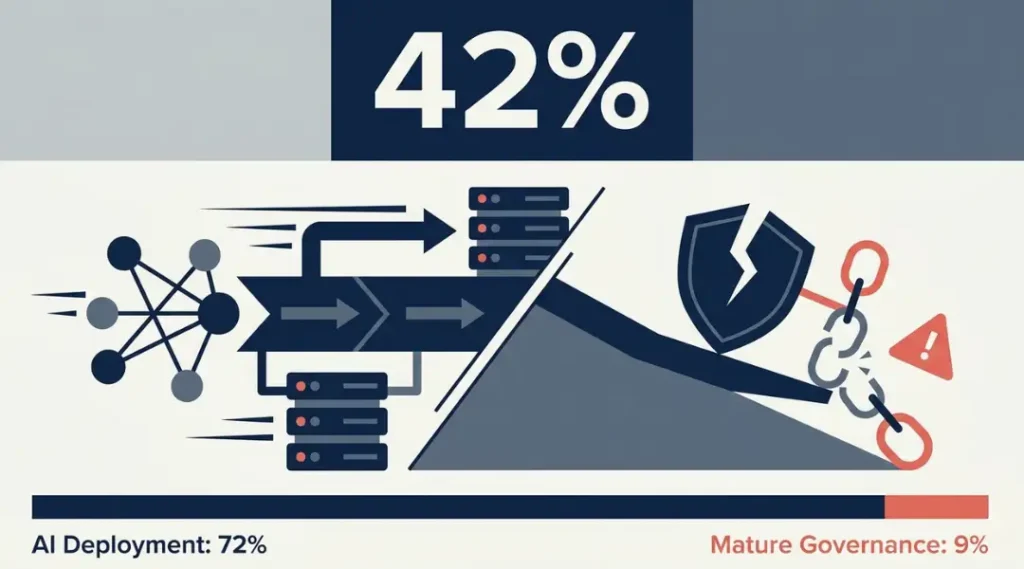
Table of Contents
ToggleWhat Is "AI Transformation Is a Problem of Governance"?
AI transformation becomes a governance problem when organizations deploy AI systems faster than they build the accountability, oversight, and policy structures needed to control them. It works by creating an accountability vacuum: the AI system makes decisions, but no defined process exists to catch errors, assign responsibility, or enforce correction.
Unlike most IT failures, which break visibly, governance failures in AI accumulate silently until a regulatory event, a public incident, or a board-level audit forces them into view. As of 2026, McKinsey’s State of AI research confirms that 72% of enterprises run AI in production while only 9% have governance they describe as mature.
Why AI Transformation Is a Problem of Governance in 2026
Governance was optional during the AI experimentation phase. It is not optional anymore.
Two structural shifts made 2025 the inflection point. In August 2024, the EU AI Act entered into force, creating the world’s first comprehensive legal framework for AI with enforcement powers now active as of August 2, 2026, covering high-risk AI systems and carrying penalties up to 35 million euros or 7% of global revenue. In January 2025, Stanford HAI’s AI Index recorded a 21.3% year-on-year rise in legislative AI mentions across 75 countries, with US federal agencies issuing roughly twice as many AI regulations in 2024 as in 2023.
Those two shifts changed the stakes permanently. AI governance failures now have regulatory consequences, not just operational ones.
The MIT 2025 State of AI in Business report found that 95% of generative AI initiatives fail to deliver measurable return on investment. The primary causes were not technical. Poor workflow integration, lack of accountability, and weak governance structures drove the failures. The technology worked. The organizational structures around the technology did not.
Here is where most articles get this wrong: they treat governance as a compliance add-on, something you layer onto an AI program after deployment. That framing is backwards. Governance is what makes AI deployment survivable at scale. Organizations that built governance structures before scaling in 2024 are now absorbing regulatory pressure without restructuring. Those that skipped governance are retrofitting under deadline pressure, which costs three to five times more than building it correctly from the start.
Governance matters less in small, isolated pilot environments where the AI output is reviewed by a human before any action is taken. The moment AI output triggers automated downstream decisions, governance becomes non-negotiable.
What competitor articles consistently miss: the accountability gap at board level. NACD’s 2025 board survey found that 62% of boards hold regular AI discussions, but only 27% have formally written AI governance into committee charters. A board that talks about AI but does not own accountability for it creates a governance vacuum that no policy document can fill.
How AI Transformation Governance Works: Step by Step
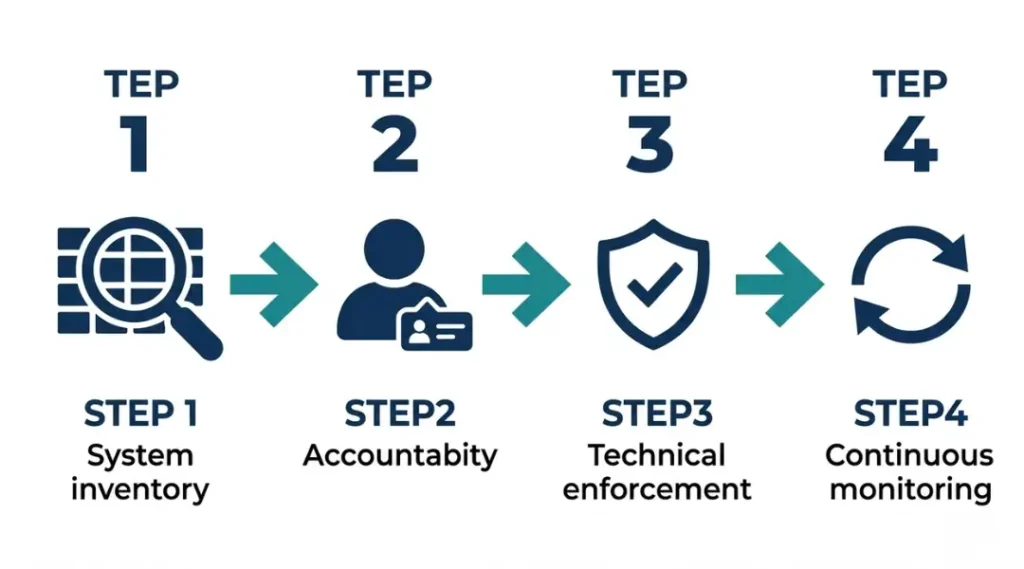
Effective AI governance is not a single policy document. It is a four-stage operating structure: identify what you are running, assign clear ownership, build enforcement into the system, and run continuous monitoring. Organizations that treat governance as a one-time setup consistently fail at Stage 3, because policy without enforcement is not governance, it is a paper exercise.
Step 1: Build a Complete AI System Inventory
Governance cannot cover what you cannot see. Map every AI system in active use, including third-party tools, embedded vendor models, and internal automations that qualify as AI under current regulatory definitions.
Shadow AI is the largest inventory gap. Stanford HAI’s 2025 AI Index noted that employee-adopted AI tools frequently operate outside IT visibility entirely. Automated discovery tools like those offered by Varonis or Securiti can surface shadow AI deployments that manual audits miss. After completing the inventory, classify each system by the EU AI Act’s four risk tiers: unacceptable, high-risk, limited-risk, and minimal-risk.
Common mistake: Teams inventory AI tools by vendor contract, not by function. A vendor tool classified as “productivity software” may perform automated screening or scoring that qualifies as high-risk under the EU AI Act. Classify by what the system does, not by how you purchased it.
Step 2: Assign Named Accountability at Every Decision Layer
Every AI system needs three named owners: a technical owner responsible for model behavior, a business owner responsible for output decisions, and an escalation owner with authority to shut the system down.
Most organizations skip the escalation owner. When an AI system makes a consequential error, the absence of a pre-designated shutdown authority creates a delay that compounds the damage. Amazon’s internal AI governance guidelines, published in their 2024 Responsible AI whitepaper, require named human decision authority for all automated systems touching customer outcomes.
How to check if you are making this mistake: Pull your last three AI deployment records. If you cannot name the escalation owner for each from memory, the role does not functionally exist in your organization.
Step 3: Build Enforcement Into the System Architecture
Written policies without technical enforcement are not governance. Only 34% of organizations with AI governance policies use any technology to actually enforce them, per Deloitte’s State of AI in the Enterprise 2026.
Enforcement mechanisms include access controls limiting which teams can modify model configurations, automated logging of model inputs and outputs for audit trail purposes, and mandatory human review gates for high-stakes outputs such as credit decisions, hiring screens, or medical recommendations. Microsoft Azure AI and Google Cloud Vertex AI both offer built-in audit logging and access control frameworks that can be configured to enforce governance policies at the infrastructure level.
Pro tip: Treat your enforcement layer as a compliance artifact. When regulators request evidence of governance under the EU AI Act, your technical enforcement logs are the primary documentation. A policy PDF is not sufficient.
Step 4: Run Ongoing Monitoring and Incident Response
AI systems drift. A model that performs within acceptable parameters at launch can shift its behavior as input data changes. Governance without ongoing monitoring is a point-in-time snapshot, not a control system.
Monthly model performance reviews against defined fairness and accuracy benchmarks are the minimum standard. IBM’s AI Fairness 360 toolkit and Microsoft’s Responsible AI dashboard both provide monitoring frameworks built for production AI environments. Define incident thresholds before deployment: what output deviation triggers an automatic review, and what threshold triggers a system pause?
Common mistake: Setting monitoring schedules based on IT convenience rather than business risk. A hiring model or a credit scoring system warrants weekly review. A content recommendation engine warrants monthly review. The schedule should match the consequence of an undetected error.
Best Tools and Frameworks for AI Transformation Governance
The right governance framework depends on your regulatory environment, not your technology stack. Organizations under EU AI Act jurisdiction need a risk classification engine and audit trail capability. Organizations primarily under US jurisdiction need frameworks that align with NIST’s AI Risk Management Framework. Many enterprises need both.
What makes a governance tool genuinely useful for this use case? It must integrate with your existing deployment infrastructure, produce auditable documentation without manual compilation, and scale across multiple AI systems without requiring a dedicated governance team per tool.
Which governance platform is actually worth the cost? The answer depends on your current state: if you have no formal governance at all, start with the NIST AI RMF as a free framework before purchasing a platform.
IBM OpenScale (now IBM Watson OpenPages) is the strongest option for enterprises already running IBM infrastructure. It monitors model bias, drift, and explainability in production. Its limitation is real: implementation requires IBM-certified consultants for complex configurations, and licensing costs begin around $50,000 per year for enterprise tiers. It is genuinely best for large financial services or healthcare organizations with existing IBM relationships.
Microsoft Purview with Azure AI governance tools integrates directly with Azure Machine Learning and provides audit logging, access controls, and compliance documentation aligned with EU AI Act requirements. The limitation: if your AI workloads run outside Azure, coverage is partial and requires manual bridging. Best for organizations already operating on Microsoft Azure infrastructure.
OneTrust AI Governance is vendor-neutral and works across multi-cloud environments. It covers policy management, risk assessment, and regulatory mapping for EU AI Act, NIST RMF, and ISO/IEC 42001 simultaneously. Honest limitation: its workflow depth is shallower than purpose-built MLOps platforms. Best for legal and compliance-led organizations that need cross-framework regulatory documentation more than technical monitoring.
NIST AI Risk Management Framework (NIST AI RMF), published in January 2023 and updated with a generative AI profile in July 2024, is free. It covers the full governance lifecycle: govern, map, measure, and manage. Its limitation is that it provides structure without enforcement tooling. Organizations need to implement the enforcement layer separately. Best for organizations starting their governance journey or those required to demonstrate NIST alignment for US federal contracts.
What most comparison articles skip: total cost after year one. Several governance platforms offer attractive entry pricing but require significant professional services engagement to operationalize. Budget for implementation costs equal to 40-60% of annual license fees when evaluating enterprise AI governance platforms.
| Tool / Framework | Best For | Key Strength | Real Limitation | Price (2026) | Verdict |
|---|---|---|---|---|---|
| IBM Watson OpenPages | Large enterprises with IBM infrastructure | Production bias and drift monitoring with explainability reporting | Requires IBM-certified consultants for complex deployments; significant implementation costs | From $50,000/year enterprise tier | Best for IBM-native financial and healthcare enterprises |
| Microsoft Purview + Azure AI | Azure-native AI deployments requiring EU AI Act documentation | Direct Azure ML integration with built-in audit logging and compliance mapping | Limited coverage for AI workloads outside Azure without manual bridging | Included in Microsoft 365 E5; Azure AI services billed per use | Best for organizations already committed to Microsoft Azure |
| OneTrust AI Governance | Legal and compliance-led teams managing multi-cloud AI portfolios | Simultaneous regulatory mapping across EU AI Act, NIST RMF, and ISO/IEC 42001 | Shallower MLOps depth than purpose-built monitoring platforms | Custom pricing; entry-level from $30,000/year | Best for compliance-first organizations needing cross-framework coverage |
| NIST AI RMF | Organizations starting their governance journey or requiring federal alignment | Comprehensive govern-map-measure-manage structure updated for generative AI in July 2024 | Framework only; requires separate tooling for technical enforcement | Free (government publication) | Best starting point for any organization; required for US federal contracts |
| ISO/IEC 42001:2023 | Multinational enterprises requiring auditable certification for enterprise clients | Internationally recognized management system standard with third-party certification path | Certification process takes 6-12 months and requires external auditor engagement | Certification costs vary; typically $15,000-$40,000 for initial audit | Best for enterprise vendors selling to regulated industries globally |
Common AI Transformation Governance Mistakes (and How to Fix Them)
The most common mistake with AI transformation governance is treating policy documentation as governance itself, which creates the appearance of compliance while the actual accountability gaps remain open. Most organizations make this mistake because formal policy documents satisfy audit requests without requiring the harder work of building technical enforcement and named accountability. Check whether you are making it right now by asking: what happens, step by step, when your most consequential AI system produces a wrong output? If you cannot answer that in under two minutes, the enforcement layer does not exist.
Mistake 1: Assigning AI Governance to IT Without Business Ownership
IT teams own the infrastructure. They do not own the business decisions that AI systems drive. When governance lives exclusively in IT, the accountability gap between technical behavior and business impact stays permanently open.
Why it happens: IT is the team closest to the deployment, so governance lands there by default. But an IT team cannot make decisions about acceptable risk in hiring, credit, or pricing. Those decisions require business authority.
The fix: Create a cross-functional AI governance committee that includes legal, compliance, product, and a senior business executive with budget authority. Deloitte’s State of AI in the Enterprise 2026, drawn from 3,235 senior leaders, found that only 1 in 5 organizations has a mature governance model for autonomous AI agents, and most of those failures trace back to governance structures that sit entirely within technical teams.
How to check now: Look at your AI governance policy. Count how many signatories are from non-technical business functions. If the count is zero, governance does not have business ownership.
Mistake 2: Writing Governance Policy After Deployment
Most organizations write AI governance policy in response to an incident or an audit request. By that point, the system has already been operating without accountability for months or years.
Why it happens: Deployment timelines create pressure to ship. Governance feels like it slows things down, so it gets deferred. The deferral creates the exact risk it was meant to prevent.
The fix: Require a governance sign-off as a deployment gate, not a post-deployment review. Build a one-page governance checklist into your AI deployment approval process. Each checklist item must be completed before the system goes live. Microsoft’s internal AI deployment process requires a Responsible AI impact assessment for any system touching external users before deployment can proceed.
How to check now: Pull your last AI deployment approval record. If governance review is not a named step in the approval workflow, the gate does not exist.
Mistake 3: Ignoring Shadow AI as a Governance Problem
Employees using AI tools outside sanctioned channels is not an employee discipline problem. It is a governance design failure. When the sanctioned path is harder than working around it, employees will route around the governance structure every time.
Why it happens: Procurement and IT approval cycles for new AI tools can take months. Employees facing a deadline will find a faster path. The governance structure made the workaround easier than the compliant option.
The fix: Create a lightweight AI tool intake process that can approve low-risk tools in under two weeks. Stanford HAI’s 2025 AI Index noted that employee shadow AI adoption is the fastest-growing source of ungoverned AI exposure in enterprise environments. Slow approval processes are the direct cause.
How to check now: Ask three team members what AI tools they use regularly. If any are not on your approved vendor list, you have an active shadow AI problem.
Mistake 4: Setting Monitoring Schedules Based on IT Capacity, Not Business Risk
A quarterly model review schedule that fits IT bandwidth is not a risk-based governance approach. It is a convenience schedule that leaves consequential errors undetected for up to three months.
Why it happens: Monitoring frequency is set during implementation when the urgency feels low, and it rarely gets revisited once the system is running.
The fix: Map monitoring frequency to the potential cost of an undetected error. A hiring algorithm or credit scoring model warrants weekly automated monitoring with monthly human review. IBM’s AI Fairness 360 toolkit and Microsoft’s Responsible AI dashboard both support automated alerting when model outputs drift outside defined fairness thresholds. Use those alerting tools as the primary monitoring layer.
How to check now: Find the last time your most consequential AI system was formally reviewed. If it was more than 60 days ago, the monitoring schedule does not match the risk level.
Quick Win: Fix Mistake 1 first. Assigning a named business owner to your highest-risk AI system takes one meeting and one calendar invite. It closes the single most common accountability gap without requiring any new tools or policy rewrites. Organizations that make this change first report that it accelerates every subsequent governance improvement because there is now a business decision-maker actively invested in making governance work.
Real-world example: A mid-size financial services firm in London spent 14 months building an AI-powered loan underwriting model. The system was technically sound and performed within its training benchmarks. When the UK Financial Conduct Authority issued a data use inquiry in March 2025, the firm could not produce the required audit trail for model decisions because no one had been assigned ownership of the audit logging infrastructure. The system was suspended while the trail was reconstructed manually, at a cost of approximately 280,000 pounds in operational disruption. The governance failure was not in the model. It was in the absence of a named technical owner responsible for audit logging from day one.
AI Transformation Governance: Frequently Asked Questions
AI compliance means meeting specific legal requirements such as the EU AI Act or NIST RMF. AI governance is the broader operational structure, which includes accountability assignment, monitoring, and decision authority, that makes compliance possible on an ongoing basis. Compliance is a checkpoint. Governance is the system that gets you to the checkpoint repeatedly without crisis. Build governance first; compliance documentation becomes a byproduct of a well-governed AI program.
A foundational governance structure covering inventory, accountability assignment, and basic monitoring can be operational within 60 to 90 days for organizations with fewer than 20 active AI systems. Full technical enforcement, including automated audit logging and formal incident response protocols, typically requires four to six months. Organizations retrofitting governance onto existing deployments consistently take 30% longer than those building governance into new deployments from the start, because discovery of undocumented systems extends the timeline significantly.
Start with the NIST AI Risk Management Framework. It is free, vendor-neutral, and updated in July 2024 with a generative AI profile that addresses large language model risks specifically. If your organization serves the European market or handles EU citizen data, map the NIST AI RMF to the EU AI Act's risk tiers simultaneously. ISO/IEC 42001:2023 is worth pursuing once your governance program is operational and you need third-party certification to satisfy enterprise client requirements.
Governance adds 15% to 25% of additional time to the initial deployment cycle, based on implementation data from Deloitte's 2026 survey cohort. Organizations that view this as a slowdown typically experience AI suspension or forced remediation within 18 months of deployment, which costs three to five times more than the original governance investment. The correct framing is not whether governance slows deployment, but whether a deployment without governance will be allowed to stay in production.
Shadow AI refers to AI tools that employees adopt and use without IT or security approval. Stanford HAI's 2025 AI Index identified it as the fastest-growing category of ungoverned AI exposure in enterprise environments. It is the biggest blind spot because it is invisible to formal inventory processes, which means it is also invisible to accountability structures and monitoring systems. The root cause is almost always a sanctioned AI tool approval process that is too slow for operational needs. Fix the approval process speed before trying to enforce a shadow AI ban.
Conclusion
AI transformation is a problem of governance because deployment without accountability creates compounding risk at every scale. The 42% project abandonment rate recorded by S&P Global in 2025 is not a technology failure statistic. It is an organizational accountability failure statistic.
In the next 10 minutes: open your last AI deployment record and identify the named escalation owner for that system. If you cannot find one, that is your starting point. Assign a named business owner before your next governance review. Document it. That single action closes the most common accountability gap in enterprise AI programs and takes no budget to execute.
Every AI transformation program will face a moment where AI transformation is a problem of governance, not technology. The organizations that prepare for that moment before it arrives are the ones still running their AI systems 18 months after deployment.