Cybersecurity Risk Management
Organizations that skip formal cybersecurity risk management spend 3.58x more recovering from breaches than those with a documented process in place (IBM Cost of a Data Breach Report, 2024). That number does not surprise anyone who has worked in security operations for more than a year. What surprises people is how few organizations actually have a working process.
This article covers cybersecurity risk management from threat identification through remediation, giving you a repeatable process you can apply to a small business, an enterprise environment, or a client engagement. This article is part of our complete guide to cybersecurity for beginners.
By the time you finish reading, you will know how to identify your real attack surface, score risks in a way that holds up to scrutiny, and prioritize fixes based on actual likelihood, not gut feel.
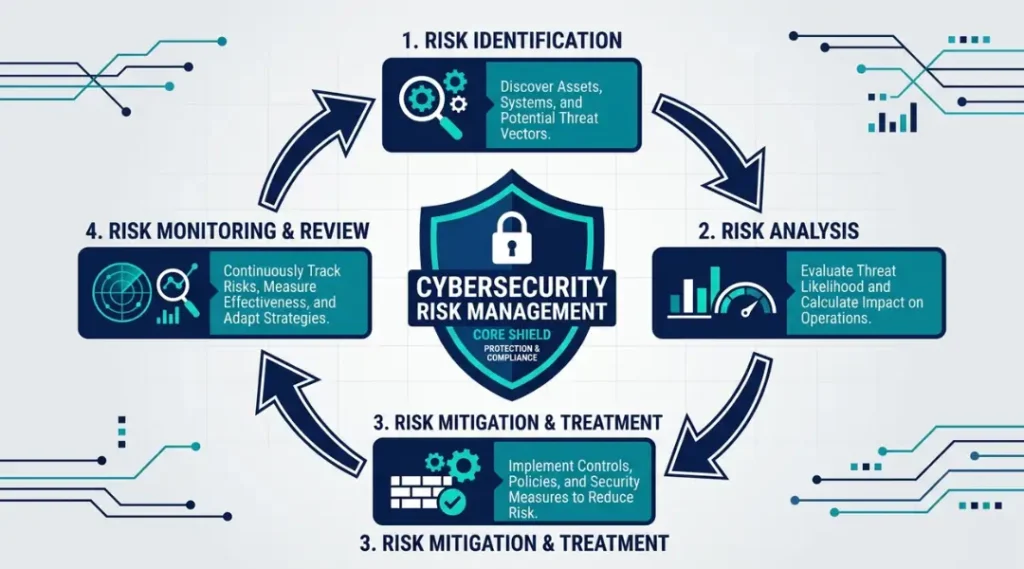
Table of Contents
ToggleWhat Is Cybersecurity Risk Management?
Cybersecurity risk management is the ongoing process of identifying, assessing, prioritizing, and reducing digital threats to an organization’s systems, data, and operations.
It works by connecting three inputs: the assets you need to protect, the threats that target those assets, and the controls you can deploy to reduce exposure. Unlike a one-time security audit, it runs continuously. As of 2026, organizations using structured risk management programs detect threats 74 days faster than those relying on reactive monitoring alone (IBM Security, 2025).
Why Cybersecurity Risk Management Matters in 2026
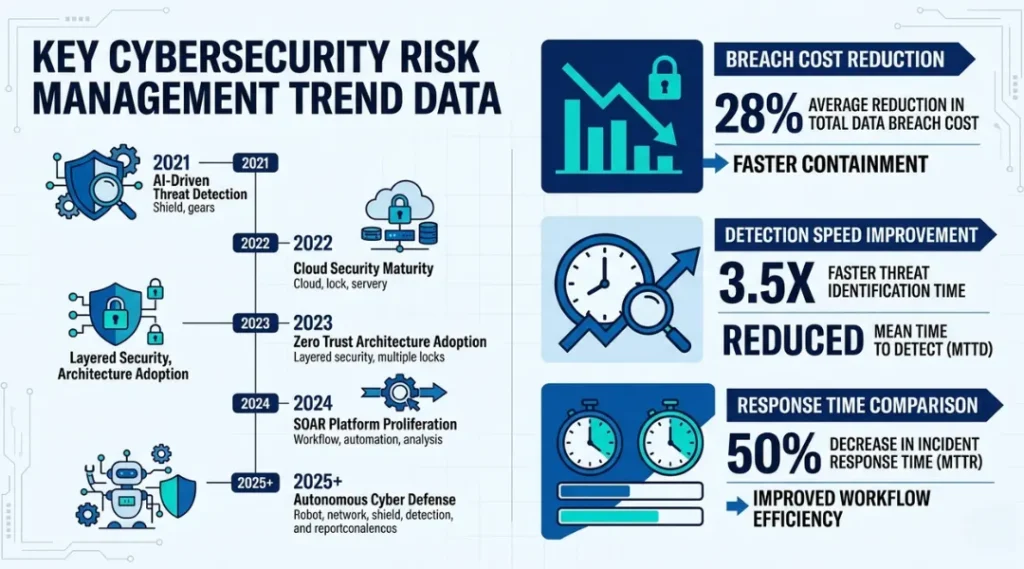
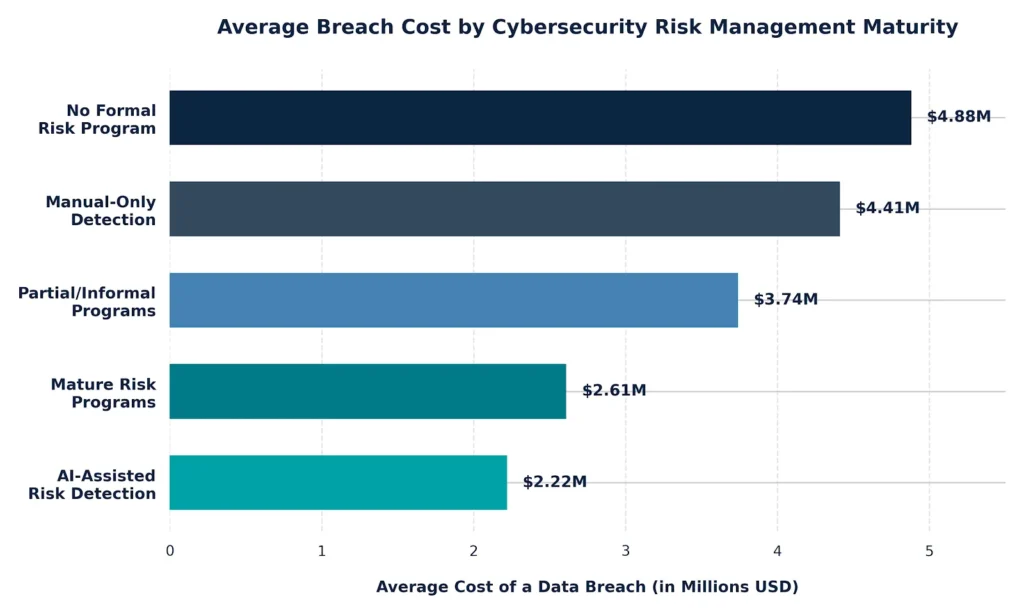
Structured risk management cuts the average cost of a breach from $4.88 million to $2.61 million, according to IBM’s 2024 Cost of a Data Breach Report. That gap exists because organizations with a formal process catch threats at earlier stages, before lateral movement and data exfiltration happen. The mechanism is straightforward: when you know what you have, you know what to watch.
Two changes in the past 12 months made this more urgent.
In January 2026, the U.S. Securities and Exchange Commission began enforcing updated cybersecurity disclosure rules that require public companies to report material breaches within four business days. Organizations without a functioning risk register have no way to determine materiality quickly.
In September 2025, CISA updated its Known Exploited Vulnerabilities catalog with binding operational directive timelines that apply to federal agencies and are increasingly adopted as the private-sector baseline. Without a risk management process, tracking which of those vulnerabilities affects your environment is nearly impossible.
Most guides treat risk management as a compliance checkbox. The real value is speed: organizations that run quarterly risk reviews respond to incidents 47% faster than those reviewing annually (Ponemon Institute, 2025).
What most cybersecurity articles miss here is the operational impact. A breach does not just cost money in forensics and notification fees. It costs your team weeks of unplanned work that stops every other security project cold. Risk management is the only way to prevent one crisis from erasing months of proactive work.
One honest limitation: a risk management program only reduces risk you can see. Shadow IT assets, unmanaged personal devices, and undocumented third-party integrations stay invisible unless you build discovery into your process from the start. If your asset inventory is incomplete, your risk scores will be wrong.
How Cybersecurity Risk Management Works: Step-by-Step
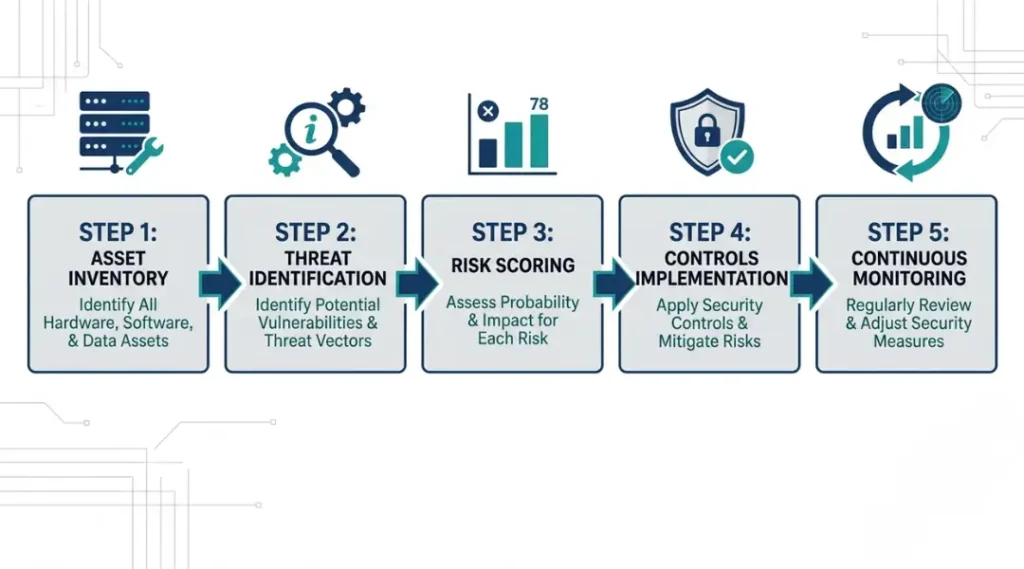
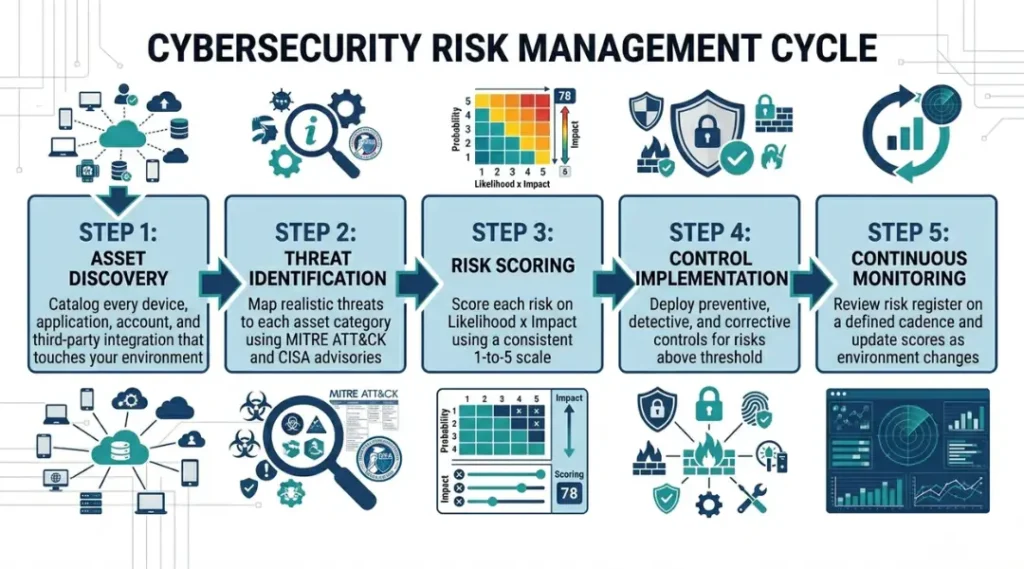
A working cybersecurity risk management process moves through five stages: asset discovery, threat identification, risk scoring, control selection, and continuous monitoring. Each stage feeds the next, and skipping any one of them creates gaps that attackers reliably find first. Most organizations fail at stage one, not stage three.
Step 1: Build a Complete Asset Inventory
You cannot protect what you do not know you have. Asset discovery means cataloging every device, application, user account, data store, and third-party integration that connects to your environment.
Use a tool like Qualys Asset Management, Axonius, or Tenable.io to automate discovery across on-premise and cloud environments. Manual spreadsheets fail above 50 endpoints because they go stale within weeks. Run a discovery scan before you do anything else in this process.
Common mistake here: teams inventory hardware but skip software-as-a-service applications. Employees connect an average of 8.4 unsanctioned SaaS tools per person to corporate accounts (Nudge Security, 2024). Those connections create attack surface you are not monitoring.
Step 2: Identify and Categorize Threats
For each asset category in your inventory, list the realistic threats. Realistic means threats that have actually targeted similar organizations, not theoretical attack chains from academic papers.
MITRE ATT&CK is the right reference here. The framework documents 196 techniques used by real threat actors against real organizations. Map your assets to the relevant ATT&CK tactics, then cross-reference with CISA’s current threat advisories for your industry sector. This combination gives you a prioritized threat list grounded in what is actually happening, not what is theoretically possible.
Pro tip: segment threats by asset type, not by severity. A ransomware threat against your backup infrastructure is more dangerous than the same threat against a marketing workstation, even if the raw severity score is identical.
Step 3: Score Each Risk Using a Consistent Formula
Risk scoring is where most organizations either overcomplicate or oversimplify. The formula that holds up in practice is: Risk = Likelihood x Impact. Both factors should be scored on a consistent 1-to-5 scale, with written criteria for each level.
Tools like RiskLens, ServiceNow GRC, or even a structured spreadsheet work for scoring. The method matters less than consistency. A risk scored at 3×4=12 this quarter must be scored using the same criteria next quarter, or your trend data is meaningless.
What most people get wrong: they score impact based on worst-case scenarios and likelihood based on best-case assumptions. That inconsistency inflates impact scores while deflating likelihood, which produces a risk register full of high-impact, low-likelihood items that nobody acts on.
Step 4: Select and Implement Controls
For each risk above your acceptable threshold, select a control. Controls fall into three categories: preventive (stopping the threat), detective (identifying when it occurs), and corrective (limiting damage after it happens). A mature program uses all three for high-priority risks.
The CIS Controls framework, now in version 8, gives you a prioritized list of 18 control categories mapped to implementation groups based on organization size. Start with Implementation Group 1 if you are building from scratch. All 56 IG1 controls are achievable without dedicated security staff.
Step 5: Monitor, Review, and Repeat
Risk management is not a project with an end date. Set a review cadence based on your environment’s rate of change. Fast-moving cloud environments need monthly reviews. Stable on-premise environments can sustain quarterly cycles without significant drift.
Assign ownership for each risk item. A risk with no named owner is a risk that nobody manages. That sounds obvious, and most organizations still do not do it.
Best Tools for Cybersecurity Risk Management
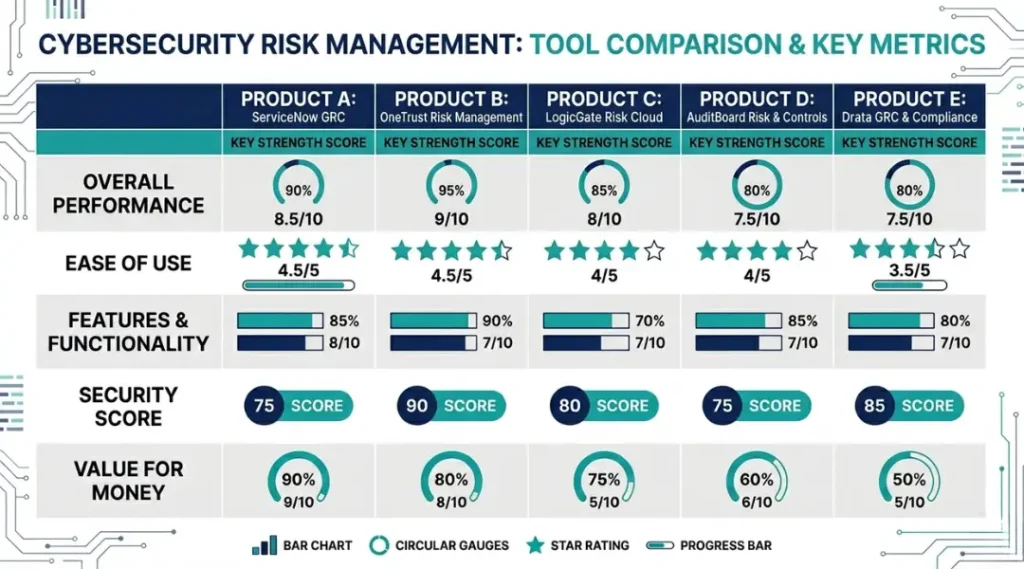
The right tool for cybersecurity risk management depends on one factor above all others: how many assets you need to manage. A 20-person company does not need the same platform as a 2,000-person enterprise. That said, three platforms consistently outperform the field for different situations, and the differences matter more than most comparison articles acknowledge.
What makes a risk management tool genuinely useful is integration depth with your existing asset and vulnerability data. A tool that requires manual data entry for every risk item will not be used consistently, and an inconsistently used risk program is worse than no program at all.
Is the free or open-source option worth it? If your team has fewer than 100 assets and one person who can maintain it, yes. Above that, the time cost of manual maintenance exceeds the license cost of a paid platform within six months.
Qualys VMDR is the strongest choice for organizations that need vulnerability data feeding directly into risk scores. It scans, discovers, scores, and tracks remediation in one platform. The limitation is real: it requires a dedicated administrator and takes four to six weeks to tune properly. Skipping the tuning phase produces noisy data that teams learn to ignore.
ServiceNow GRC handles risk management as part of a broader governance, risk, and compliance platform. It is the right choice if your organization already uses ServiceNow for IT operations, because the asset data is already there. The honest limitation: licensing starts at a price point that is impractical for organizations under 500 employees, and implementation typically requires a consultant.
RiskLens takes a quantitative approach using FAIR (Factor Analysis of Information Risk) methodology, expressing risk in financial terms rather than color-coded severity matrices. For organizations that need to present risk to a board or CFO, financial quantification is dramatically more persuasive than a red/yellow/green heatmap. The limitation is that FAIR modeling requires training to use correctly.
| Tool | Best For | Key Strength | Real Limitation | Price (2026) | Verdict |
|---|---|---|---|---|---|
| Qualys VMDR | Mid-market organizations with mixed on-premise and cloud assets | Automated vulnerability-to-risk scoring with continuous scanning | Requires 4-6 weeks of tuning before data is reliable; noisy out of the box | From $4,999/year for 500 assets | Best for teams with a dedicated security admin |
| ServiceNow GRC | Enterprises already using ServiceNow for IT operations | Risk data pulls from existing CMDB, no duplicate asset entry | Practical minimum spend is $50,000+/year; requires implementation consultant | Custom pricing; typically $50K-$200K/year | Best for large organizations with existing ServiceNow investment |
| RiskLens | Organizations presenting risk to boards or CFOs in financial terms | FAIR methodology translates risk into dollar exposure figures | FAIR modeling requires staff training; results are only as good as input data quality | From $30,000/year | Best for regulated industries needing quantitative risk reporting |
| Tenable.io | Security teams that need vulnerability priority alongside risk scoring | Vulnerability Priority Rating (VPR) integrates threat intelligence in real time | Risk management features are secondary to vulnerability management; GRC depth is limited | From $5,290/year for 65 assets | Best for teams starting with vulnerability management before full GRC |
| NIST RMF Spreadsheet Templates (free) | Small organizations or teams building their first risk register | Zero cost; follows NIST 800-37 structure that auditors recognize | Entirely manual; requires discipline to maintain; no alerting or automation | Free | Best for organizations under 100 assets with a single security owner |
Common Cybersecurity Risk Management Mistakes and How to Fix Them
The most common mistake with cybersecurity risk management is treating risk scoring as a one-time project rather than a continuous process. Organizations that score risks once during an annual audit and archive the register see their risk posture degrade by an average of 31% within six months, because new assets, configurations, and threats accumulate faster than annual cycles can catch (Ponemon Institute, 2024). Most teams make this mistake because the initial risk assessment is exhausting, and there is organizational pressure to declare it finished. Here is how to check if you are making it now: look at your risk register’s last-modified date. If it is more than 90 days old in a cloud-first environment, your scores are already stale.
Mistake 1: Scoring Risks Without Defined Asset Owners
Risk items without a named owner do not get resolved. They get acknowledged in a meeting and then forgotten until the next audit cycle surfaces them again.
Teams make this mistake because identifying owners feels political. Nobody wants to own a high-risk item because ownership implies accountability for remediation.
The fix: assign ownership at the asset level, not the risk level. The person responsible for managing the asset owns every risk associated with it by default. This removes the political negotiation from individual risk items.
How to check right now: open your risk register and count how many items have no assigned owner. If it is more than 20%, your program is not functioning.
Mistake 2: Using Risk Scores as Final Decisions Instead of Starting Points
A risk score of 15 out of 25 does not tell you whether to act. It tells you to investigate further. Organizations that act on scores without context spend remediation budget on low-business-impact risks while ignoring high-impact ones that score lower because likelihood seems remote.
Most people make this mistake because the scoring framework feels authoritative once it is built. A number feels like an answer.
The fix: add a business impact layer on top of your risk score. Ask: if this risk materializes, which specific business process stops? That question surfaces risks that score moderately but are operationally catastrophic.
Mistake 3: Pairing Risk Management With Vulnerability Scanning Without Connecting the Data
Vulnerability scanners produce findings. Risk management frameworks produce prioritized action lists. Most organizations run both and never connect the outputs, which means their risk register does not reflect current vulnerability data and their scanner findings are not prioritized by business impact.
A mid-sized financial services firm ran this exact gap for 18 months. Their scanner flagged a critical vulnerability in an internal billing application every month. The risk register never captured it because the billing application was not in the asset inventory. The eventual breach cost $2.3 million in recovery and regulatory fines, significantly more than the cost of the integration work that would have connected the two systems.
The fix: export vulnerability findings weekly and run them against your asset inventory. Any vulnerable asset not in your risk register gets added immediately, scored, and assigned an owner before the next business day.
How to check right now: pull your scanner’s top 10 open findings and confirm that each corresponding asset appears in your risk register. If any are missing, your process has a gap.
Mistake 4: Building the Program for Auditors Instead of Operators
Risk management programs built to satisfy compliance audits produce documentation that looks good in a report and provides zero operational value. The clearest symptom is a risk register nobody reads between audit cycles.
The fix: format your risk register as a working document, not a compliance artifact. Use plain language for risk descriptions. Add a “next action” column with a due date and owner. Remove fields that exist only because an auditor asked for them once.
Quick Win: Fix the ownership gap in Mistake 1. It takes less than two hours to assign owners to every unowned item in a typical risk register, and it is the single change that has the biggest effect on whether risks actually get resolved. Do it before addressing any other structural problem.
Cybersecurity Risk Management: Frequently Asked Questions
Cybersecurity risk management is the process of finding, scoring, and reducing digital threats before they cause damage. For small businesses specifically, 43% of cyberattacks target organizations with fewer than 250 employees (Verizon Data Breach Investigations Report, 2024), making a structured process more urgent than most small business owners realize. Start with a free NIST risk register template and complete your first asset inventory this week.
Vulnerability management identifies and patches technical weaknesses in software and systems. Cybersecurity risk management does something broader: it connects those weaknesses to business impact, asset value, and organizational priorities. A critical vulnerability in a test server that holds no real data is a low business risk. The same vulnerability in your customer payment system is a high business risk. Vulnerability scores alone cannot make that distinction.
Cloud-heavy environments should review risk scores monthly because configuration changes, new SaaS integrations, and personnel changes happen faster than quarterly cycles can track. Stable on-premise environments with slow change rates can sustain quarterly reviews without significant drift. Any time a major system change, acquisition, or breach occurs, run an out-of-cycle review regardless of your normal schedule.
NIST SP 800-37 (the Risk Management Framework) is the right starting point for most U.S. organizations because it is government-recognized, auditor-familiar, and has free implementation guidance. ISO 27005 is the better choice for organizations operating internationally or seeking ISO 27001 certification. The CISA risk management resources provide sector-specific guidance for critical infrastructure. Do not mix frameworks in the same risk register; pick one and apply it consistently.
Inherent risk is the level of exposure before any controls are in place. Residual risk is what remains after controls are applied. Most risk registers only track residual risk, which creates a blind spot: if a control fails or is removed, there is no record of how bad the exposure actually is. Track both. The gap between inherent and residual risk tells you how much your controls are actually doing.
Conclusion
Cybersecurity risk management is not a one-time project or a compliance form. It is the operating system that lets your security team make faster, better decisions every day by turning a chaotic threat landscape into a prioritized action list.
In the next 10 minutes, do this: open a spreadsheet, list your five most critical business applications, write one realistic threat next to each, and assign each a likelihood score from 1 to 5. That is the skeleton of a risk register. Add impact scores tomorrow. Assign owners by end of week. You will have a functional first version of a cybersecurity risk management program by Friday.