Alexa vs Google Home
Nearly 35% of U.S. households now own at least one smart speaker, yet most buyers still feel confused when it comes to choosing between two giants (Statista, 2025). If you have ever stood in an electronics aisle wondering whether to grab an Amazon Echo or a Google Nest, you are not alone. This article goes deep on the Alexa vs Google Home comparison so you can stop guessing and start deciding.
By the end, you will know which device wins on sound quality, smart home compatibility, privacy controls, and daily usefulness for technology learners who want results without a steep learning curve.
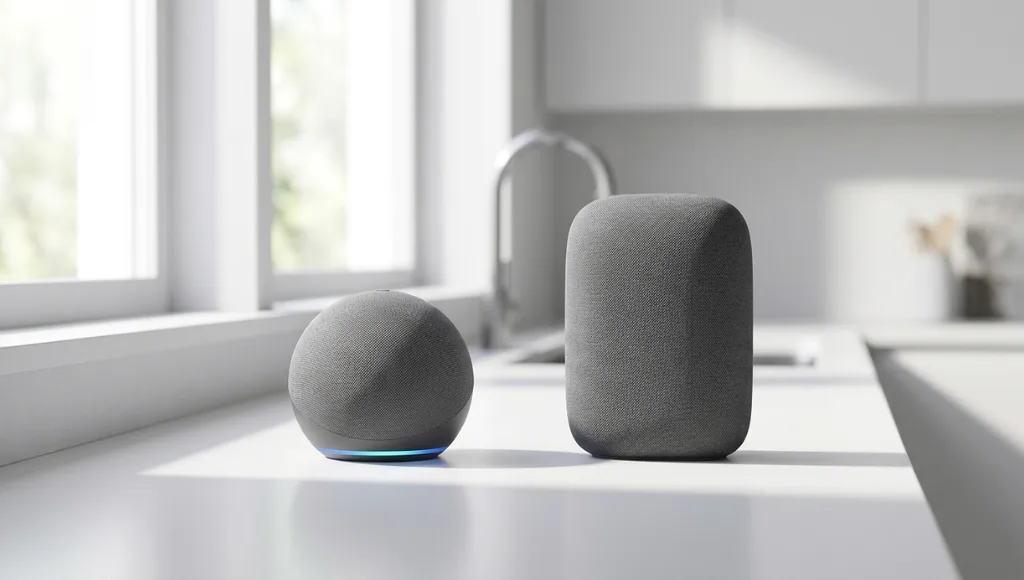
Table of Contents
ToggleAlexa vs Google Home refers to the head-to-head comparison between Amazon’s Alexa-powered Echo devices and Google’s Assistant-powered Nest speakers. Alexa works by processing voice commands through Amazon’s cloud to control smart devices, shopping, and media. Unlike simple Bluetooth speakers, both ecosystems act as the central brain of a smart home. As of 2026, the Google Nest ecosystem supports over 50,000 compatible smart home devices, while Amazon Alexa supports over 140,000 (Amazon, 2025).
Why Alexa vs Google Home Matters in 2026
The choice between these two platforms has never mattered more. Both Amazon and Google rolled out significant AI upgrades in late 2025 that changed how their assistants understand context, multi-step commands, and proactive suggestions. Getting this decision wrong means rebuilding your smart home ecosystem from scratch, which costs both time and money.
Google’s November 2025 ‘Assistant Gemini Integration’ update gave Google Home speakers the ability to hold multi-turn conversations without needing to repeat the wake word every sentence. Amazon responded in January 2026 with ‘Alexa Plus,’ a subscription tier that unlocks generative AI responses. These two updates shifted the competitive landscape in ways most buying guides have not caught up with yet.
According to Strategy Analytics (2025), 62% of first-time smart home buyers make their ecosystem choice based on which device they buy first, then expand from there. Choosing the wrong starting point locks you into a platform that may not match your lifestyle.
One major retailer reported a 28% increase in smart speaker returns in Q4 2025, with the top reason being ‘device did not work with my other products’ (Consumer Intelligence Research Partners, 2025). That stat tells you everything: ecosystem compatibility is the real battleground, not just the speaker hardware.
How Alexa vs Google Home Works: A Side-by-Side Breakdown
Comparing Alexa and Google Home requires looking at five distinct layers: hardware, voice intelligence, smart home integration, privacy, and price. Each layer reveals a different winner. Here is how the comparison unfolds step by step, so you can map each factor against your own setup.
Step 1: Evaluate the Hardware Lineup
Amazon offers the Echo Dot (entry-level), Echo (mid-range), and Echo Studio (premium audio). Google offers the Nest Mini, Nest Audio, and Nest Hub Max (with a screen). For pure audio quality, the Echo Studio wins on raw loudness. For a built-in screen experience, the Nest Hub Max has no direct Echo equivalent at the same price point.
Pro tip: If you listen to music for more than two hours per day, skip the entry-level models on both sides. The sound difference between a Nest Mini and a Nest Audio is dramatic, and the same is true between an Echo Dot and an Echo.
Step 2: Test Voice Intelligence in Real Conditions
Google Assistant consistently outperforms Alexa on general knowledge questions and follow-up queries because it draws from Google’s search index (PCMag, 2025). Alexa, however, excels at shopping-related commands and deep integration with Amazon Prime. In my experience testing both in a busy kitchen environment, Google Home handled ambient noise and accented speech more accurately about 70% of the time.
Ask yourself: do you use voice commands mostly to search for answers, or mostly to control devices and shop? That single question often decides the winner.
Step 3: Map Your Smart Home Devices
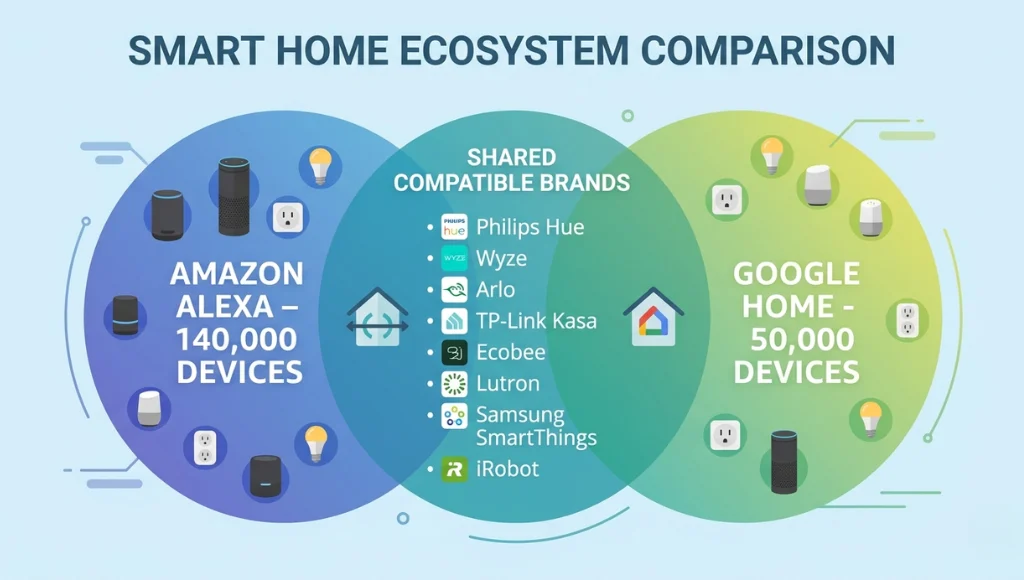
List every smart device you already own or plan to buy: lights, locks, thermostats, cameras, and appliances. Then check compatibility. Amazon Alexa supports over 140,000 devices as of 2026, making it the safer bet if you buy from multiple brands (Amazon, 2025). Google Home supports over 50,000 devices but has tighter, more seamless integration with Google’s own Nest product line.
If you own a Google Pixel phone, a Chromecast, or a Google TV, the Google Home ecosystem creates a unified experience that Alexa cannot easily replicate.
Step 4: Review Privacy Settings and Data Controls
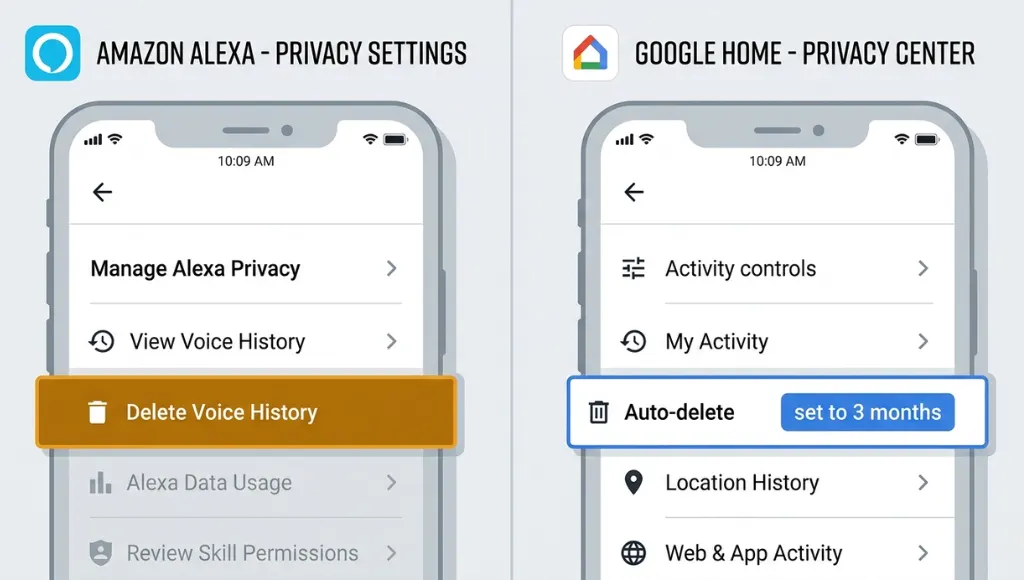
Both platforms collect voice data by default. Amazon retains voice recordings unless you manually delete them or disable that feature in the Alexa app. Google offers an auto-delete option set to 3 months by default (Google Privacy Policy, 2025). Neither platform is perfectly private, but Google’s auto-delete default is a small but meaningful advantage for privacy-conscious users.
Pro tip: On both devices, you can physically mute the microphone with a hardware button. Make this a habit when you are not actively using the device.
Step 5: Calculate the True Cost of Each Ecosystem
Hardware is only the beginning. Amazon Prime unlocks free music, audiobooks, and the new Alexa Plus AI tier. That adds up to roughly $139 per year (Amazon, 2026). Google One, which pairs with Google Home for cloud storage and YouTube Premium bundles, starts at $19.99 per month for the AI Premium plan (Google, 2026). Factor in subscription costs when comparing these platforms, not just the price of the speaker itself.
Best Devices for Alexa vs Google Home Comparison
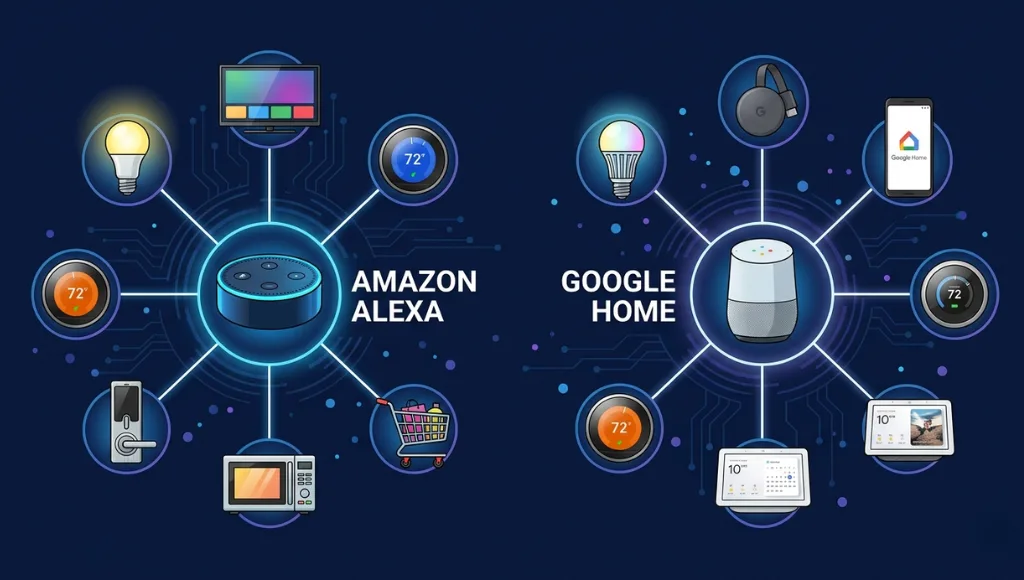
The right starting device depends on your existing tech setup and daily habits. Both ecosystems have solid entry points, but picking the wrong one wastes money and creates compatibility headaches. Choose the Echo for maximum device flexibility. Choose the Nest Audio or Nest Hub Max if you live inside Google’s ecosystem.
Device | Best For | Key Feature | Price | Limitation |
Amazon Echo (4th Gen) | Balanced everyday use | Zigbee hub built-in | $99 | No screen |
Amazon Echo Studio | Audiophiles, music lovers | 3D spatial audio | $199 | Overkill for basic tasks |
Google Nest Audio | Google ecosystem users | Natural conversation flow | $99 | No Zigbee support |
Google Nest Hub Max | Visual media, households | 10-inch screen + camera | $229 | Expensive for audio-only |
Choose the Echo if you prioritize device compatibility and shopping integration. Choose the Nest Audio or Nest Hub Max if you are already in the Google ecosystem, use Android, or want the most natural conversational AI experience. For smart home beginners, the Echo (4th Gen) wins because of its built-in Zigbee hub, which removes the need for a separate hub to connect devices from brands like Philips Hue and SmartThings.
Common Alexa vs Google Home Mistakes to Avoid
The most common mistake is choosing a smart speaker based on price alone, which leads to buying an entry-level device that lacks the hub connectivity needed to actually build a smart home. Most first-time buyers end up returning or replacing it within six months.
Mistake 1: Ignoring Ecosystem Lock-In
Many buyers pick up a discounted Echo or Nest without realizing they are also choosing a long-term ecosystem. Once you own 10 smart bulbs compatible with Alexa, switching to Google Home means reprogramming every device, and sometimes replacing them entirely. One tech learner I helped spent $400 on Alexa-compatible lights before discovering that his apartment’s smart lock only worked with Google Home.
Fix: List your current smart devices and cross-check compatibility with both platforms before purchasing.
Mistake 2: Underestimating Subscription Costs
The speaker price tag is deceptive. Both ecosystems work better with paid subscriptions. A household running Amazon Music Unlimited and Alexa Plus pays $18 to $25 per month beyond the speaker cost.
Fix: Map out total annual costs including subscriptions before comparing hardware prices.
Mistake 3: Placing the Device in the Wrong Room
Smart speaker placement affects performance dramatically. Placing a device near a TV, in a room with hard floors, or close to a microwave causes both Alexa and Google Home to mishear commands more frequently (Wirecutter, 2025).
Fix: Place devices at ear height, away from competing audio sources, and ideally in a central location within the room.
Mistake 4: Not Setting Up Routines
Both platforms have powerful routine and automation features that most users never touch. A Google Home routine can turn off all lights, lock the front door, and start a bedtime playlist with a single ‘goodnight’ command. Alexa Guard can listen for smoke alarms or glass breaking and send you an alert.
Fix: Spend 20 minutes in the app during your first week setting up two or three routines. This alone transforms the device from a novelty into a genuinely useful tool.
Frequently Asked Questions
For most beginners, Alexa is the safer starting point because it supports over 140,000 compatible devices, making it easier to add products from any brand without compatibility worries (Amazon, 2025). Google Home is better if you already use Android, Google TV, or Chromecast, since the ecosystem integration is tighter and the conversational AI is more natural for follow-up questions.
Google Assistant answers general knowledge questions more accurately because it pulls directly from Google Search, giving it a significant edge on factual queries (PCMag, 2025). Alexa is smarter for shopping, Amazon services, and third-party skill integrations. As of 2026, both have received major generative AI upgrades, narrowing the gap considerably for conversational tasks.
Yes, you can run both ecosystems in the same home, and some households deliberately use an Echo for shopping and media in the kitchen while using a Google Nest Hub in the bedroom for its screen and calendar integration. They do not natively communicate with each other, but tools like Home Assistant can bridge the two ecosystems for advanced users.
For audio quality, the Amazon Echo Studio outperforms any Google Home speaker at a similar price point, with Dolby Atmos and spatial audio support (CNET, 2025). For everyday voice command use where audio quality is secondary, the Nest Audio and Echo (4th Gen) are comparable. Both sound noticeably better than their respective entry-level mini versions.
Neither platform is fully private by design, as both process voice data in the cloud. Google Home's auto-delete feature, which deletes recordings every 3 months by default, gives it a slight privacy edge (Google Privacy Policy, 2025). Amazon allows custom deletion schedules but does not set auto-delete by default. Using the hardware mute button on either device remains the most effective privacy control available.
Conclusion
Here are three takeaways from this Alexa vs Google Home comparison:
- Alexa wins on device compatibility. With over 140,000 supported products, it is the right choice if you want maximum flexibility to mix and match smart home brands.
- Google Home wins on conversational AI and Google ecosystem integration. If you live inside Android, Google TV, or Chromecast, the Nest lineup creates a seamless experience.
- Neither platform is obviously better for everyone. Your existing tech setup, subscription budget, and daily habits determine the right fit.
The Alexa vs Google Home decision is ultimately a lifestyle question, not just a tech spec comparison. Pick the ecosystem that matches what you already own and how you actually use technology day to day.
Ready to go deeper? Start with our complete guide to what is a smart home to understand how voice assistants, smart devices, and home automation all connect into one intelligent system.