Mobile Network Virtual Operator: How MVNOs Work in 2026
A mobile network virtual operator is a company that provides mobile communication services without necessarily owning the physical cellular network used to connect its customers.
Instead of building and maintaining thousands of towers, radio equipment, and spectrum assets, the operator typically purchases network capacity from an established mobile network operator (MNO) and sells mobile services under its own brand.
The basic relationship looks like this:
MNO → Network capacity → MVNO → Customer
For example, an MVNO can purchase wholesale access from a major carrier and then create its own pricing, customer service, branding, data packages, and other services.
The important point is that the customer may interact entirely with the virtual operator even though the underlying wireless infrastructure belongs to another company.
The U.S. Federal Communications Commission describes MVNOs as resellers that purchase mobile wireless services from facilities-based providers and resell those services to consumers.

Table of Contents
ToggleHow Does a Mobile Network Virtual Operator Work?
The easiest way to understand a mobile network virtual operator is to separate the mobile service into two layers: the physical network and the customer-facing business.
A traditional MNO invests in physical infrastructure such as:
- Cell towers
- Radio access networks
- Spectrum
- Core network systems
- Transmission infrastructure
- Network operations
- Network maintenance
An MVNO can avoid owning most or all of this infrastructure. Instead, it negotiates an agreement with an MNO or another wholesale provider.
The quality of the underlying connection also matters. Network performance is influenced by factors such as latency, throughput, congestion, and reliability. These principles are important in other network environments as well, including disaster recovery infrastructure. For a deeper look at how network connectivity can affect data replication and reliability, see this guide to recovery database network design.
The MVNO then builds its business around that connectivity.
Its responsibilities may include:
- Creating mobile plans
- Marketing and advertising
- Customer acquisition
- Billing
- Customer support
- SIM or eSIM distribution
- Managing subscriptions
- Developing mobile apps
- Creating specialized services
The precise division of responsibilities depends on the MVNO model.
The GSMA defines an MVNO as a mobile operator that does not own the mobile network infrastructure over which it provides services.
This explains why two mobile brands can offer service in the same geographic area while having completely different pricing, customer experiences, and business strategies.
MNO vs MVNO
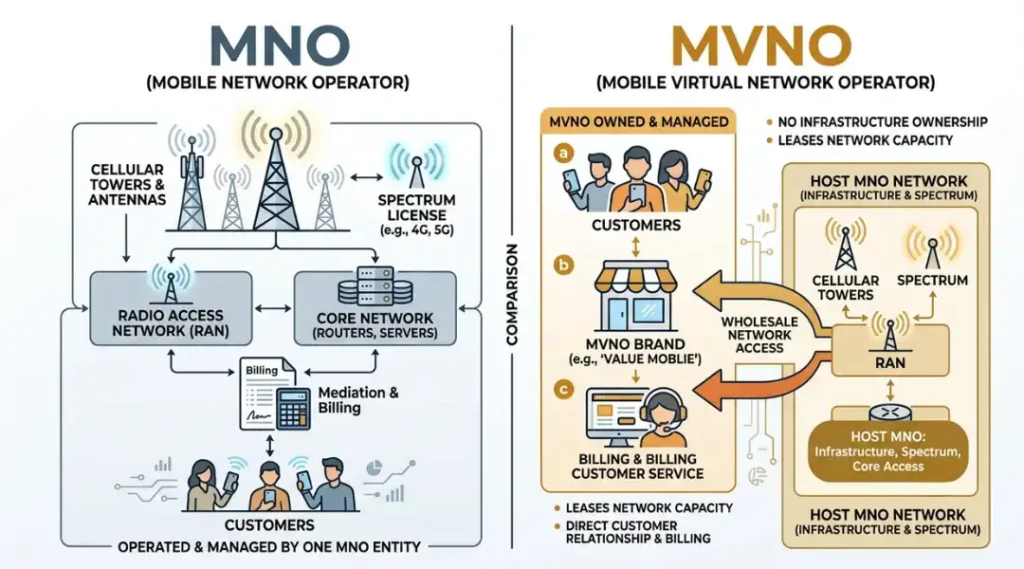
An MNO, or mobile network operator, owns and operates the underlying mobile network infrastructure and spectrum.
An MVNO, or mobile virtual network operator, uses another operator’s network resources to provide mobile services.
| Feature | MNO | MVNO |
|---|---|---|
| Owns cellular infrastructure | Usually yes | Usually no |
| Owns spectrum | Yes | Generally no |
| Builds towers | Yes | Usually no |
| Controls customer brand | Yes | Yes |
| Creates retail plans | Yes | Yes |
| Uses wholesale network access | Not normally | Yes |
| Infrastructure investment | Very high | Usually lower |
This distinction is central to understanding the mobile network virtual operator business model.
Types of Mobile Virtual Network Operators
Not every mobile network virtual operator operates at the same technical level.
MVNOs can have different degrees of control over infrastructure and customer services.
1. Full MVNO
A full MVNO generally has greater control over its own network components, while still relying on an MNO for radio access.
This can give the operator greater flexibility in areas such as:
- Subscriber management
- Core network services
- Interconnection
- Routing
- Billing
- Product development
The Canadian Radio-television and Telecommunications Commission also distinguishes between different MVNO structures based on how much network infrastructure they operate themselves.
2. Light or Thin MVNO
A lighter MVNO depends more heavily on its host MNO or wholesale provider.
The MVNO may concentrate primarily on:
- Branding
- Marketing
- Sales
- Customer support
- Pricing
- Subscriber management
This approach can reduce technical complexity and infrastructure requirements.
3. Branded Reseller
A branded reseller typically has even less control over the technical network environment.
The focus is primarily on selling mobile services under a specific brand or through a particular distribution channel.
4. MVNE-Based Model
A Mobile Virtual Network Enabler (MVNE) can provide technology and operational services that help an MVNO launch and manage its business.
Depending on the arrangement, an MVNE may support:
- Provisioning
- Billing
- SIM management
- Network integration
- Customer management
- Operational platforms
This allows companies to enter the mobile market without building every technical component themselves.
Why Do Companies Launch an MVNO?
There are several reasons a business may choose the MVNO route rather than becoming a traditional network operator.
Lower infrastructure requirements
Building a nationwide cellular network requires substantial capital, spectrum access, engineering resources, and ongoing maintenance.
A mobile virtual network operator can potentially enter the market without duplicating the entire physical network.
Niche customer targeting
MVNOs are often attractive because they can target specific customer groups.
For example, a company could develop plans for:
- Students
- International travelers
- Seniors
- Small businesses
- IoT deployments
- Budget-conscious consumers
- Enterprise customers
- Specific geographic communities
The FCC has noted that MVNOs can target particular demographic, lifestyle, and market niches.
Flexible product strategies
An MVNO can build its differentiation around pricing, customer experience, digital services, or specialized packages instead of competing purely on physical network ownership.
Faster experimentation
A virtual operator can test new plans and customer segments without having to deploy a completely new radio network.
This flexibility can be particularly useful when combined with digital onboarding, eSIM technology, automated customer service, and mobile applications.
Benefits and Limitations of a Mobile Network Virtual Operator
A mobile network virtual operator can offer meaningful advantages, but it is not automatically better than a traditional carrier.
Benefits
Potentially lower operating costs: The operator does not have to duplicate the full physical network.
Competitive pricing: Wholesale network access can allow an MVNO to develop competitive retail plans.
Niche positioning: Smaller operators can concentrate on underserved customer segments.
Brand flexibility: The customer experience can be designed around the MVNO’s own brand.
Digital-first services: eSIM activation, mobile apps, online support, and automated account management can simplify customer onboarding.
Limitations
Dependence on a host network: Network coverage and availability depend heavily on the underlying arrangement.
Wholesale costs: The MVNO still needs to pay for network access.
Potential service limitations: Some plans may have different priority, roaming, speed, or feature conditions compared with the host operator’s direct customers.
Less infrastructure control: A virtual operator may have less control over physical network upgrades and radio performance.
Regulatory requirements: Telecom licensing and compliance requirements vary considerably by country.
Therefore, consumers should evaluate the actual plan rather than assuming that every mobile network virtual operator provides exactly the same experience as the host carrier.
Mobile Network Virtual Operator vs Traditional Carrier
The biggest difference is ownership and control.
A traditional carrier generally invests directly in network infrastructure and spectrum. A virtual operator instead builds its business around access to an existing network.
Think of it like transportation.
A traditional carrier is closer to a company that owns the roads and vehicles.
An MVNO is closer to a company that uses existing transportation infrastructure while creating its own customer-facing service.
This does not mean an MVNO is simply a middleman. Depending on its structure, it can operate sophisticated systems for subscribers, billing, customer management, applications, and even parts of the network core.
That is why the term mobile network virtual operator covers several different business models rather than one identical technical architecture.
What Role Does eSIM Play in MVNOs?
eSIM technology has made digital mobile onboarding considerably more convenient.
Instead of requiring customers to receive and physically insert a traditional SIM card, compatible devices can download an electronic SIM profile.
For an MVNO, eSIM can support a more digital customer journey:
- Customer selects a plan.
- Customer completes online verification.
- The operator provisions the subscription.
- The eSIM profile is downloaded.
- The customer activates mobile service.
This can reduce physical distribution requirements and make it easier for operators to serve customers across different locations.
The GSMA also highlights eSIM and other technologies among areas of interest for MVNOs and MVNEs.
However, eSIM does not eliminate the need for network agreements, regulatory compliance, provisioning systems, or customer support.
How to Choose a Mobile Network Virtual Operator
If you are a consumer evaluating a mobile network virtual operator, do not choose a plan based only on its monthly price.
Use this checklist.
1. Check network coverage
First, identify which underlying network the provider uses in the areas where you live, work, and travel.
Coverage maps are more useful than marketing claims because network availability can vary significantly by location.
2. Compare data policies
Check:
- High-speed data allowance
- Data throttling
- Hotspot limits
- Video streaming restrictions
- Data rollover
- Unlimited-plan conditions
The word “unlimited” does not necessarily mean unlimited high-speed data under every condition.
3. Review calling and texting
If you frequently make international calls, check international calling rates and included destinations.
4. Check roaming
Frequent travelers should examine domestic and international roaming policies carefully.
5. Evaluate customer support
A low-cost plan is less attractive if getting help with activation or billing is difficult.
6. Check eSIM compatibility
If you prefer instant digital activation, verify that the operator supports eSIM and that your device is compatible.
7. Read the fine print
Before purchasing, check activation fees, cancellation terms, taxes, device compatibility, promotional pricing, and any restrictions.
The Future of the Mobile Network Virtual Operator Market
The MVNO model continues to evolve as mobile technology becomes increasingly software-driven.
5G, eSIM, cloud platforms, IoT, artificial intelligence, automated customer support, and digital identity technologies can create new opportunities for virtual operators.
The International Telecommunication Union has also examined MVNOs in the context of 5G policy and future networks.
For businesses, this could mean more specialized mobile services rather than one-size-fits-all connectivity.
For consumers, increased competition can create more choices in pricing and service design.
Regulation will remain an important part of that development. In India, the Department of Telecommunications now provides a dedicated Virtual Network Operator authorization under the 2026 telecommunications authorization framework. The framework covers specific access services that can be provided by a VNO through arrangements with a parent Network Service Operator.
The Indian framework specifically allows eligible virtual network operators to provide defined telecommunications services without owning the underlying network infrastructure.
That makes the MVNO model particularly relevant as telecom markets move toward more flexible service architectures.
Is a Mobile Network Virtual Operator Right for You?
For consumers, a mobile network virtual operator can be a strong choice when the plan offers the right combination of coverage, price, data allowance, customer support, and features.
For businesses, the model can provide an alternative route into mobile services without the enormous infrastructure investment associated with building a nationwide network.
The key is understanding what you are actually buying.
The brand on the SIM or eSIM may not own the towers. That is not necessarily a problem. What matters is the quality of the underlying network agreement, the operator’s service model, pricing, customer support, and the conditions attached to the plan.
In short, a mobile network virtual operator separates the customer-facing mobile business from ownership of the underlying wireless infrastructure. That separation can encourage competition, specialized services, and new ways of delivering connectivity.
As 5G, eSIM, IoT, and software-based telecom platforms continue to develop, the role of virtual operators is likely to become increasingly important.
FAQ: Mobile Network Virtual Operator
A mobile network virtual operator is a company that provides mobile services using network infrastructure supplied by another mobile network operator rather than owning the complete underlying cellular network itself.
No. An MNO generally owns and operates the underlying mobile network infrastructure and spectrum. An MVNO uses network access obtained from another operator and focuses on its own mobile service and customer offering.
It depends on the MVNO model. Some virtual operators control parts of the network core and other infrastructure, while lighter MVNOs rely more heavily on their host operator.
Often, yes. An MVNO typically obtains access to an established operator's wireless network. However, the exact network arrangement and service conditions vary by provider and country.
They can be, but not always. MVNOs may have lower infrastructure costs and can use those economics to compete on price. Customers should compare the complete plan, including data limits, coverage, roaming, fees, and support.
Yes. An MVNO can offer 5G service when its network agreement, technical platform, plan, device, and host network support 5G.
Many MVNOs support eSIM, but compatibility varies. Customers should check both the device and the specific MVNO plan before purchasing.
Telecom regulation varies by country. MVNOs may need specific authorisations, registrations, licences, or commercial arrangements depending on the services they provide and the jurisdiction in which they operate.