AI Governance
Artificial intelligence is transforming industries at a pace that regulators, executives, and society are still racing to keep up with. As AI systems make decisions that affect hiring, lending, healthcare, and national security, one question has risen to the top of every boardroom agenda: who is accountable when AI gets it wrong? The answer lies in AI governance the policies, frameworks, tools, and oversight mechanisms that ensure AI systems behave safely, fairly, and responsibly.
This comprehensive guide covers everything you need to know about AI governance: what it is, why it matters, how to implement it, which frameworks lead the industry, and which tools can help your organization stay compliant in an increasingly regulated world.
Whether you are a technology leader building your first AI governance policy, a compliance officer evaluating enterprise AI governance platforms, or a researcher exploring AI ethics and governance, this pillar page is your definitive starting point.
Key Stat
The global AI governance market is projected to exceed $1.8 billion by 2030, driven by surging regulatory activity across the EU, US, UK, and Asia-Pacific regions. Organizations that invest early in AI governance frameworks are 3x more likely to avoid costly compliance penalties and reputational damage.
Table of Contents
ToggleWhat Is AI Governance?
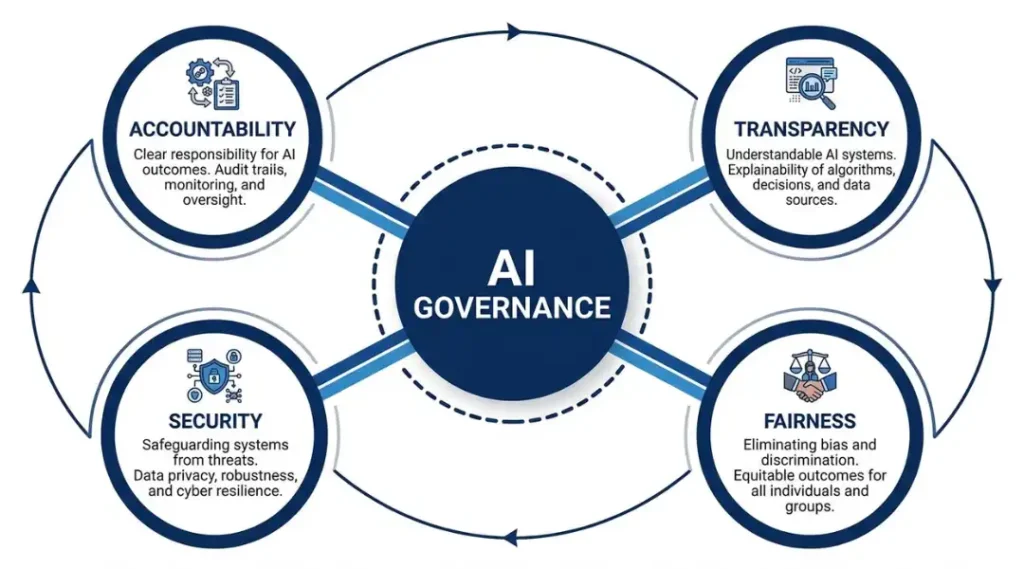
AI governance refers to the set of rules, standards, processes, and organizational structures that guide how artificial intelligence systems are designed, deployed, monitored, and retired. It encompasses both the technical controls applied to AI models and the institutional policies that govern human oversight of those models.
At its core, AI governance answers three fundamental questions:
- Who is responsible when an AI system causes harm or makes an error?
- How do we ensure AI systems are fair, transparent, and aligned with human values?
- What processes exist to identify, document, and mitigate AI-related risks?
Unlike traditional software governance, AI governance must address unique challenges such as model opacity (the ‘black box’ problem), data bias, emergent behavior, and the speed at which AI capabilities evolve. It draws on disciplines including law, ethics, data science, risk management, and organizational design.
AI governance is often confused with AI ethics and AI regulation, but these are distinct concepts. AI ethics refers to the moral principles guiding AI development. AI regulation refers to legally binding government rules. AI governance is the operational layer that translates both into concrete organizational practice it is how an organization actually implements responsible AI on a day-to-day basis.
AI Governance for SaaS Companies
SaaS companies building or integrating AI features face governance requirements that are more immediate and more commercially consequential than those facing most other businesses. When your product uses AI to make decisions that affect customers such as automated scoring, content moderation, recommendations, or pricing, your governance framework is no longer an internal compliance matter. It becomes a product liability question.
Enterprise buyers evaluating SaaS tools in 2026 increasingly require vendors to provide AI transparency documentation as part of procurement due diligence. That means SaaS companies need governance policies that are externally legible and not just internally understood.
The governance principles covered in this article apply to SaaS product teams building AI features and not just large enterprises deploying third-party models. If your product description includes the words “AI-powered,” “machine learning,” or “automated,” the frameworks here are directly relevant to how you document, audit, and communicate how your system makes decisions.
Why AI Governance Matters in 2026
The case for robust AI governance has never been stronger. In 2025, AI systems are embedded in financial credit scoring, medical diagnostics, criminal justice risk assessment, and content moderation. The consequences of ungoverned AI range from individual harm to systemic societal risk.
The scale of this challenge is well documented. As analysis across enterprise deployments consistently shows, AI transformation is a problem of governance long before it becomes a problem of technology. Organizations that deploy AI without governance infrastructure are building on a foundation that regulatory and reputational pressure will eventually expose.
Regulatory Pressure Is Accelerating
The EU AI Act, the world’s first comprehensive AI regulation, came into full effect in 2025. It mandates strict requirements for high-risk AI systems, including mandatory conformity assessments, transparency obligations, and human oversight provisions. Organizations that fail to comply face fines of up to 35 million euros or 7% of global annual turnover.
In the United States, the Biden-era AI Executive Order created voluntary commitments, while states including Colorado, California, and Illinois have enacted their own AI-specific legislation covering algorithmic discrimination and automated decision-making. In the UK, the AI Safety Institute continues its frontier model evaluations.
The Business Case for AI Governance
Beyond compliance, strong AI governance delivers competitive advantages:
- Investor confidence: ESG frameworks increasingly include AI risk as a key metric for institutional investors
- Customer trust: 78% of enterprise buyers cite transparent AI practices as a purchasing criterion (Gartner, 2024)
- Operational resilience: Governed AI systems fail more gracefully, reducing costly outages and liability
- Talent retention: Employees prefer organizations with clear ethical AI standards
- Partner requirements: Many enterprise procurement contracts now require AI governance documentation as a condition of partnership
The Reputational Cost of Getting It Wrong
High-profile AI failures in 2023 and 2024 including biased hiring algorithms, discriminatory credit models, and AI-generated misinformation at scale led to class-action lawsuits, regulatory investigations, and significant stock value losses. The reputational cost of a single major AI governance failure can exceed hundreds of millions of dollars.
Industry Insight
According to IBM’s 2024 Global AI Adoption Index, 42% of companies globally have deployed AI in production, yet only 24% report having a formal AI governance program. This gap represents both significant risk and a strategic opportunity for organizations that act first.
Core Pillars of a Responsible AI Governance Framework
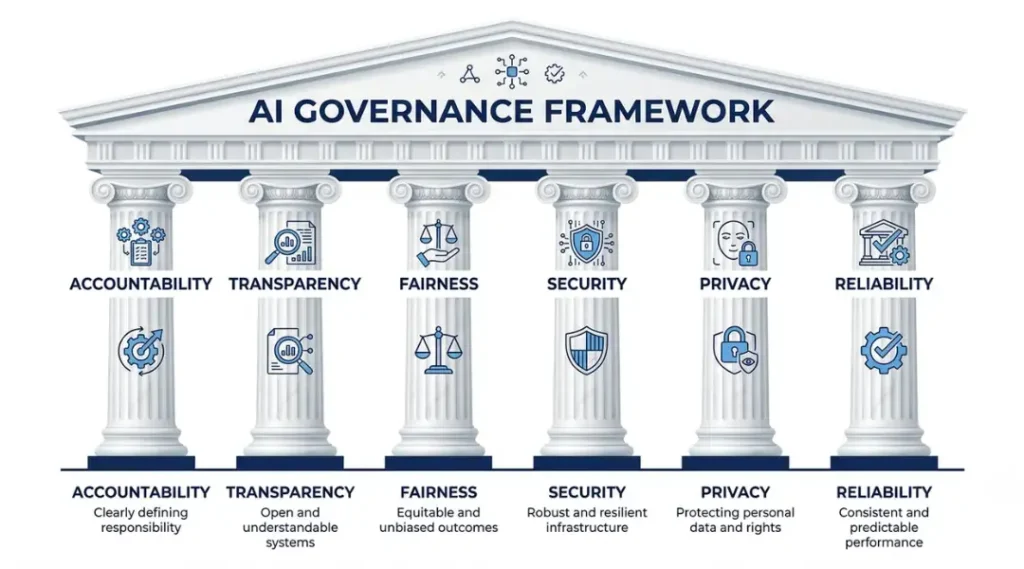
A robust AI governance framework is built on six interconnected pillars. Each pillar addresses a distinct dimension of responsible AI and requires specific policies, tools, and human oversight to operationalize.
Accountability
Every AI system must have a clearly designated owner who is responsible for its behavior. Accountability structures include a designated AI owner or product manager, a clear escalation path for AI-related incidents, board-level AI oversight in regulated industries, and regular governance reviews tied to model update cycles.
Accountability also extends to third-party AI vendors. Organizations using external AI systems such as large language models, computer vision APIs, or credit scoring engines must ensure contractual accountability mechanisms are in place. This is addressed in detail in our guide to AI model governance.
Transparency
Transparency requires that AI systems and their decision-making processes are explainable to relevant stakeholders including users, regulators, and internal auditors. This does not necessarily mean exposing proprietary algorithms, but it does mean:
- Documenting model architecture, training data sources, and known limitations in model cards
- Providing plain-language explanations to individuals affected by automated decisions
- Maintaining audit logs of model inputs, outputs, and version history
- Publishing transparency reports for customer-facing AI systems
Fairness and Non-Discrimination
AI systems trained on historical data often inherit and amplify existing societal biases. Fairness governance requires organizations to proactively identify, measure, and mitigate bias across protected characteristics including race, gender, age, disability, and religion.
Fairness metrics such as demographic parity, equalized odds, and calibration must be selected based on the specific context and impact of the AI system. A single fairness metric is rarely sufficient – organizations typically need a balanced portfolio of metrics reviewed by both technical teams and domain experts.
Privacy and Data Governance
AI systems consume vast amounts of data, often including personal and sensitive information. A strong AI governance policy integrates with data governance to ensure compliance with GDPR, CCPA, HIPAA, and sector-specific regulations. Privacy-by-design principles – including data minimization, purpose limitation, and differential privacy techniques should be embedded in the AI development lifecycle from the earliest stages.
Security and Robustness
AI systems face unique security threats including adversarial attacks, model inversion attacks, prompt injection, and data poisoning. AI governance frameworks must include AI-specific security controls beyond traditional cybersecurity measures, with input from red teams specialized in AI vulnerabilities.
Organizations can reference MITRE ATLAS (Adversarial Threat Landscape for AI Systems) to map known adversarial tactics and techniques specific to AI into their security governance controls.
Reliability and Performance Monitoring
Model performance degrades over time as real-world data distributions shift – a phenomenon known as model drift or data drift. Continuous monitoring of AI system performance against defined KPIs is a non-negotiable governance requirement. This includes automated alerting when models perform below threshold, periodic revalidation, and clear criteria for model decommissioning.
Types of AI Governance Frameworks: A Global Overview
Multiple AI governance frameworks have emerged from governments, standards bodies, and industry consortia. Understanding the landscape helps organizations choose the right foundation for their own governance program.
NIST AI Risk Management Framework (AI RMF)
The National Institute of Standards and Technology’s AI RMF, published in January 2023, provides a voluntary, technology-neutral framework organized around four core functions: GOVERN, MAP, MEASURE, and MANAGE. It is the most widely adopted framework in North America and is increasingly referenced by regulators globally. Its companion Playbook provides specific practices mapped to each function.
EU AI Act Framework
The EU AI Act introduces a risk-based classification system: unacceptable risk (prohibited), high risk (strictly regulated), limited risk (transparency obligations), and minimal risk (self-regulatory). High-risk categories include AI used in critical infrastructure, education, employment, essential services, law enforcement, and democratic processes. This regulatory framework is reshaping how multinational organizations design and document their AI systems.
ISO/IEC 42001: AI Management System Standard
Published in 2023, ISO/IEC 42001 is the first international standard specifically for AI management systems. Modeled on the ISO 27001 structure familiar to information security teams, it provides certifiable requirements for establishing, implementing, maintaining, and improving an AI management system. Achieving ISO 42001 certification is increasingly seen as a trust signal in enterprise procurement.
OECD AI Principles
Adopted by 46 countries, the OECD AI Principles provide a values-based international reference. They cover inclusive growth, human-centered values, transparency, robustness, and accountability. While not enforceable, they inform the design of national regulatory frameworks worldwide.
IEEE Ethically Aligned Design
The IEEE’s framework focuses specifically on the technical and engineering dimensions of AI ethics, providing guidance for AI system designers and developers. It is particularly relevant for organizations building AI products rather than deploying third-party systems.
Framework Selection Tip
Most enterprise organizations benefit from a layered governance approach: use NIST AI RMF as your operational backbone, align to ISO 42001 for certification readiness, and map your controls to the EU AI Act for regulatory compliance. If you operate in multiple markets, the OECD Principles provide the common language that bridges national frameworks.
How to Build an AI Governance Policy: Step-by-Step
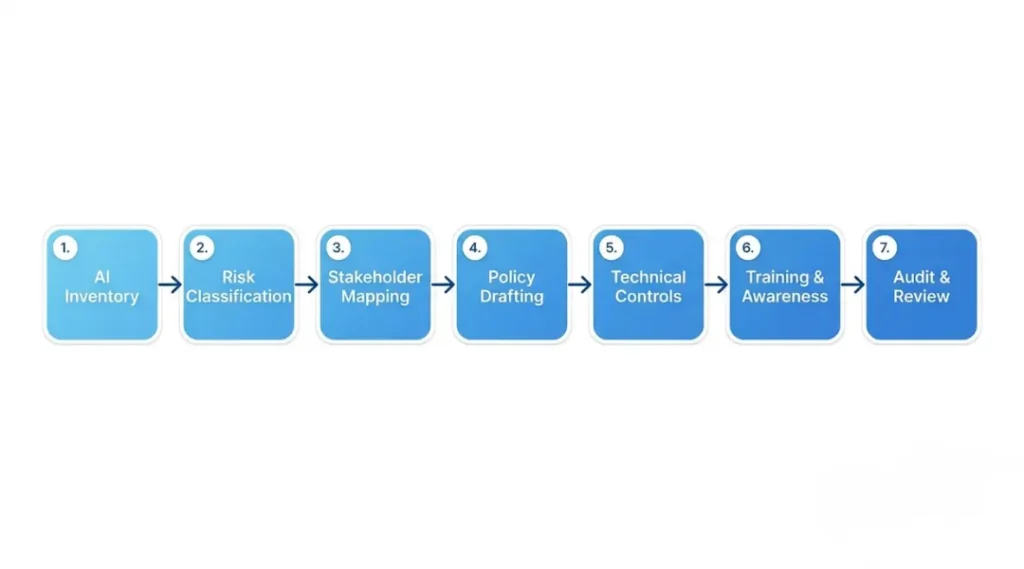
Building a comprehensive AI governance policy requires cross-functional collaboration across legal, IT, risk management, data science, and business leadership. The following seven-step process provides a proven pathway from initial assessment to operational governance.
Step 1: Conduct an AI Inventory
You cannot govern what you cannot see. Begin by cataloging every AI system your organization develops, deploys, or procures. For each system, document its purpose, the data it uses, who makes decisions with its outputs, and any existing risk assessments. Many organizations are surprised to discover the breadth of AI already in use across functions.
Step 2: Classify AI Systems by Risk Level
Apply a risk tiering model adapted from the EU AI Act or NIST AI RMF. Categorize each AI system as high, medium, or low risk based on the severity and reversibility of potential harm, the breadth of people affected, the degree of human oversight in the decision process, and the sensitivity of data used.
Step 3: Map Stakeholders and Accountability Roles
Assign a named owner, a governance committee sponsor, a data steward, and a technical reviewer to each AI system. Define escalation paths and incident response responsibilities. In large organizations, this may require creating a dedicated AI governance office or appointing a Chief AI Ethics Officer.
Step 4: Draft Your AI Governance Policy Document
Your formal policy document should cover: the scope and applicability of the policy, principles guiding AI development and use, roles and responsibilities, the AI lifecycle governance process (from development through decommissioning), data governance requirements, third-party AI vendor management, incident reporting and response procedures, and the review and update cadence.
“Organizations operating in or selling into European markets should cross-reference the EU AI Act official text to ensure policy content meets mandatory documentation and transparency obligations for high-risk AI systems.
Step 5: Implement Technical Controls
Policy without technical enforcement is aspirational at best. Technical controls for AI governance include model cards and datasheets for every production model, automated bias testing integrated into CI/CD pipelines, model monitoring dashboards with drift alerts, explainability tooling for regulated decisions, access control and audit logging for AI systems, and version control for models and training data.
Step 6: Train and Embed Governance Culture
Governance policies fail when they exist only as documents. Effective implementation requires role-specific training for data scientists, product managers, legal teams, and executives. Regular governance workshops, AI ethics case studies, and a clear speak-up culture for reporting concerns are essential components.
Step 7: Establish Audit, Review, and Continuous Improvement
AI governance is not a one-time project. Establish a regular audit cadence at minimum annually for low-risk systems and quarterly for high-risk ones. Track governance KPIs including the percentage of AI systems with current risk assessments, time to resolve AI-related incidents, and training completion rates. Review and update the governance policy whenever significant regulatory changes occur or major new AI capabilities are deployed.
AI Governance Tools and Platforms
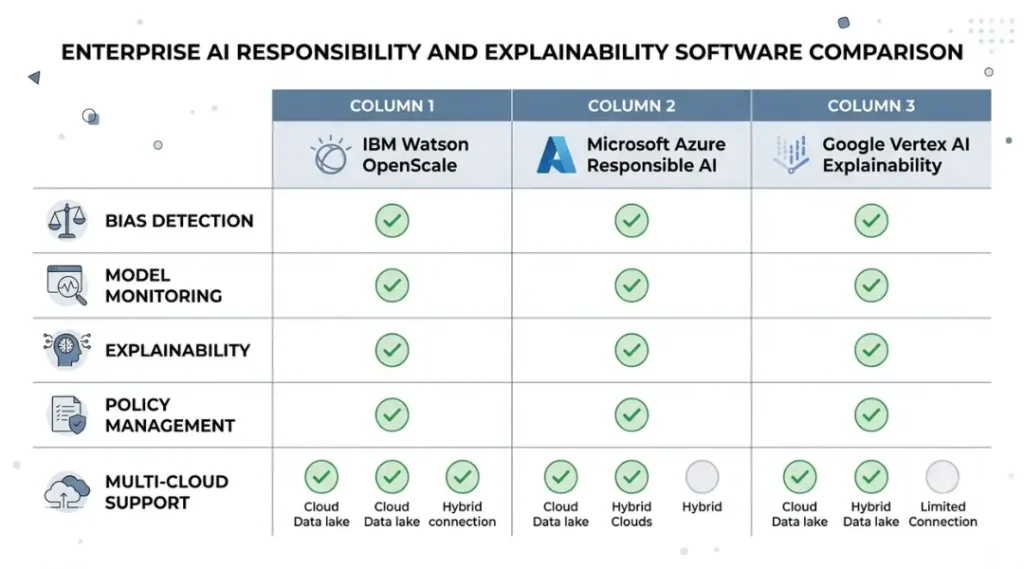
A growing ecosystem of AI governance tools and platforms has emerged to help organizations move from policy to practice. These tools span the AI lifecycle from development through monitoring and provide the technical infrastructure that makes governance scalable.
Core Categories of AI Governance Tools
- Model monitoring and observability: Detect performance degradation, drift, and anomalies in production AI systems
- Bias detection and fairness testing: Identify disparate impact across demographic groups before and after deployment
- Explainability and interpretability: Generate human-readable explanations for model predictions
- Model documentation automation: Streamline creation of model cards, datasheets, and risk assessments
- Policy management and audit: Track governance requirements, control mapping, and compliance evidence
- AI asset registry: Centralized catalog of all AI systems with risk classifications and ownership metadata
Leading AI Governance Platforms
IBM OpenPages with Watson: Integrates AI governance with broader enterprise risk management. Strong in regulated industries such as financial services and healthcare, with built-in support for NIST AI RMF and EU AI Act control mapping.
Microsoft Azure Responsible AI: Embedded within Azure ML, providing Responsible AI dashboards, error analysis, fairness assessment, and model cards. Particularly strong for organizations already standardized on the Microsoft stack.
Google Vertex AI Explainability and Model Monitoring: Provides feature attribution, training-serving skew detection, and prediction drift monitoring natively within the Vertex AI platform.
Fiddler AI: Dedicated AI observability platform with advanced explainability, fairness, and NLP monitoring capabilities. Popular with financial services firms for model risk management compliance.
Credo AI: Purpose-built AI governance platform with policy-to-control mapping, risk assessments, and compliance reporting aligned to regulatory frameworks including the EU AI Act and NIST AI RMF.
Holistic AI: Provides AI auditing services and governance software, with particular strength in bias auditing and regulatory compliance documentation.
AI Model Governance: Managing the AI Lifecycle
AI model governance is a subset of AI governance focused specifically on the technical management of AI models throughout their lifecycle. It is the operational heartbeat of your governance program, ensuring that every model in production is documented, monitored, and managed to standard.
The AI Model Lifecycle
- Data collection and labeling: Documenting data sources, quality checks, labeling methodologies, and known biases
- Model development and training: Version-controlled code, experiment tracking, hyperparameter documentation
- Model evaluation and validation: Performance benchmarks, fairness testing, adversarial testing, human review for high-risk systems
- Deployment: Staged rollouts, shadow deployment, A/B testing, rollback procedures
- Production monitoring: Real-time performance tracking, drift detection, usage anomaly alerting
- Retraining and updates: Triggered by drift alerts or scheduled reviews, with full documentation of changes
- Decommissioning: Formal retirement process including stakeholder notification, data archival, and audit documentation
Model Cards and Datasheets
Model cards are structured documents that describe an AI model’s intended use, performance characteristics, ethical considerations, and known limitations. First introduced by Google researchers in 2018, model cards have become a governance standard adopted by organizations including Hugging Face, Microsoft, and IBM.
Datasheets for datasets (inspired by the influential Gebru et al. paper) serve the equivalent purpose for training data, documenting provenance, collection methodology, demographic representation, and intended use cases.
Model Risk Management in Financial Services
In the financial services sector, AI model governance intersects directly with SR 11-7 model risk management guidance from the Federal Reserve and OCC. AI models used for credit scoring, fraud detection, and anti-money laundering are subject to formal validation requirements including independent review, ongoing monitoring, and outcome analysis. Organizations must be prepared to produce comprehensive model documentation on regulatory request.
Challenges in Implementing AI Governance
Despite growing awareness, many organizations struggle to move from governance intentions to operational reality. Understanding the most common barriers helps teams design more effective governance programs from the outset.
- Organizational silos: AI governance requires coordination between legal, IT, data science, risk, and business units that often operate independently with different priorities and vocabularies.
- Speed of AI development: Governance processes designed for traditional software can become bottlenecks that slow AI deployment velocity, creating pressure to bypass controls.
- Talent gaps: AI governance requires hybrid expertise in both technical AI systems and regulatory compliance a rare combination that is difficult and expensive to hire for.
- Vendor opacity: Many commercial AI systems are provided as black boxes with limited documentation, making meaningful risk assessment and governance challenging.
- Framework fragmentation: The proliferation of national and sector-specific AI regulations creates compliance complexity for multinational organizations.
Keeping pace with capability changes: Generative AI has introduced new governance challenges including hallucination, deepfakes, and prompt injection – that existing frameworks were not designed to address.
AI Governance Best Practices for Enterprises
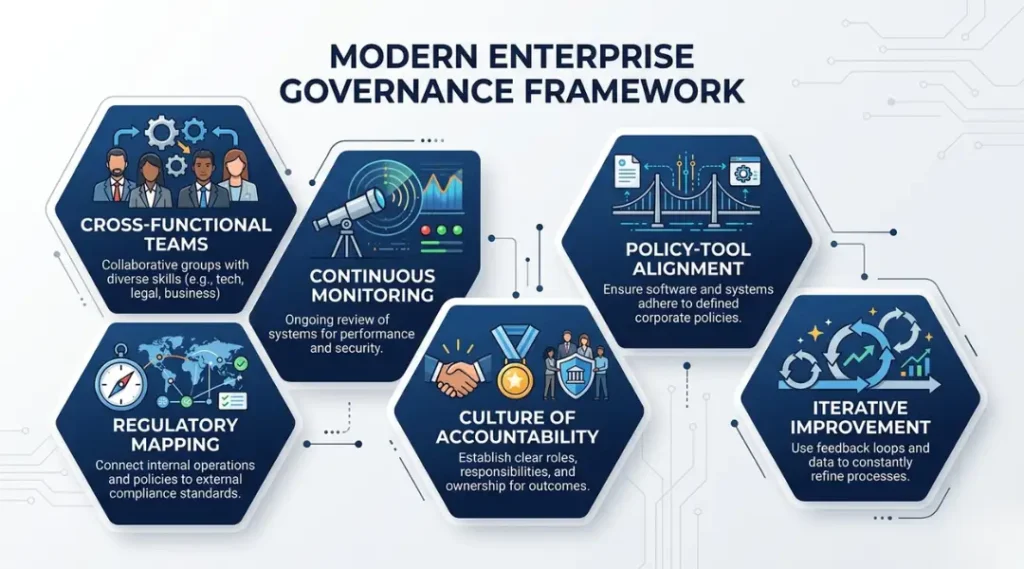
Organizations with mature AI governance programs share a set of common practices that translate policy into measurable outcomes. The following best practices are drawn from analysis of leading programs across financial services, healthcare, technology, and government sectors.
Start with Governance by Design
The most effective AI governance is embedded in the AI development process from day one, not bolted on afterward. Integrate governance checkpoints into your AI development lifecycle at every stage: design review, data selection, model evaluation, deployment approval, and periodic review. Governance-by-design is both more effective and less costly than retrospective remediation.
Build a Cross-Functional AI Governance Committee
AI governance decisions require diverse expertise. Effective governance committees include representation from legal and compliance, data science and engineering, risk management, product management, and business leadership. This ensures governance decisions are both technically sound and commercially realistic, while maintaining regulatory alignment.
Invest in Governance Tooling Early
Manual governance processes do not scale. Invest in AI governance platforms, model monitoring tools, and automated bias testing infrastructure before your AI portfolio grows to the point where manual oversight becomes impossible. The ROI on governance tooling in terms of avoided incidents and compliance efficiency is typically realized within 12 to 18 months.
Align Governance to Business Risk Appetite
Not every AI system requires the same level of governance rigor. Calibrate your governance investment to the risk profile of each AI system. A low-risk internal productivity tool requires lighter governance than a customer-facing credit decision model. This risk-proportionate approach ensures governance resources are allocated where they matter most.
Document Everything
In the event of a regulatory investigation or litigation, your documentation is your defense. Maintain comprehensive records of model development decisions, risk assessments, testing results, governance approvals, and monitoring data. Store this documentation in a governed repository with clear ownership, version history, and retention policies.
Measure and Report Governance Effectiveness
What gets measured gets managed. Define and track a governance scorecard with metrics including the percentage of AI systems with current risk assessments, mean time to resolve governance findings, bias testing coverage, and training completion rates. Report these metrics to senior leadership quarterly to maintain visibility and accountability.
For cross-industry benchmarking on AI adoption and governance maturity, the annual Stanford HAI AI Index Report provides one of the most comprehensive independent datasets available to enterprise governance teams.
The Future of AI Governance
AI governance is not a static discipline. The rapid evolution of AI capabilities particularly the rise of generative AI, autonomous AI agents, and multimodal AI systems is forcing governance frameworks to evolve in real time.
Generative AI Governance
Generative AI presents governance challenges that legacy frameworks were not designed to address. These include hallucination and factual inaccuracy in high-stakes contexts, copyright and intellectual property risks from training data, potential for AI generated misinformation and synthetic media, and novel attack vectors such as prompt injection and jailbreaking. Organizations deploying generative AI systems need governance policies that specifically address these characteristics, including human review workflows for high-stakes outputs and clear disclosure requirements for AI-generated content.
Autonomous AI Agents
The emergence of AI agents systems that can take autonomous actions in the world, including browsing the web, executing code, and interacting with external services raises the governance stakes substantially. Agent governance requires robust sandboxing and permission controls, clear boundaries on autonomous action scope, mandatory human-in-the loop for consequential decisions, and comprehensive audit logging of agent actions.
International AI Governance Harmonization
The current fragmentation of national AI regulatory frameworks creates significant compliance complexity for global organizations. International harmonization efforts including the Council of Europe’s AI Convention, the G7 Hiroshima AI Process, and bilateral AI agreements between major trading partners are working toward greater consistency. Organizations should monitor these developments and design their governance architecture for adaptability rather than point-in-time compliance.
“The Council of Europe Framework Convention on Artificial Intelligence represents the first legally binding international treaty on AI, and organizations building global governance architectures should map their controls against its requirements now rather than waiting for national transposition.”
AI Governance as Competitive Advantage
Forward-looking organizations are beginning to treat AI governance not merely as a compliance burden but as a source of competitive differentiation. Certified, governed AI systems can command premium pricing, win regulated industry contracts, and build the customer trust that translates into long-term revenue. The organizations that invest in governance infrastructure today will be best positioned to scale AI safely and profitably as the regulatory environment matures.
The regulatory and technical landscape around AI governance shifts rapidly. Staying current with AI governance news ensures your governance program adapts to emerging risks, new regulatory guidance, and industry developments before they become compliance gaps.
Conclusion: AI Governance Is Not Optional
AI governance has crossed the threshold from optional best practice to operational imperative. As AI systems become more capable, more pervasive, and more consequential, the organizations that treat governance as a strategic investment rather than a compliance checkbox will be the ones that earn lasting trust from customers, regulators, and society.
The good news is that the frameworks, tools, and expertise needed to build effective AI governance programs exist today. Whether you are starting from scratch or maturing an existing program, the seven-step policy framework, pillar-based governance model, and platform ecosystem described in this guide provide a comprehensive foundation.
At Zprostudio, we publish in-depth resources on AI governance, digital strategy, and enterprise technology. Explore our related guides on AI governance frameworks, AI governance platforms, AI governance policies, and AI model governance to continue building your knowledge and your program.
Start your AI governance journey today. The cost of waiting is growing every quarter.
Frequently Asked Questions About AI Governance
AI governance is the set of rules, processes, and oversight structures that ensure AI systems are developed and used responsibly, safely, and fairly. Think of it as the management system for AI - it defines who is accountable, how risks are managed, and how compliance is maintained.
AI regulation refers to legally binding government laws that mandate specific requirements for AI systems - such as the EU AI Act. AI governance refers to an organization's internal policies, processes, and controls for responsible AI. Governance is how organizations implement and operationalize regulatory requirements internally.
The best framework depends on your industry, geographic markets, and risk profile. Most North American organizations start with the NIST AI RMF. Organizations seeking certification choose ISO/IEC 42001. Companies operating in or selling to the EU must align to the EU AI Act. A layered approach that maps controls across multiple frameworks is increasingly the standard for enterprise organizations.
AI governance tools include platforms for model monitoring, bias detection, explainability, model documentation, policy management, and AI asset registry. Leading platforms include IBM OpenPages, Microsoft Azure Responsible AI, Credo AI, Fiddler AI, and Holistic AI.
A basic AI governance program - including an AI inventory, risk classification, a formal policy, and initial technical controls - can be established in 3 to 6 months for most mid-sized organizations. A mature, fully operational governance program with comprehensive tooling, auditing, and culture integration typically takes 12 to 24 months to develop.
AI model governance is the subset of AI governance focused specifically on managing AI models throughout their lifecycle - from development and training through deployment, monitoring, retraining, and eventual decommissioning. It ensures every model in production is documented, tested, monitored, and managed to defined standards.
In an increasing number of contexts, yes. The EU AI Act makes specific AI governance requirements legally mandatory for high-risk AI systems. Financial services regulators in the US, UK, and EU require model risk management practices that constitute functional AI governance. Many procurement contracts in regulated industries now require documented AI governance as a supply chain requirement. Even where not legally mandated, the reputational and operational risks of ungoverned AI make governance a practical necessity.