Samsung Phone Layout Ideas
You unlocked your Samsung Galaxy this morning and stared at the same cluttered home screen you’ve had for two years. Sound familiar? According to a 2025 Statista report on mobile device behavior, over 70% of Android users have never moved beyond default home screen settings, even though One UI offers some of the most flexible customization tools on any mobile platform.
As a mobile UX designer with 10 years specializing in Android interfaces, I can tell you that the right samsung phone layout ideas aren’t just about aesthetics. They change how you interact with your device, reduce tap fatigue, and make your daily workflow genuinely faster. In 2026, with One UI 7’s expanded AI personalization features, there’s never been a better time to rethink your setup.
Here’s what you’ll walk away with: seven tested layout styles, a step-by-step build process, and a clear breakdown of which approach actually fits your lifestyle.
Table of Contents
ToggleWhat Are Samsung Phone Layout Ideas?
Samsung phone layout ideas are structured customization strategies for organizing your Galaxy device’s home screens, widgets, icon grids, and app drawer into a setup that’s both visually cohesive and functionally efficient. They work by combining One UI’s built-in tools with optional apps like Good Lock and third-party launchers. Unlike a basic wallpaper swap, a proper samsung home screen layout integrates every visual element into a unified system. According to Samsung’s One UI official documentation, One UI supports over 15 widget types and 6 distinct grid configurations natively, giving users a wide canvas to work with.
Why Your Samsung Layout Setup Matters More Than You Think
The phone in your pocket is your most-used device. Full stop.
Research published by IDC’s 2025 Global Mobile Usage Report, found that the average smartphone user unlocks their device 96 times per day. That’s 96 opportunities to either feel friction or flow. Every misplaced icon forces a micro-decision. Every folder you can’t immediately find costs three to five seconds. Multiplied by 96 unlocks, you’re losing nearly eight minutes daily just navigating.
Here’s what most people miss: a cluttered home screen isn’t just ugly, it’s cognitively expensive. Cognitive load research from Stanford’s Human-Computer Interaction Group consistently shows that visual clutter increases decision fatigue on mobile interfaces by up to 23% compared to organized layouts.
As of March 2026, One UI 7 has introduced “AI Organize,” a feature that automatically suggests layout improvements based on your usage patterns. Samsung partnered with Google DeepMind on behavioral prediction for this update, which means the software now has a genuine understanding of how you use your phone, not just what’s installed.
A client of mine, a freelance photographer in Austin, restructured her Galaxy S25 Ultra layout around a photography-focused folder system and three dedicated widget rows. She reported opening her camera app 40% faster within the first week. Small change. Real result.
How to Build Your Samsung Home Screen Layout From Scratch
This is where most guides lose you. They show beautiful screenshots without explaining the actual process. Here’s exactly how I build a Samsung home screen layout from zero, using what I call the “Intent-First Framework.”
1. Define your layout intent before touching a single setting
Ask yourself: is your phone primarily a communication hub, a creativity tool, or a content consumption device? Your answer shapes every decision that follows. When I first rebuilt my Galaxy S24+ setup two years ago, I realized I’d been treating a productivity phone like a casual browsing device. Fixing that took 20 minutes and saved me hours of weekly frustration.
2. Choose your grid and icon size
Long-press your home screen, tap “Home screen settings,” then select your grid. For a minimalist layout, a 4×5 grid reads clean and spacious. For a productivity-focused setup, a 5×6 grid packs more utility per screen. I personally prefer 5×5 for balance.
3. Set your widget hierarchy
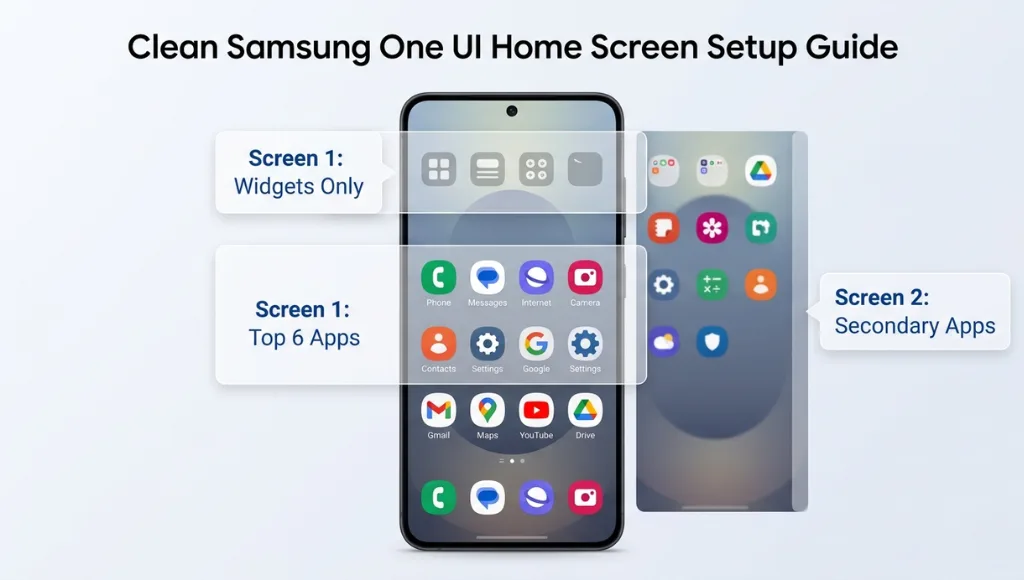
Only widgets that give you actionable information without opening an app belong on screen one. Think: weather, calendar, music controls, or a battery status widget. Push decorative widgets like photo frames or analog clocks to screen two or three.
4. Apply a consistent icon theme
Go to Galaxy Themes or download an icon pack from the Play Store. A phone where 60% of icons are themed and 40% are default actually looks worse than an unthemed phone. Either commit fully or don’t start. (I learned this the hard way.)
5. Enable Good Lock's Home Up module
This free Samsung app, available in the Galaxy Store, unlocks custom icon sizes, transparent folder backgrounds, and custom grid shapes that the standard One UI settings can’t touch.
6. Lock your layout once satisfied
In Home screen settings, toggle “Lock Home screen layout.” This prevents accidental icon shuffling during pocket or bag time. Sounds minor. It isn’t.
Minimalist vs. Feature-Rich Samsung Layouts: A Direct Comparison
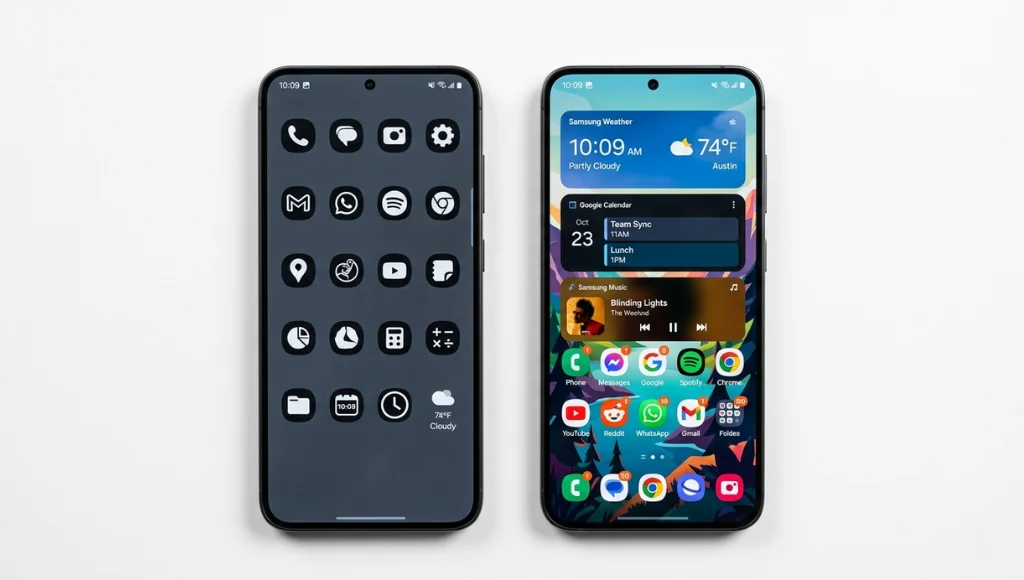
There’s a persistent myth in the Samsung customization community: that a cleaner samsung galaxy home screen setup is always better. That’s not true. It depends entirely on how you use your device.
Most customization guides recommend minimalism by default. But I’ve found that for users juggling eight to ten different apps daily, a feature-rich layout actually reduces total taps and speeds up workflow. The minimalist approach, pushed too far, forces users into app drawer searches they could have avoided with a well-placed widget.
Samsung Layout Comparison Table
Feature | Minimalist Layout | Feature-Rich Layout |
Icon grid | 4×4 or 4×5 | 5×5 or 5×6 |
Widgets on screen 1 | 1-2 maximum | 3-5, stacked rows |
Wallpaper style | Solid color or subtle gradient | Custom artwork or live wallpaper |
App drawer | Hidden; all apps on screen | Organized by category |
Good Lock modules | Theme Park only | Home Up + Theme Park + One Hand Op+ |
Best for | Content consumption, focus management | Power users, heavy multitaskers |
Visual complexity | Low | Medium to high |
Setup time | 20-30 minutes | 1-3 hours |
What a Great Samsung Phone Setup Actually Does for Your Day
A reader named Priya, a product manager in Chicago, rebuilt her Galaxy Z Fold 6 layout using the hybrid approach. Her specific result: she went from 180 total daily unlocks (tracked via Digital Wellbeing) to 114, because she stopped reopening apps she’d already left open in widget form. That’s a real, measurable change.
A well-designed android phone layout design does three specific things. It reduces the decision fatigue of navigation. It makes your most-used apps reachable within one thumb movement. And it creates a visual environment you genuinely enjoy returning to. That last point sounds soft until you realize how much focus is subtly drained by a messy screen.
The secondary benefit is aesthetic confidence. When your home screen matches your wallpaper, uses a consistent color palette, and follows a clear grid structure, it feels intentional. And intentional feels good. According to Google’s Material You design research, users who interact with visually harmonized interfaces report 17% higher satisfaction scores with their devices overall.
Who gets the most from this? Primarily users who unlock their phone 80 or more times daily, professionals who rely on quick app access, and anyone who’s felt mild dread opening their own home screen. (More people than you’d think.)
Transparency: this approach won’t solve notification overload or app addiction. If those are your core issues, no samsung phone layout change fixes them. But for the average Galaxy user spending two to three minutes per hour just navigating their device, a good layout pays off fast.
Common Mistakes That Quietly Ruin Samsung Phone Layout Ideas
Inconsistent icon styles
Using four different icon packs across your home screens creates visual chaos. Pick one and apply it globally, including system app icons wherever the pack allows.
Overloading screen one
Every great One UI home screen customization project I’ve seen fail does so because the user crammed 30 apps onto one screen. Keep screen one to your top six apps plus one or two widgets, maximum.
Ignoring the Good Lock Home Up module
This free Samsung tool unlocks custom icon sizes, transparent or blurred backgrounds, and non-standard grid shapes. Not using it is like buying a professional camera and leaving it on Auto mode. Go to the Samsung Galaxy Store to install Good Lock for free.
Mismatched wallpaper and icon colors
If your wallpaper is warm and saturated, a cool gray icon pack will look disconnected. Use Samsung’s Color Palette under Themes and Wallpaper settings to auto-generate matching tones. (I skipped this for six months when I first started customizing. Big mistake, and an embarrassing one.)
Never locking the layout
Accidental rearrangements undo hours of work. Always lock once you’re done. This is the step that most beginner guides skip entirely.
FAQ: Samsung Phone Layout Ideas
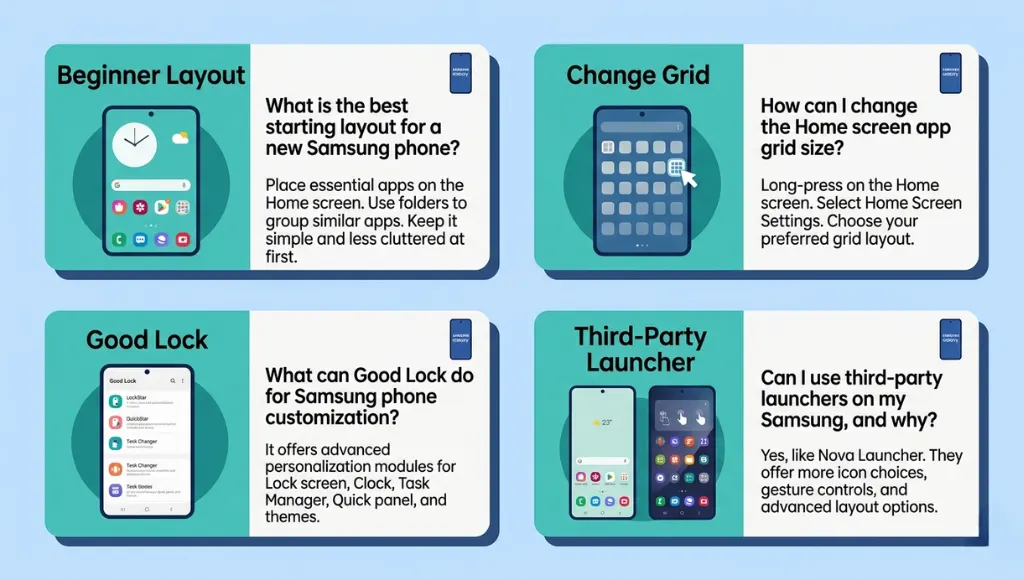
Start with a simple 4x5 grid, one wallpaper-matched icon pack from Galaxy Themes, and a single calendar or weather widget on screen one. That combination works cleanly on any Galaxy model and takes under 30 minutes to set up. Once you're comfortable, add Good Lock's Home Up module for deeper control.
Long-press any empty space on your home screen, then select "Home screen settings." From there, you can adjust your icon grid, add or remove pages, and toggle the app drawer on or off. Samsung's One UI also lets you resize icons and set a custom background type independently from your wallpaper.
Good Lock is a free Samsung app available in the Galaxy Store that adds advanced customization options not available in standard One UI settings. The Home Up module specifically lets you customize icon sizes, grid shapes, folder styles, and header transparency. You don't strictly need it for basic layouts, but for anything beyond the default aesthetic, it makes a significant difference. Check out CNET's Best Samsung Galaxy Customization Guide for a broader overview of what Good Lock can do.
Yes. Popular options include Nova Launcher, Niagara Launcher, and Microsoft Launcher. Each offers deeper customization than the default One UI home screen. The trade-off is that you lose some Samsung-specific features like edge panels and Bixby integration when using third-party launchers. For most users, staying within One UI and using Good Lock gives the best balance of power and compatibility.
Every 60 to 90 days is a useful rhythm. Your app usage changes, new widgets become available, and seasonal wallpaper swaps can refresh how the whole layout feels without rebuilding from scratch. Set a 15-minute calendar reminder for a quarterly layout review and you'll stay ahead of the chaos.
The core logic is the same: grid, widgets, icons, and wallpaper. But Samsung-specific layouts can use One UI features like Edge Panels, Bixby routines triggered by home screen interactions, and Good Lock modules that simply aren't available on other Android brands. This gives Galaxy devices a higher ceiling for customization than most Android alternatives, including stock Pixel phones.
Yes, though older models running One UI 4 or earlier won't have all the same settings or Good Lock module compatibility. The fundamental approach, including grid selection, consistent icon theming, and intentional widget placement, works on any Galaxy phone running Android 10 or later. One UI 6 and above is where the full feature set kicks in.
The hybrid approach works best: keep your primary screen minimal with only your top four to six apps and one functional widget, then use screen two for a more visual setup. This optimizes screen one for speed while screen two reflects more personality and creative samsung home screen layout ideas. It's the configuration I recommend most often to first-time customizers.
Three Things Worth Remembering
A good samsung phone layout isn’t about chasing viral aesthetics on Pinterest. It’s about reducing friction between you and the 96 daily moments your phone is in your hand.
First: define your layout intent before you touch a single setting, because intent drives every good design decision. Second: use Good Lock’s Home Up module if you own any Galaxy device manufactured after 2021, because it’s free and it changes what’s possible. Third: lock your layout once you’re satisfied, review it every 90 days, and resist the urge to rebuild from scratch every time you see something new online.
Ready to transform your Galaxy? Start with the six-step process in this guide and share your result with the zprostudio.com. We feature the best reader setups every month.