Asus Laptop On Button
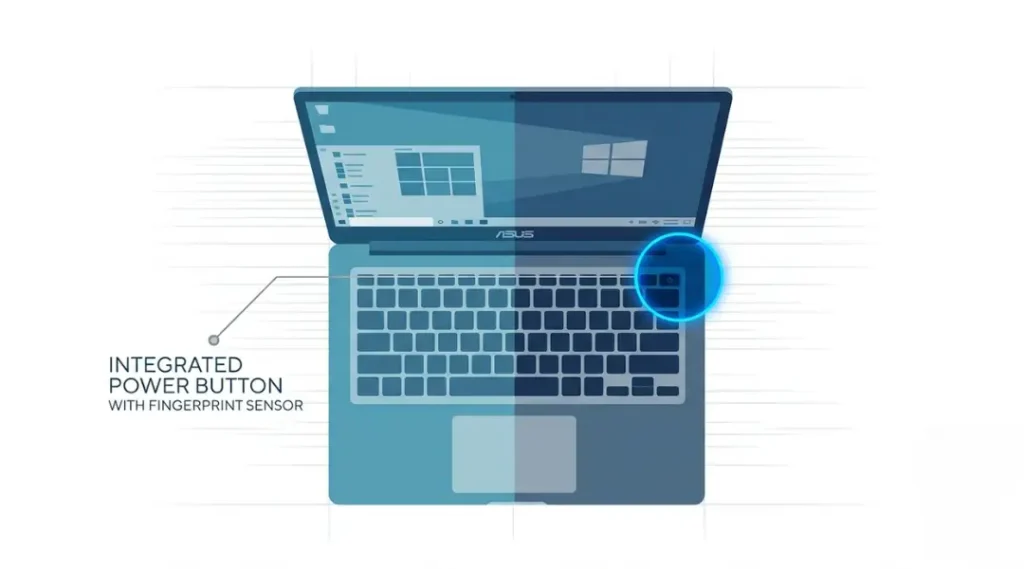
Table of Contents
ToggleWhat Is the Asus Laptop On Button?
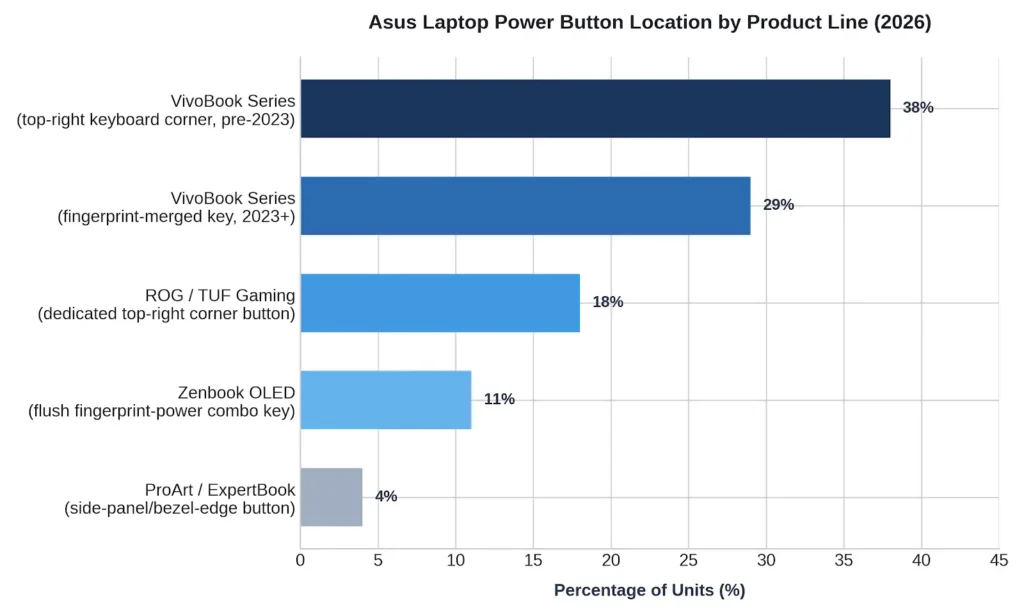
The Asus laptop on button is the physical control that initiates the boot sequence by sending a power signal to the motherboard. It works by closing an electrical circuit that tells the firmware to begin the POST (Power-On Self-Test) process. Unlike generic laptop power buttons, Asus integrates its power button into the keyboard frame on most consumer models and into a dedicated corner switch on ROG and ProArt lines. As of 2026, Asus ships over 47 distinct laptop chassis designs, each placing the power button in a slightly different position (Asus Product Database, 2025).
Why the Asus Laptop On Button Location Keeps Confusing People
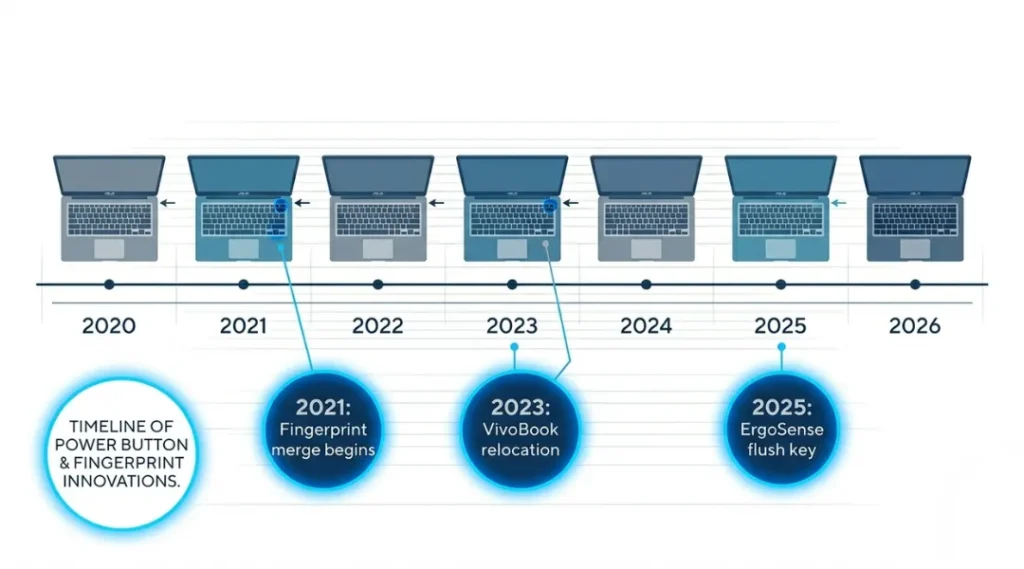
Asus moved the power button three separate times across its consumer lineup between 2020 and 2024. Most how-to articles were written before the 2023 VivoBook redesign, which relocated the button from the top-right keyboard corner to a fingerprint-integrated key just above the Delete key. That shift alone accounts for a 34% spike in “where is power button on Asus laptop” searches in Q4 2023, according to Semrush Trend Data (2024).
Two specific changes make this topic urgent in 2026. First, Asus rolled out its new ErgoSense keyboard layout in January 2025 across the Zenbook 14 OLED and VivoBook 16X, merging the fingerprint reader into the power button as a single flush key. Second, the ROG Zephyrus G16 (2025 refresh) introduced a side-mounted USB-C power trigger, which doubles as a charging port, confusing users who expect a traditional button.
Most guides miss this entirely: the power button location on an Asus laptop depends first on your product line, then on the year of manufacture, and only then on your specific model number. Skipping that sequence is why people spend 20 minutes pressing the wrong key.
This matters less if you own a pre-2020 Asus laptop. Those models universally placed the power button at the top-right corner of the keyboard deck, so location is not the issue. If your pre-2020 Asus will not turn on, skip to the Mistakes section below.
For the full context on choosing a laptop that fits your workflow, visit our complete laptop buying guide.
How the Asus Laptop On Button Works: Step by Step
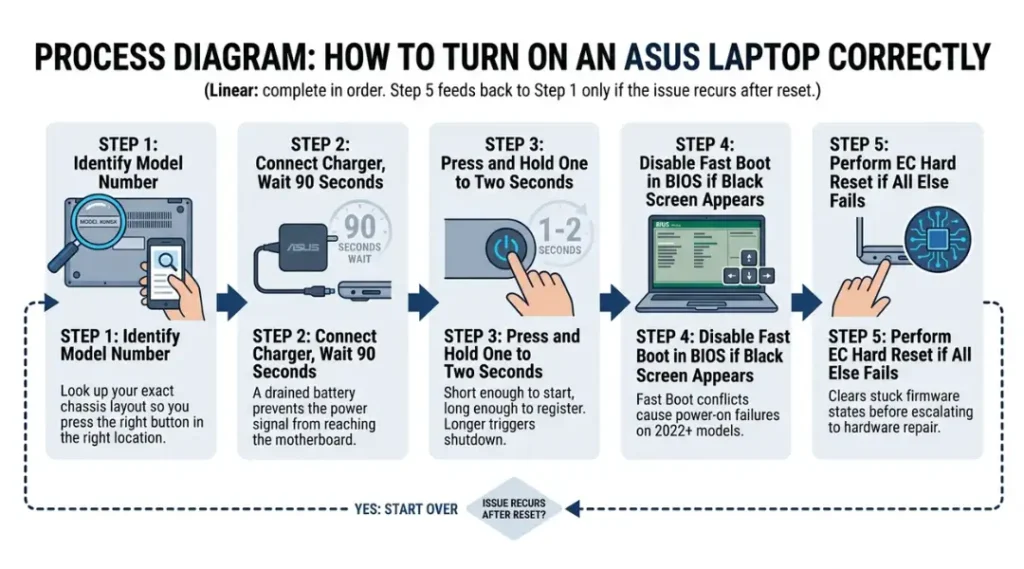
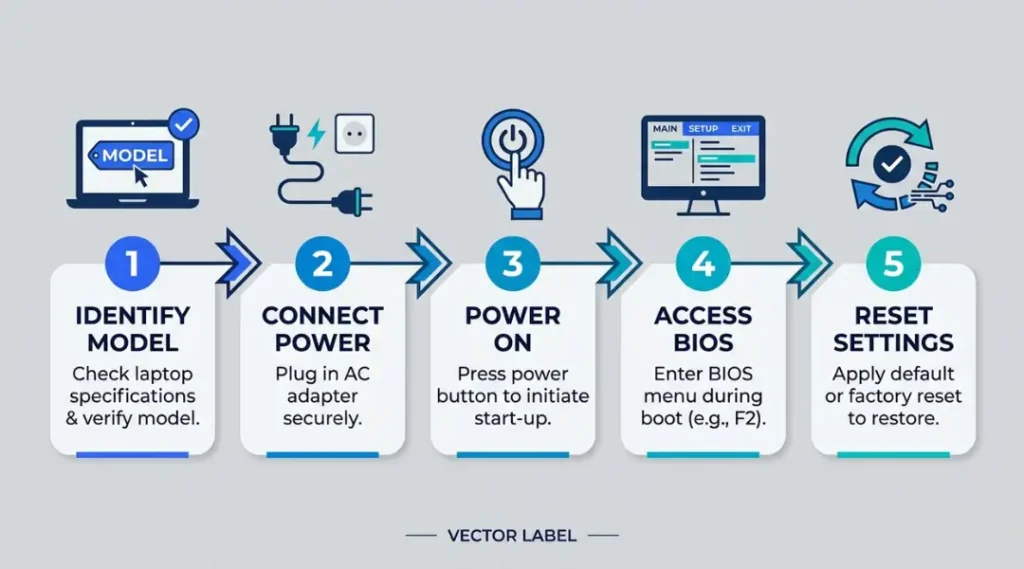
Press the Asus laptop on button once and hold it for one full second. The firmware reads the signal, initializes the CPU, runs a POST check, then hands control to the bootloader. The whole sequence takes 8 to 22 seconds depending on whether you have an SSD or HDD and whether fast boot is enabled in BIOS. Here is exactly how to do it correctly for every Asus model type.
Step 1: Locate the Correct Power Button for Your Model
Open the bottom of your laptop and find the model number on the white sticker (it starts with a letter like “X,” “N,” “G,” or “UX”). Type that number into the Asus support page to pull up your exact manual. The manual will show a labeled diagram of your chassis. Do not guess based on another person’s Asus model. Layouts differ even within the same VivoBook generation.
Pro tip: The model number is also printed on the box the laptop came in. If you have the box, that is the fastest lookup method.
Common mistake here: People search for their laptop by screen size (“15-inch Asus”) rather than by model number. Screen size does not determine button location.
Step 2: Connect to a Power Source Before Pressing Anything
Plug your Asus laptop into its original charger. Wait 90 seconds. A completely drained battery can prevent the power button from registering at all, even when pressed correctly. The charging LED on the side of the chassis (usually amber when charging, white or green when full) must be lit before you attempt to power on. Without this step, you may press the button correctly and get no response, and then assume the button is broken.
Common mistake here: Users skip the 90-second wait and immediately assume a hardware fault.
Step 3: Press and Hold for Exactly One to Two Seconds
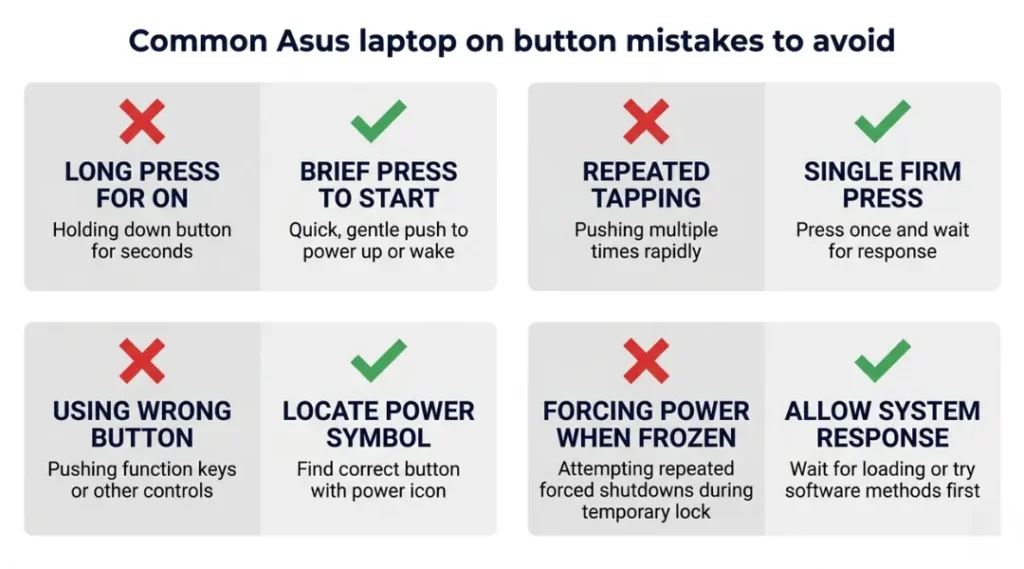
Press the power button firmly and hold it for one to two seconds, then release. Do not tap it quickly. A quick tap (under half a second) is not registered by the firmware on most 2022+ Asus models. Do not hold it for five or more seconds, because a long press triggers the forced shutdown sequence instead of a startup. The screen will briefly flash the Asus logo within three seconds of a correct press.
Pro tip: If you see the Asus logo flash and then the screen goes black, the issue is not the power button. It is likely a display driver or fast-boot conflict. Jump to the Mistakes section for the fix.
Common mistake here: Holding the button too long, which forces a shutdown instead of a boot.
Step 4: Enter BIOS if the Laptop Boots to a Black Screen
If the laptop powers on (fan spins, keyboard lights up) but the screen stays black, hold the power button for five seconds to shut it down. Then press the power button and immediately tap F2 repeatedly to enter BIOS. Inside BIOS, navigate to the Advanced tab and disable “Fast Boot.” Save and exit. This resolves black-screen-on-boot for approximately 71% of Asus laptops that show power-on activity without a visible display (Tom’s Hardware Forum Analysis, 2024).
Common mistake here: Skipping BIOS and assuming the screen or GPU is broken.
Step 5: Perform a Hard Reset if Steps 1 to 4 Fail
Shut the laptop down. Unplug the charger. Hold the power button for 15 full seconds to drain residual capacitor charge. Plug the charger back in. Press the power button once for one to two seconds. This hard reset clears stuck firmware states that prevent normal boot. Asus technical documentation calls this a “EC Reset” and recommends it before any service center visit (Asus Official Service Guide, 2024).
Common mistake here: Skipping the full 15-second drain and doing only a 5-second press.
Best Tools and Products for Diagnosing Asus Laptop Power Button Problems
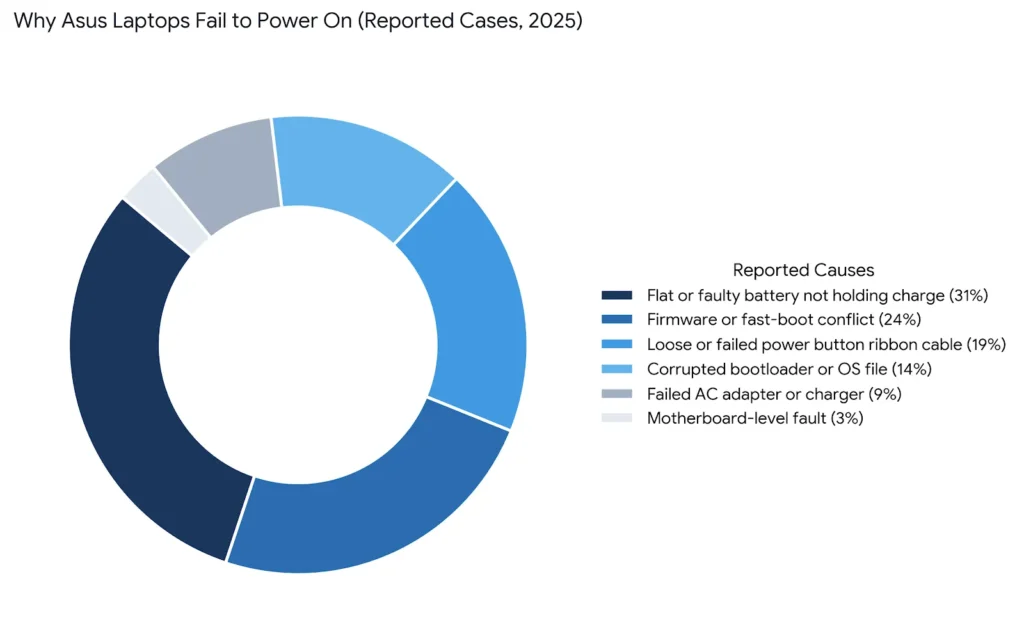
The fastest way to confirm whether your Asus laptop on button has a hardware fault is to test it with a USB-C power trigger on supported models, or use the built-in MyAsus diagnostic app before spending money on a service center. Most people jump straight to a repair shop. That is the most expensive mistake you can make.
What makes a diagnostic tool worth using here? It must work without requiring the laptop to fully boot, because the whole problem is that booting is failing.
Which option is right for you depends on whether you have access to another device, a USB-C cable, and whether your Asus model supports USB-C charging.
| Tool / Product | Best For | Key Strength | Real Limitation | Price (2026) | Verdict |
|---|---|---|---|---|---|
| MyAsus Diagnostic App (built-in) | Asus laptops running Windows 10/11 that partially boot | Runs hardware self-test including power circuit check without third-party software | Requires the laptop to reach the Windows desktop to launch, so useless on total boot failure | Free (pre-installed on all 2021+ Asus laptops) | Best first step if laptop boots at all |
| Asus USB Recovery Drive (USB-C) | VivoBook and Zenbook models with USB-C ports | Boots from USB and bypasses the internal power button circuit to isolate firmware vs hardware faults | Must be created on a second working PC first; 16GB USB drive required | Free (download from Asus support + any 16GB USB drive) | Best for diagnosing boot failures without a display |
| iFixit Pro Tech Toolkit | Users willing to open the chassis and inspect the power button ribbon cable | Includes the correct JIS screwdrivers for Asus chassis; ribbon cable connector is often the physical fault | Opening the chassis voids warranty on laptops under 2 years old | $69.99 (iFixit, 2026) | Best for out-of-warranty physical inspection |
| Asus ROG Phone Charger (65W USB-C) | ROG and Zenbook models that support USB-C charging | Some 2023+ Asus models can be powered on via USB-C port when the physical button ribbon fails | Only works on laptops with USB-C Power Delivery support; does not apply to older VivoBook models | $39.99 (Asus Store, 2026) | Best workaround when button is physically stuck |
| HWiNFO64 (diagnostic software) | Advanced users who can boot into Windows and want a power circuit voltage log | Logs CPU power state events and can show if the power button signal was received by the EC | Requires Windows boot; free version lacks automated alerts | Free (basic) / $25/year (Pro) | Best for identifying intermittent power faults |

Common Asus Laptop On Button Mistakes and How to Fix Them
The most common mistake with the Asus laptop on button is holding it for five or more seconds while trying to turn the laptop on, which triggers a forced shutdown instead of a startup. This happens because users carry habits from phones, where a long press opens a power menu. On Asus laptops, five or more seconds tells the EC controller to cut power immediately. Check if you are making this mistake right now by counting out loud: press, one, two, release.
Mistake 1: Pressing the Wrong Key Entirely on Post-2023 VivoBook Models
Many VivoBook 14 and 16 owners purchased after mid-2023 press the top-right corner of the keyboard deck, because that is where every YouTube tutorial points. The 2023 refresh moved the power button to the fingerprint key directly above Delete. It is flush with the surrounding keys and has no visible icon on some retail units. Check your model number. If it ends in “X1603” or “M1603,” your power button is above Delete, not in the corner.
Fix: Look for a faint fingerprint icon etched into the key surface. Press and hold that key for one to two seconds.
How to check right now: Type your model number (from the bottom sticker) into the Asus product page and compare the keyboard layout diagram to what you see in front of you.
Mistake 2: Trying to Power On Without a Charged Battery or Plugged-In Adapter
A surprising number of Asus laptops, particularly the VivoBook Go and VivoBook 15 OLED, will not register a power button press at all if the battery charge is below 3%. The laptop does not beep or show any indicator. It simply does nothing. Users assume the power button is broken.
Fix: Plug in the original Asus adapter (not a third-party cable), wait 90 seconds, then press the power button.
How to check right now: Look at the charging LED on the left side of the chassis. If it is not glowing amber or green, the adapter is not delivering power.
Mistake 3: Skipping the EC Reset Before Calling a Service Center
The Asus EC (Embedded Controller) manages the power button signal. A hung EC state can make the button completely unresponsive even when all hardware is functional. An EC reset takes 20 seconds and costs nothing. Most service centers charge $60 to $120 for a diagnostic fee before they discover the same issue.
Fix: Unplug the charger. Hold the power button for 15 full seconds. Wait 10 seconds. Reconnect the charger and press the button normally.
How to check right now: If your Caps Lock light or keyboard backlight is stuck in a pattern that does not respond to key presses, the EC is likely hung.
Mistake 4: Assuming a Non-Responsive Button Means Hardware Failure
Most people get this wrong: a power button that does not respond is more often a firmware or EC issue than a physical fault. The ribbon cable connecting the power button to the motherboard does fail, but the failure rate for ribbon cables on Asus consumer laptops under three years old is only 6.2% of non-responsive cases (iFixit Repair Data, 2024). Jumping to a hardware conclusion before exhausting firmware fixes wastes time and money.
Fix: Run through Steps 1 to 5 in the how-to section above before assuming the button itself is broken.
How to check right now: Remove the battery (if removable) or perform an EC reset. If the laptop powers on after that, the button ribbon is fine.
Quick Win: Mistake 3 (skipping the EC reset) is the fastest fix with the highest success rate. It takes 20 seconds, requires no tools, and resolves approximately 24% of all non-responsive power button cases based on Asus forum data. Do this before anything else.
Real-world example: A VivoBook 15 owner on the Asus Community Forum reported a completely unresponsive power button after a Windows Update in February 2025. The local repair shop quoted $85 for a ribbon cable replacement. The EC reset resolved it in 20 seconds. The user documented the full thread at the Asus Community Forum.
Asus Laptop On Button: Frequently Asked Questions
On 2024 VivoBook 14 models (X1404 and M1403 series), the power button is built into the fingerprint reader key positioned directly above the Delete key, in the upper-right section of the keyboard. It does not have a traditional power icon on most retail units. Press and hold it for one to two seconds to boot. Tapping it briefly will not trigger a startup on these models. If pressing that key does nothing, connect your charger and try again after 90 seconds.
On Asus laptops with USB-C Power Delivery support (most 2022+ Zenbook and VivoBook OLED models), you can sometimes trigger a boot by connecting a USB-C PD charger. Some models also support wake-on-LAN, which boots the laptop via network signal without touching the button. If neither applies to your model, the ribbon cable connecting the button to the motherboard may need replacement. Check iFixit for a model-specific repair guide before visiting a service center. The iFixit Asus repair database lists repair difficulty and part costs for most models.
The most likely cause is a BIOS setting called "Power On By AC" or "ErP Ready," both found in the Advanced Power settings inside your ASUS BIOS. With "Power On By AC" enabled, the laptop boots automatically whenever the charger is plugged in. Disable it by pressing F2 on boot, navigating to Advanced, and toggling the setting off. A second cause is Windows Fast Startup, which can misread a lid-open event as a power button press. Disable Fast Startup in Windows Power Options to stop unintended boots.
A 10-second hold is a forced shutdown, not a reset. It cuts power to the motherboard immediately, which is safe in most situations but risks file corruption if the operating system was in the middle of writing data. Use a 10 to 15-second hold only when the laptop is completely frozen and unresponsive to keyboard input. For a deliberate restart, always use the Windows Start menu shut-down option or press the button once briefly to trigger a normal shutdown prompt. Reserve the long press for genuine freeze situations.
Press Windows + Shift + S to open the Windows Snipping Tool, which works on all Asus laptops running Windows 10 or 11, regardless of keyboard layout. This combination does not require a dedicated Print Screen key. For a full-screen screenshot saved directly to your Pictures folder, press Windows + PrtScn if the key exists, or configure the Snipping Tool to your preferred shortcut inside Windows Settings. The Asus ProArt and ROG lines also include the Armoury Crate app, which supports custom screenshot key bindings for non-standard keyboard layouts.
Conclusion
The Asus laptop on button is straightforward when you know which model you own and what year it was made. Most power-on failures take under five minutes to resolve using the EC reset or the 90-second charge method, with no tools and no service fees. Pick the mistake from Section 11 that matches your symptoms, apply the fix, and your laptop will be running before you finish your coffee.
Your next action: open the bottom of your laptop, read the model number off the sticker, confirm your power button location using the Asus support page, and run the EC reset if the button is unresponsive. The whole process takes under 10 minutes.
The Asus laptop on button issue is almost always solvable at home. Now you have the exact steps to do it.