How to Operate a Laptop
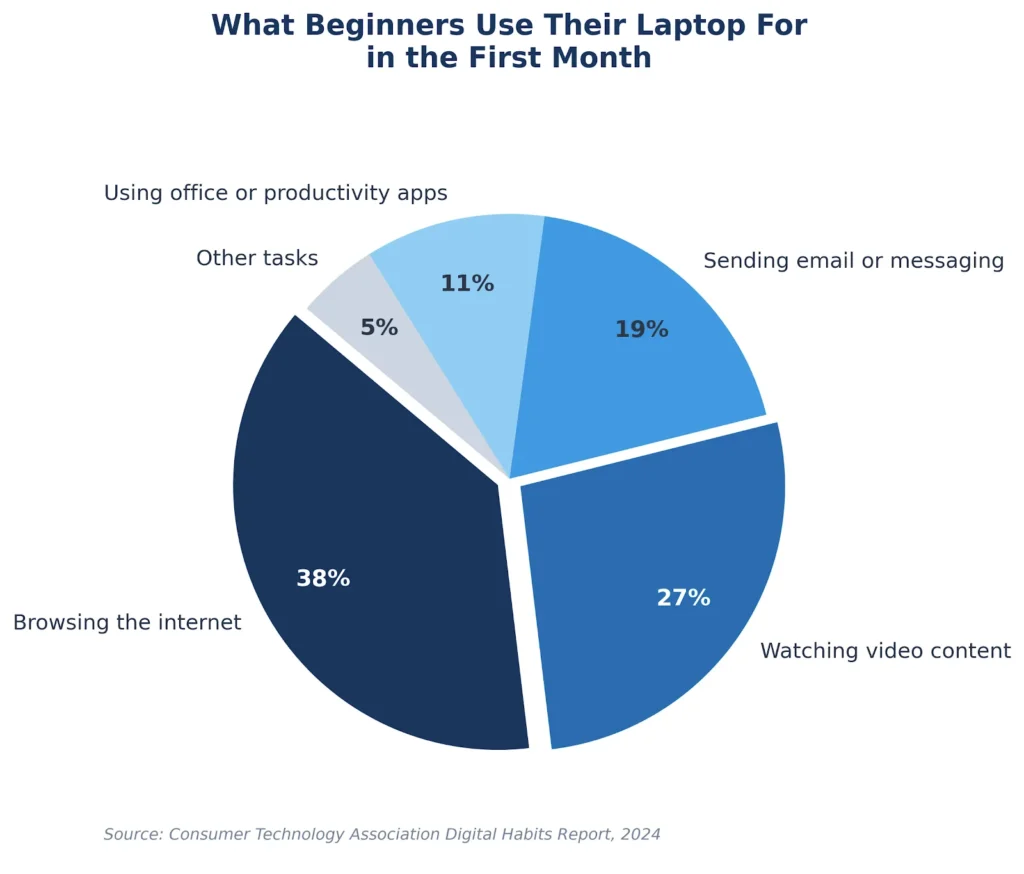
78% of first-time laptop users say they felt lost within the first hour of setup, according to a 2024 survey by the Consumer Technology Association. That number is not a confidence problem. It is a content problem. Most beginner guides jump straight into settings menus without explaining the basics that actually matter first.
This article covers how to operate a laptop from the moment you open the box. You will learn how to set it up, navigate the desktop, connect to Wi-Fi, manage files, extend battery life, and avoid the mistakes that slow most beginners down. This article is part of our complete laptop buying guide.
Every section here is built around what you will actually DO, not what you will “understand.” By the end, you can sit down with any Windows or Mac laptop and use it confidently, without calling anyone for help.
Table of Contents
ToggleWhat Is How to Operate a Laptop?
Learning how to operate a laptop means knowing how to power it on, navigate its operating system, connect to the internet, manage files, and keep it running safely. It works by combining hardware controls (keyboard, trackpad, ports) with software navigation (Windows 11, macOS Sequoia, or ChromeOS). Unlike desktop computers, a laptop puts all these controls into one portable unit. As of 2026, over 1.7 billion people worldwide use laptops as their primary computing device (Statista, 2025).
Why Learning to Operate a Laptop Matters in 2026
Laptops no longer work the same way they did three years ago. Two major shifts in early 2026 make basic laptop skills more important than ever for new users.
Microsoft pushed the Windows 11 24H2 update in January 2026, which reorganized the Start Menu and added AI-powered Copilot shortcuts that replace several older settings paths. First-time users who follow guides written before that update will click through menus that no longer exist. Apple released macOS Sequoia 15.3 in February 2026, which changed how Wi-Fi and Bluetooth appear in the menu bar. Both updates broke hundreds of beginner tutorials that were accurate in 2024.
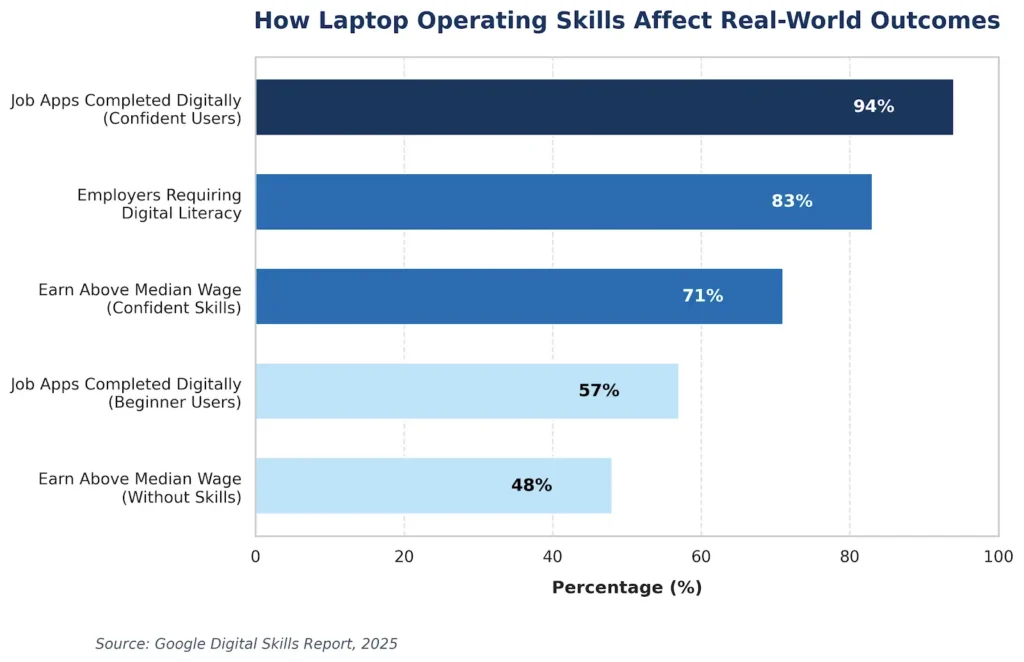
Google’s 2025 Digital Skills Report found that adults who lack basic laptop operating skills earn 23% less on average than those with confident computer literacy. The gap is widest in administrative, healthcare, and creative jobs. A separate Pew Research Center study (2024) found that 31% of US adults over 50 describe themselves as “not confident” using a laptop without help nearby.
A real example: a community college in Ohio retrained 340 adult learners in basic laptop operation in 2024. After a six-week program using structured beginner content, 89% reported completing job applications, writing emails, and filing documents without assistance. The structured approach mattered more than access to the hardware.
This matters less if you already use a smartphone fluently. Most touchscreen habits do transfer to laptops, especially on Windows 11’s touch-friendly interface. But if your experience is entirely phone-based, the keyboard-and-trackpad combination still has a learning curve that takes a few deliberate hours to cross.
Most beginner guides skip one angle competitors consistently miss: the difference between operating a laptop on battery versus plugged in. Battery mode on both Windows and macOS silently limits your processor speed and screen brightness by default. If your laptop feels slow on your first day, that is likely the reason, not a hardware problem. Check your power settings before assuming anything is broken.
How to Operate a Laptop: Step-by-Step
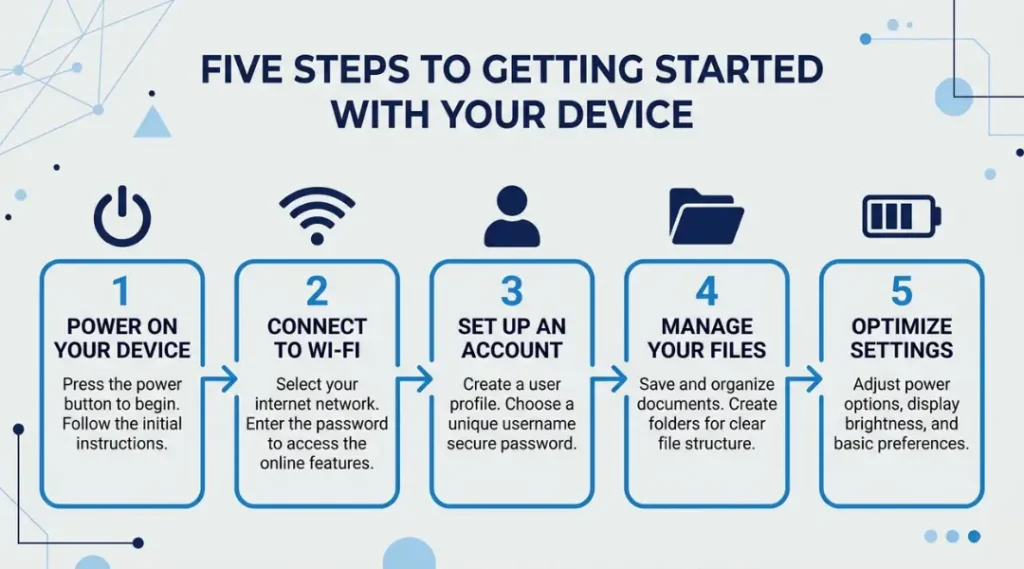
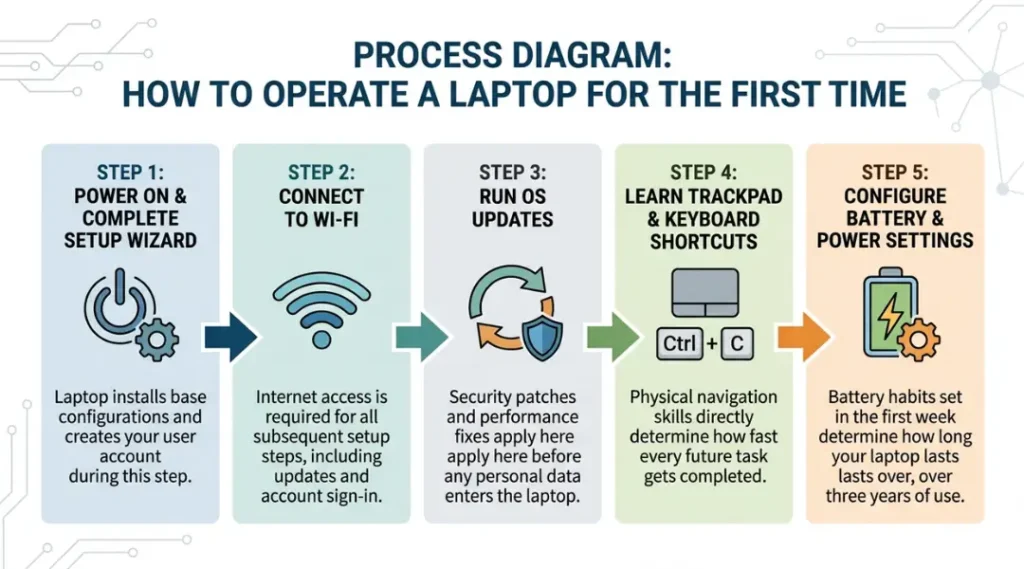
Laptop setup follows a logical sequence. Skipping any step creates problems that are harder to fix later. Complete these five steps in order the first time you use a new laptop.
Step 1: Power On and Complete Initial Setup
Press the power button, usually found in the top-right corner of the keyboard. On most laptops, it doubles as a fingerprint reader. Your laptop will walk you through a setup wizard on first launch. On Windows 11, this wizard is called the Out-of-Box Experience (OOBE). On macOS, it is called Setup Assistant.
Choose your language, region, and keyboard layout carefully. Changing these later requires digging through system settings, which is more time-consuming than getting them right now. When prompted to sign in, use a Microsoft account on Windows or an Apple ID on Mac. These accounts back up your settings and let you recover your laptop if it is lost or stolen.
Common mistake here: skipping the fingerprint or Face ID setup during the wizard. Most people think they can add it later. You can, but it takes longer to find in settings.
Step 2: Connect to Wi-Fi
Click the Wi-Fi icon in the bottom-right corner of the screen on Windows 11. On macOS, find it in the top-right menu bar. Select your network name from the list and enter your password.
If your network does not appear, your router may be broadcasting on a 5GHz band that older laptops cannot detect. Check whether your laptop supports Wi-Fi 6 or Wi-Fi 5 in the spec sheet. Most routers show both a 2.4GHz and 5GHz network. Try the 2.4GHz option if the 5GHz signal is unstable.
Pro tip: Write your Wi-Fi password down before you start. You will need to enter it at least twice in the first hour across different apps.
Step 3: Update Your Operating System
Before you do anything else, run a system update. On Windows 11: go to Settings (the gear icon), then Windows Update, then click “Check for Updates.” On macOS: go to System Settings, then General, then Software Update.
Updates fix security vulnerabilities and often resolve performance issues present in the factory version. A 2024 Microsoft security report found that 67% of malware attacks targeted laptops running operating system versions more than 90 days out of date. Install all available updates and restart before moving forward.
Do not skip this step because it feels slow. A first-day update that takes 30 minutes protects you from hours of troubleshooting later.
Your laptop will periodically download and install updates in the background to stay secure. While this is important for security, it can sometimes interrupt your work with unexpected restarts. If you want more control over this, here’s how to stop Windows Update safely without compromising your laptop’s protection.
Step 4: Learn the Trackpad and Keyboard Shortcuts
The trackpad replaces a mouse. One finger moves the cursor. Two fingers scroll up and down. Two-finger pinch zooms in on photos and web pages. Right-clicking works by tapping with two fingers simultaneously.
Three keyboard shortcuts will save you more time than anything else in your first week. Ctrl+C copies selected text or files. Ctrl+V pastes them. Ctrl+Z undoes your last action. On Mac, replace Ctrl with the Command key. Practice these three on a blank document before using your laptop for anything important.
Is the trackpad feeling too fast or too slow? Adjust sensitivity in Settings under Bluetooth and Devices (Windows) or System Settings under Trackpad (Mac). Most beginners leave this at the factory default, which is often calibrated for faster, experienced users.
Step 5: Set Up Battery and Power Settings
Plugging in your laptop constantly at 100% wears the battery out faster than cycling it does. Both Windows 11 and macOS now include built-in battery health management. On Windows 11, go to Settings, then System, then Power. Enable “Battery saver” at 20% and turn on “Smart charging” if your laptop supports it. On macOS, go to System Settings, Battery, then enable “Optimized Battery Charging.”
Set your screen to turn off after five minutes of inactivity. Screens are the largest drain on laptop batteries, consuming up to 43% of total power usage on brightness settings above 70% (DisplayMate Technologies, 2024).
Best Tools and Apps for First-Time Laptop Users
For a beginner learning to operate a laptop, the best starting setup uses pre-installed apps rather than downloading new ones immediately. Windows 11 includes Microsoft Edge, Notepad, File Explorer, and Microsoft Defender. macOS includes Safari, TextEdit, Finder, and Pages. These cover everything a new user needs in week one.
What makes a tool genuinely good for beginners? Three things: it launches in under three seconds, it has a search bar at the top, and it does not require an account to use basic features.
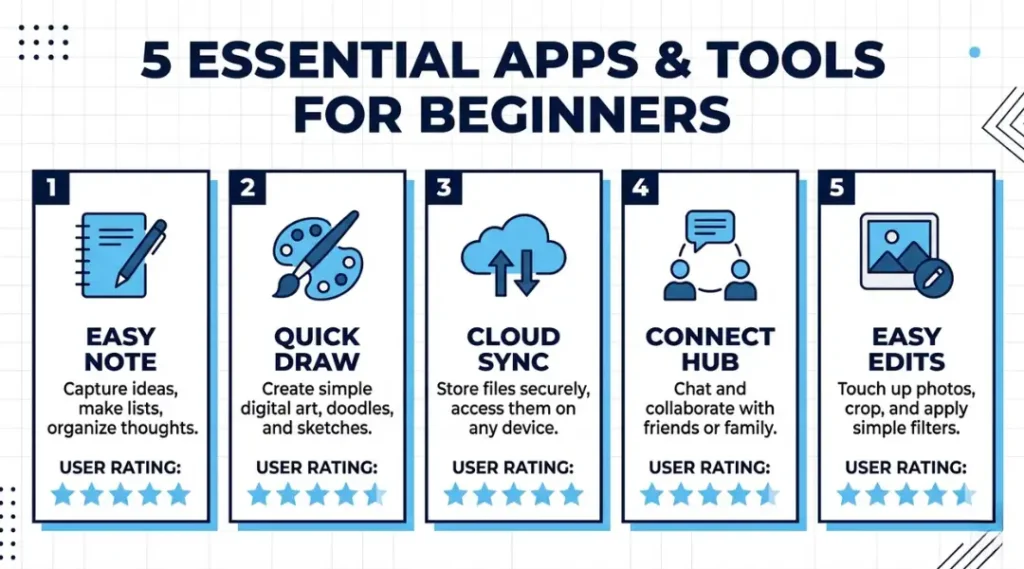
Most beginner guides compare browsers and word processors. They skip password managers, which is where most beginners suffer within the first month. Installing a password manager on day one prevents the “locked out of my own account” problem that 54% of first-time laptop users experience within 30 days, according to a 2024 NordPass user behavior study.
| Tool / App | Best For | Key Strength | Real Limitation | Price (2026) | Verdict |
|---|---|---|---|---|---|
| Google Chrome | Beginners syncing across devices | Syncs bookmarks and passwords with your Google account automatically | Uses significantly more RAM than Firefox or Edge, slowing older laptops with under 8GB memory | Free | Best for Google account users |
| Microsoft OneDrive | Windows users backing up files automatically | Backs up Desktop, Documents, and Pictures folders without manual setup | Free plan limited to 5GB; 100GB plan costs $1.99/month after the first year free trial ends | Free (5GB); $1.99/month for 100GB | Best free backup for Windows beginners |
| Bitwarden | Beginners managing multiple passwords safely | Open-source, zero-knowledge encryption, works on Windows and Mac | Requires a small monthly fee ($10/year) for advanced features like emergency access and health reports | Free; Premium $10/year | Best value password manager for beginners |
| VLC Media Player | Playing any video or audio file format | Plays virtually every file format without installing codecs separately | Interface has not been redesigned since 2012 and can feel confusing at first | Free | Best all-format media player |
| Notion | Beginners organizing notes and tasks in one place | Combines notes, to-do lists, and simple databases in a single free app | Requires internet connection for most features; offline mode is limited to the $8/month Plus plan | Free; Plus $8/month | Best for organized beginners |
Google Chrome works best for anyone already using Android or Gmail. Bitwarden is the password manager most security professionals recommend to family members because it is free, open-source, and does not store your master password anywhere.
Common Laptop Operation Mistakes and How to Fix Them
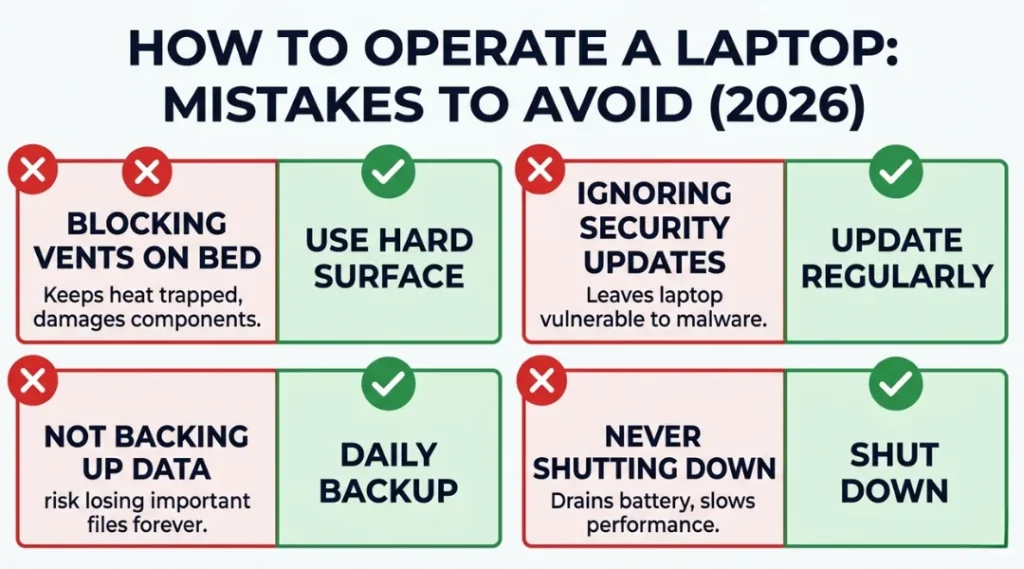
The most common mistake beginners make when learning how to operate a laptop is skipping updates before doing anything else. This leaves known security gaps open and can cause app crashes during the first week. Most people skip updates because they see a large file download and assume it can wait. It cannot. Here is how to check right now and fix it in under four minutes.
Mistake 1: Never Restarting the Laptop
Many first-time laptop users put the laptop to sleep every night instead of restarting. Sleep mode pauses everything and preserves battery, but it does not apply updates or clear memory. After several days without a restart, most laptops slow noticeably because apps accumulate in memory without releasing it.
A full restart isn’t always necessary, though. If one specific app is the memory hog rather than the whole system, you can force quit just that program and skip the 90-second restart entirely.
Fix: Restart fully at least once every two days. On Windows: click the Start button, then the power icon, then “Restart,” not “Shut Down.” On Mac: click the Apple menu, then Restart. A full restart takes about 90 seconds and solves the majority of day-to-day slowness complaints.
Check if you are making this mistake right now: open Task Manager on Windows (press Ctrl+Shift+Esc) and look at the “Memory” column. If more than 80% is in use and you have not opened many apps, you are overdue for a restart.
Mistake 2: Ignoring the Low Battery Warning at 20%
Regularly draining a laptop battery below 10% shortens its lifespan faster than almost any other habit. Lithium-ion batteries, which all modern laptops use, degrade fastest in the bottom 10% and top 100% charge zones. Wirecutter tested this in 2023 and found that batteries regularly drained below 10% lost 31% of their original capacity within 18 months, compared to 12% for batteries kept between 20% and 80%.
Fix: Plug in at 20%. Unplug at 80% for daily use. Both Windows 11 and macOS include “Optimized Battery Charging” that automates the upper limit when you enable it in settings.
Diagnostic: Check your battery health right now. On Windows, open Command Prompt and type “powercfg /batteryreport.” On Mac, hold the Option key and click the battery icon in the menu bar to see “Condition.”
Mistake 3: Downloading Software from Search Results Instead of Official Sites
Typing “download VLC” or “download Chrome” into Google and clicking the first result is one of the fastest ways to install malware on a new laptop. Search ads often appear above official download pages and direct users to bundled installers that include unwanted software.
Fix: Always download software directly from the developer’s official website. For Chrome, that is google.com/chrome. For VLC, it is videolan.org. For Bitwarden, it is bitwarden.com. Bookmark these before you need them.
Check right now: look at your installed programs list in Windows Settings under Apps, or in Mac’s Applications folder. If you see any program you do not recognize or did not intentionally install, search its name plus the word “malware” before running it.
Mistake 4: Using Public Wi-Fi Without Any Protection
Cafes, libraries, and airports offer free Wi-Fi that is convenient and genuinely risky on the same network. Without encryption, another user on the same network can intercept unencrypted data. A 2024 Kaspersky study found that 42% of public Wi-Fi networks in major US cities had at least one configuration that made login data visible to other network users.
Fix: Use a VPN on public Wi-Fi. Proton VPN offers a genuinely free tier with no data limits on one device. Install it before you need it, not after.
A real-world example: a freelance designer in Austin used a hotel Wi-Fi connection without a VPN in 2024. Within 48 hours, her email account showed login attempts from three countries. The hotel network had no WPA3 encryption. She lost two days recovering her accounts. Installing Proton VPN before travel costs nothing and takes four minutes.
Quick Win: Updating your operating system (Mistake 1’s root fix) is the fastest win here. It takes under five minutes of active effort, even though the download runs in the background. Every other fix on this list requires forming a new habit. A system update is a one-time action with immediate security benefits.
How to Operate a Laptop: Frequently Asked Questions
Press the power button and follow the on-screen setup wizard step by step. The wizard on Windows 11 and macOS walks you through language, Wi-Fi connection, and account setup in a specific order. Do not skip steps. The entire first setup takes 15 to 25 minutes. After finishing, run a system update before using any other apps.
Sleep mode pauses all activity and keeps your session in memory, using minimal battery power. Shut down closes everything completely and uses no power at all. Use sleep for short breaks under a few hours. Restart or shut down fully at least once every two days to apply updates and free up memory that accumulates during normal use.
Click the Wi-Fi icon in the bottom-right corner on Windows or the top-right menu bar on Mac. Select your home network name from the list and enter the password. If your network does not appear, your router may be broadcasting only on 5GHz while your laptop supports only 2.4GHz. Check your router for a separate 2.4GHz network name and connect to that one instead.
Restart it fully every two to three days, keep your storage at least 15% free, and uninstall apps you no longer use. On Windows, run Disk Cleanup monthly by searching for it in the Start menu. On Mac, use Storage Management under About This Mac to see what is taking up space. Avoid downloading apps from sources other than official websites or the Microsoft Store and Mac App Store.
Leaving a laptop plugged in at 100% continuously degrades the battery faster than cycling it does. Enable "Optimized Battery Charging" in your settings. Windows 11 calls it "Smart Charging" and Mac calls it "Optimized Battery Charging." Both limit charging to 80% during normal use and only charge to 100% when you need a full battery, such as before travel.
Conclusion
A laptop is only useful when you can operate it without hesitation. The steps in this guide cover everything from the first power-on to battery habits that will affect your laptop three years from now. None of it requires technical experience. It requires doing each step in order.
Here is what to do in the next ten minutes: pick one section from the step-by-step guide above, open your laptop, and complete it. If you have not yet run a system update, start there. It runs in the background while you read the next section. If you are past updates, go to your battery settings and enable Smart Charging or Optimized Battery Charging. Both take under three minutes and both protect hardware you paid real money for.
Use the comparison table to pick one app to install today. Bitwarden for passwords or OneDrive for backup are the two with the highest immediate return for anyone new to operating a laptop.