Is Cybersecurity a Good Career
Over 4.8 million cybersecurity positions sat unfilled worldwide in 2023, according to ISC2’s annual workforce study. That number is not a marketing stat employers use to recruit. It is a structural problem that has persisted for nearly a decade, and it directly shapes whether this field is worth entering in 2026. The answer, for most people who are detail-oriented, genuinely curious about how systems fail, and willing to commit to continuous learning, is yes.
This guide will walk you through what working in cybersecurity is actually like, what it pays at different career stages, who it suits, who it does not, and exactly how to break in without a traditional computer science degree. For a broader starting point, the Cybersecurity for Beginners guide covers the foundational concepts that underpin everything discussed here.

Table of Contents
ToggleWhat Is a Cybersecurity Career?
A cybersecurity career means working professionally to protect computer systems, networks, and data from unauthorized access, theft, or damage. Practitioners can specialize in dozens of sub-fields, including offensive security (ethical hacking), defensive security (SOC analysis), governance and compliance, cloud security, and application security. The field spans every industry that runs software, which in 2026 means virtually all of them.
Why Cybersecurity Is a Good Career in 2026
The short answer: persistent demand, rising pay, and genuine job security. Three structural forces reinforce this right now.
First, the regulatory landscape tightened significantly in late 2024 and early 2025. The U.S. SEC’s updated cybersecurity disclosure rules, fully enforced from January 2025, require public companies to report material incidents within four business days and to disclose their cybersecurity risk management programs in annual filings. This created immediate demand for compliance-focused security professionals that has not slowed down.
Second, AI-powered threats accelerated through 2024 and into 2025. Phishing kits using large language models can now generate highly personalized, grammatically flawless lures at scale. Organizations responded by expanding their threat intelligence and detection engineering teams, roles that did not exist in large numbers five years ago.
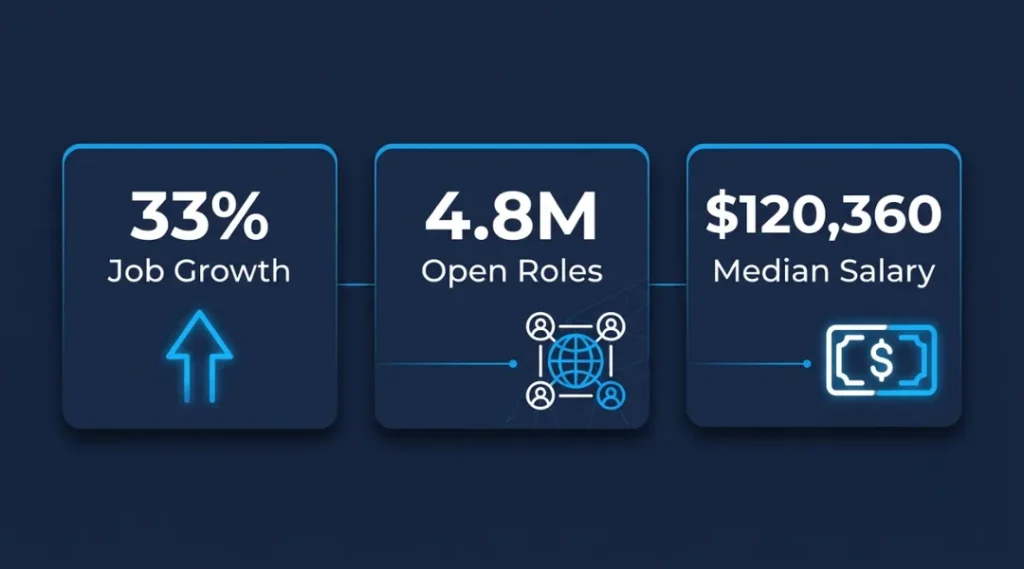
The U.S. Bureau of Labor Statistics projects 33% job growth for information security analysts through 2033, which is more than four times the average growth rate across all occupations. The ISC2 2023 Cybersecurity Workforce Study puts the global gap at 4.8 million professionals. One context where cybersecurity matters less as a career choice: organizations in very early-stage, pre-revenue environments. Startups under 20 people rarely hire dedicated security staff, meaning fewer roles exist at that company size.
Larger enterprises, government agencies, financial institutions, and healthcare organizations represent the core demand. For further context on how the threat environment has shaped this demand, the NIST Cybersecurity Framework documentation provides the authoritative reference that most enterprise programs are built around.
How a Cybersecurity Career Works: Step-by-Step
Most cybersecurity professionals do not start in security. They move laterally from IT support, system administration, software development, or even non-technical roles. Here is how the progression typically unfolds.
Step 1: Build Foundational IT and Networking Knowledge
Before you can secure systems, you need to understand how they work. This means getting comfortable with TCP/IP networking (how data moves across the internet), operating systems (especially Linux and Windows server environments), and basic scripting. You do not need to be a developer, but you need to read code and understand what it does. The most efficient way to cover this ground is CompTIA A+ and Network+ certifications combined with hands-on lab practice. The entire foundation phase typically takes 6 to 12 months when studied part-time.
A common mistake at this stage is skipping networking fundamentals and jumping straight into hacking tools. Professionals who skip this step consistently struggle with incident analysis because they cannot read packet captures or interpret firewall logs.
Step 2: Earn Your First Security Certification
CompTIA Security+ is the industry-standard entry credential. It is vendor-neutral, recognized by the U.S. Department of Defense under Directive 8570, and covers cryptography, threat analysis, identity management, and risk assessment. Passing it demonstrates baseline competency to hiring managers. Study time averages 60 to 90 hours for candidates with an IT background. The exam costs $392 USD as of 2025. For a structured certification path, CompTIA’s official certification roadmap maps out the sequence from entry-level through expert credentials.
The most common mistake here is over-studying theory without practicing in labs. Employers want to see that you can apply concepts, not just pass multiple-choice questions.
Step 3: Choose a Specialization and Build Hands-On Experience
Cybersecurity is broad. Committing to a direction early accelerates your job search. The four most accessible entry paths in 2026 are: Security Operations Center (SOC) analyst, penetration testing/ethical hacking, cloud security (AWS or Azure security specializations), and GRC (governance, risk, and compliance). Build a home lab using free tools: VirtualBox or VMware for virtual machines, Kali Linux for offensive tools, and a retired router for network practice. Platforms like TryHackMe and Hack The Box provide structured, beginner-friendly challenge environments that directly mirror real-world scenarios.
The mistake at this stage is building a lab, never documenting what you do, and then having nothing to show during interviews.
Step 4: Create a Portfolio and Apply Strategically
Hiring managers in cybersecurity are not primarily looking at GPA or degree prestige. They look at GitHub repositories, CTF (Capture the Flag) competition results, home lab write-ups, and certifications. A write-up documenting how you attacked a vulnerable virtual machine in a controlled environment demonstrates more practical skill than a transcript.
LinkedIn is the primary sourcing channel for corporate roles; government and defense contractor roles often list exclusively on USAJobs or agency-specific portals. The ISC2 entry-level cybersecurity job guide contains current role data and hiring pathway breakdowns that align entry-level titles with specific skill requirements.
Step 5: Advance Through Continuous Learning
Cybersecurity has one characteristic that makes it genuinely different from many technology careers: the threat landscape changes fast enough that skills have a shelf life. A professional who certified in 2019 and stopped learning is measurably less capable today.
Staying current requires following threat intelligence feeds, taking periodic advanced training, and contributing to the professional community through platforms like BSides conferences, DEFCON, or local ISAC groups. Senior roles, particularly CISO (Chief Information Security Officer), require a blend of technical credibility and business communication skills that most pure-technical paths do not naturally develop. Budget time for both.
Best Platforms and Tools to Start a Cybersecurity Career
Not all learning platforms deliver equal value for people entering this field. The right choice depends on your current experience level, your learning style, and whether you are prioritizing certification, practical skills, or career switching speed.
Selection criteria to apply before committing: hands-on lab availability (not just video content), certification alignment, community size (larger communities mean better peer help), and cost relative to your timeline.
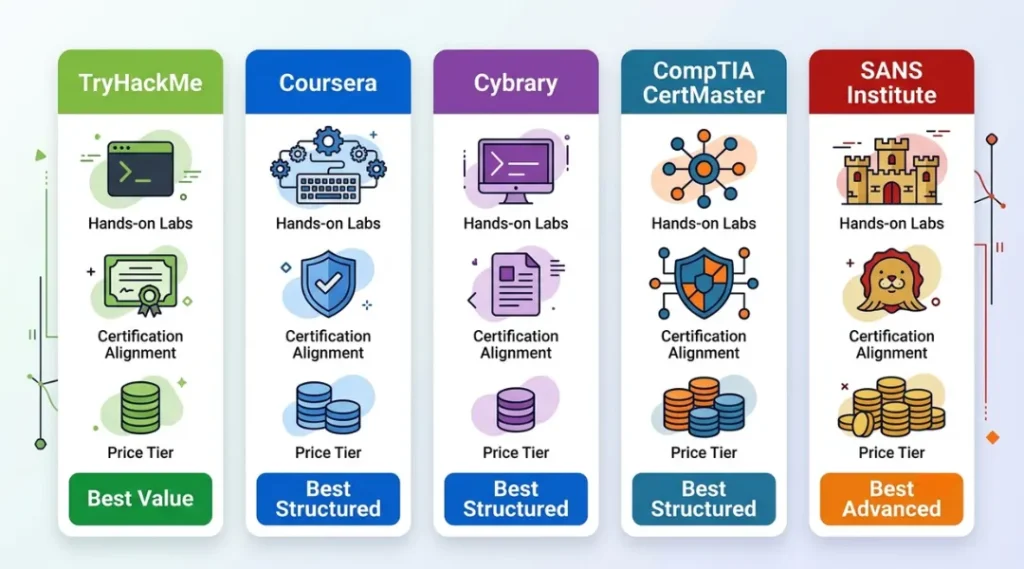
TryHackMe is the strongest recommendation for true beginners because it requires zero local setup. Everything runs in the browser, which removes the technical barrier of configuring a home lab before you understand why you are doing it. Its learning paths for SOC analyst and penetration tester roles are sequenced well and updated regularly. The concrete limitation is that the free tier locks most content behind a paywall quickly, and the Pro tier at $14 per month is necessary for serious learning.
Coursera’s Google Cybersecurity Certificate is the best option for career switchers who need structured, paced learning with a recognizable credential. It takes approximately six months at 10 hours per week, costs $49 per month (frequently discounted), and is accepted by many mid-market employers as a legitimate entry credential. The limitation is a near-complete absence of offensive security content, making it inadequate if penetration testing is your target role. Google’s Cybersecurity Certificate on Coursera provides the current syllabus and enrollment options.
SANS Institute OnDemand courses carry the highest industry respect, particularly for GIAC certifications that are standard requirements in large enterprise and government contracts. The limitation is price: most courses start at $2,000 and go significantly higher. This is a mid-to-senior career investment, not an entry point.
Platform Comparison Table
Tool / Product | Best For | Key Strength | Real Limitation | Price (2026) | Verdict |
CompTIA CertMaster | Beginners preparing for Security+ | Structured, exam-mapped learning paths | No hands-on labs included | $299 one-time | Best for exam prep |
TryHackMe | Hands-on skill building | Gamified, browser-based real labs | Free tier is very limited | Free / $14/mo Pro | Best for practical skills |
Cybrary | Career pathway learners | Role-based learning tracks | Video-heavy, less interactive | $99/mo Team plan | Best for structured paths |
SANS Institute (OnDemand) | Advanced professionals | Industry-respected certifications | Very expensive for individuals | From $2,000/course | Best for senior roles |
Coursera (Google Career Cert) | Career switchers on a budget | Affordable, flexible, beginner-friendly | No offensive security content | $49/mo (often discounted) | Best budget option |
Quick Facts: Cybersecurity Career at a Glance
- The U.S. Bureau of Labor Statistics projects 33% job growth for information security analysts through 2033, far faster than most fields.
- The global cybersecurity workforce gap stood at 4.8 million unfilled positions in 2023, according to ISC2.
- Median annual salary for U.S. information security analysts: $120,360 (BLS, May 2023).
- Entry-level professionals with CompTIA Security+ can earn $65,000 to $85,000 in their first role.
Fully remote work is common: over 60% of cybersecurity job postings in 2024 listed remote or hybrid options.
Is Cybersecurity a Good Career for You? Honest Pros and Cons
Most articles about this field talk only to people who are already convinced. Here is a balanced view.
Genuine advantages: job security that is structurally built into the role (organizations cannot function without security), above-average compensation at every experience level, remote work availability that exceeds most technology fields, intellectual variety (no two incidents are identical), and a genuine ethical dimension to the work. Many practitioners cite protecting hospitals, utilities, and financial systems as a meaningful reason to stay in the field.
Real disadvantages: the on-call and incident response nature of many roles means your evenings and weekends are not always your own; alert fatigue in SOC roles is a documented occupational health concern; the pace of change is relentless and can feel exhausting rather than stimulating if you prefer stable, mastered skill sets; and the field has a documented culture problem in certain organizations where burnout is normalized rather than addressed.
Community discussions, including candid threads on platforms like Reddit’s r/cybersecurity community, consistently surface both the genuine enthusiasm professionals feel and the frustrations around alert fatigue and organizational under-investment in security teams. Reading those perspectives is worth your time before committing.
What Does Cybersecurity Pay in 2026?
Compensation varies significantly by role, location, clearance level, and sector. The following figures reflect U.S. market data as of early 2026.
- Entry-level SOC Analyst (Tier 1): $55,000 to $75,000 annually
- Security Engineer (3 to 5 years): $95,000 to $130,000 annually
- Penetration Tester (mid-level): $90,000 to $125,000 annually
- Cloud Security Architect: $130,000 to $175,000 annually
- CISO (enterprise): $200,000 to $400,000+ with equity and bonuses
- Cleared professionals (Top Secret/SCI) add 15 to 25% to base in most roles
Geographic variation is significant. San Francisco and New York pay a 20 to 35% premium over national median figures. Fully remote roles have partially equalized this, but senior roles at major financial institutions still pay notably more for in-office presence.
The BLS Occupational Outlook Handbook entry for Information Security Analysts contains the most reliable, government-sourced salary and growth projection data available.
Who Cybersecurity Is Right For
This career genuinely suits people who are comfortable with ambiguity, interested in how adversarial systems think, willing to read documentation deeply, and capable of communicating technical risk to non-technical stakeholders. Strong written communication is underrated as a requirement, because most security work ultimately becomes a report or a recommendation that someone else acts on.
It suits career changers with backgrounds in law (policy and compliance roles), mathematics (cryptography and data analysis), psychology (social engineering awareness programs), and military or intelligence work (threat intelligence analysis). It does not require a computer science degree, though a degree accelerates access to government and cleared roles where educational requirements are more rigid.
It is likely a poor fit for people who prefer highly stable, predictable daily work, who are not interested in ongoing self-directed learning, or who want to master a single skill set over a long career without significant evolution. Those preferences are legitimate. Cybersecurity will fight them at every turn.
Common Questions About Cybersecurity Careers
Yes, with realistic expectations about timeline. Expect 12 to 18 months of foundational learning before your first role. People who try to skip the IT foundation phase consistently struggle in their first jobs. Start with CompTIA A+ concepts, then Network+, then Security+.
Some roles are highly stressful, particularly incident response and SOC analysis during active threat events. Others, like GRC and security awareness program management, operate on relatively predictable schedules. Role selection matters more than field selection when it comes to stress levels.
Yes. Remote and hybrid options are more common in cybersecurity than in most other technology specializations. Roles requiring physical lab access (certain pentesting engagements) or security clearance (most cleared positions) have more in-person requirements.
The structural demand drivers, regulatory pressure, AI-powered threat escalation, and enterprise digital expansion, are multi-decade trends. The 4.8 million professional shortfall reported by ISC2 is not resolving quickly. The Cybersecurity and Infrastructure Security Agency (CISA) national cyber workforce strategy specifically targets this gap as a national security concern, which signals long-term investment in the pipeline.
Final Verdict: Is Cybersecurity a Good Career?
For people who match the profile, yes, with conviction. The combination of structural demand, above-average compensation, genuine intellectual challenge, and meaningful work makes it one of the stronger career bets available in 2026. It is not the right choice for everyone, and articles that refuse to name that do a disservice to people trying to make an informed decision.
The clearest path forward: start with the networking and operating system fundamentals, earn CompTIA Security+, build a hands-on lab portfolio using TryHackMe or Hack The Box, pick a specialization, and apply to entry-level roles while continuing to learn. The field is demanding. It rewards people who treat it as a long-term commitment rather than a fast path to a high salary.