Smart Home Manager
Did you know the average smart home now has over 15 connected devices, but most homeowners manage them through three or four different apps? That fragmented chaos is exactly what a smart home manager is designed to solve. Here, we go deeper on smart home manager specifically: what it is, how to pick the right one, and how to actually use it to simplify your connected life.
By the end of this guide, you’ll know exactly how a smart home manager works, which platform best fits your setup, and the most common mistakes that keep people stuck in app-switching purgatory.
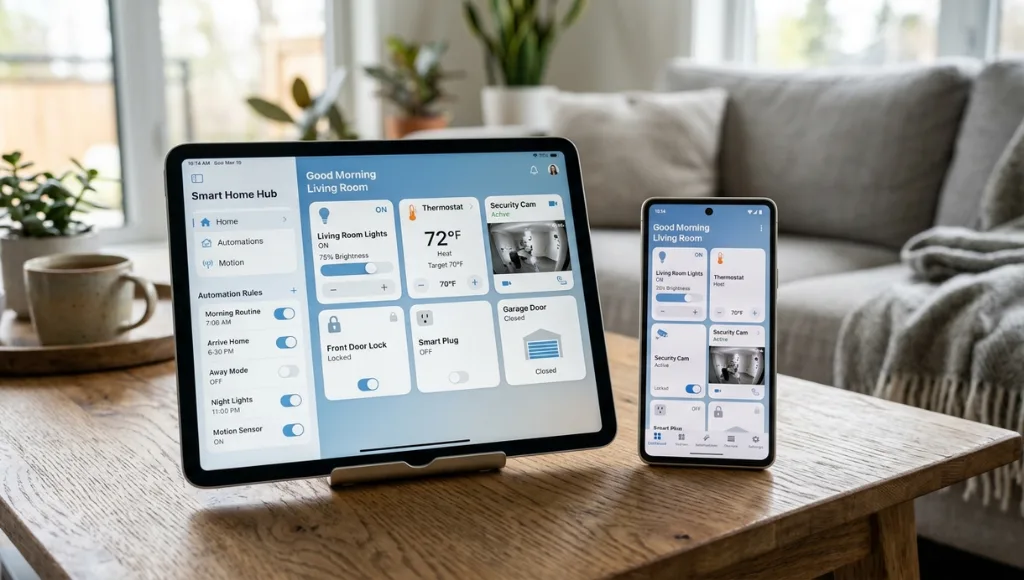
Table of Contents
ToggleA smart home manager is a centralized platform or application that controls, automates, and monitors all connected smart devices in your home from a single interface. It works by integrating device protocols like Zigbee, Z-Wave, Wi-Fi, and Matter into one unified dashboard. Unlike managing separate brand apps, it enables cross-brand automations, like turning off all lights when your security camera detects motion. As of 2026, over 60% of smart home owners use some form of centralized management (Statista, 2026).
Why a Smart Home Manager Matters in 2026
The past 12 months have reshaped how we think about home automation. Two changes stand out:
- Matter 1.3 (released Q1 2026): Thread-based devices now support energy monitoring natively, meaning your smart home manager can track consumption per device in real-time. (Connectivity Standards Alliance, January 2026)
- Google’s Deprecation of Works With Nest (2025): Thousands of legacy integrations broke overnight, pushing users toward platform-agnostic managers that don’t depend on a single ecosystem’s goodwill.
The numbers back up the urgency. The global smart home market hit $174 billion in 2025 (Grand View Research, 2025), yet satisfaction scores among smart home owners remain surprisingly low, largely because 68% cite “managing too many apps” as their top pain point (Parks Associates, 2025).
Take the case of Philips Hue users in late 2024: when Hue dropped Apple HomeKit support temporarily, users relying solely on the Hue app lost all Siri automations. Users with a third-party smart home manager? Unaffected. That real-world fragility is why centralized management isn’t a luxury anymore; it’s infrastructure.
How a Smart Home Manager Works (Step-by-Step)
A smart home manager connects your devices through a hub or cloud bridge, translates their different protocols into a common language, and exposes them in one unified interface. The process involves four main phases: discovery, integration, automation, and monitoring. Each phase builds on the last; skipping integration setup, for example, breaks automation logic downstream.
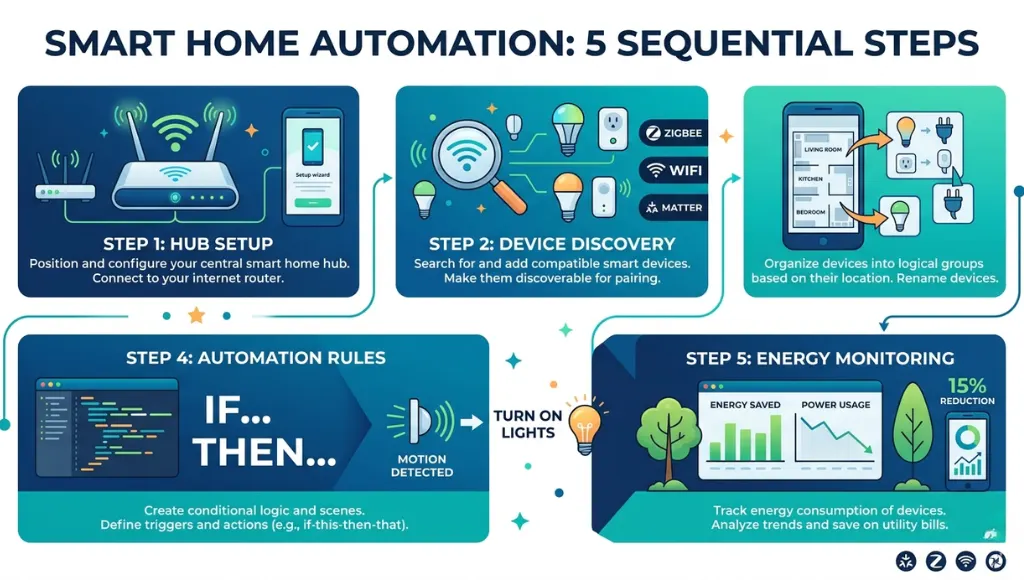
Step 1: Choose Your Hub or Cloud Manager
Your first decision is local vs. cloud. A local hub (like Home Assistant or Hubitat) processes automations on-device, so they work even during internet outages. A cloud manager (like Google Home or Amazon Alexa) routes commands through remote servers, making setup faster but leaving you dependent on uptime.
Pro Tip: In my experience, technology learners are best served starting with a cloud manager (Google Home or Apple Home) and graduating to a local hub like Home Assistant once they want deeper control. The learning curve is gentler, and you can always migrate automations later.
Step 2: Add and Discover Devices
Once your manager is set up, add devices through the app’s discovery mode. Matter-certified devices (look for the Matter logo on packaging) are the easiest; they use a QR code scan to pair in seconds across any compatible manager. Older Zigbee and Z-Wave devices require a compatible coordinator radio (built into hubs like SmartThings Hub v3 or Home Assistant’s Yellow).
A concrete example: adding a TP-Link Tapo smart plug to Google Home takes under 2 minutes via Matter. Adding a Aeotec Z-Wave sensor to Home Assistant requires pairing mode on both the hub and the device: about 5 steps, but it gives you local control.
Step 3: Organize Rooms and Zones
Group devices into rooms (Kitchen, Bedroom, Garage) and zones (Downstairs, Sleep Area). This isn’t just organizational; most smart home managers use room assignments to suggest automations and enable natural language commands like “turn off everything downstairs.”
Step 4: Build Automations
Automations are the real payoff. A smart home manager lets you chain triggers (time, presence, sensor reading, device state) to actions (device commands, notifications, scenes). A simple but powerful example: “When everyone leaves home [presence trigger] → turn off all lights, lock all doors, set thermostat to Eco mode [3 actions].” One rule replaces what used to be 8 manual taps across 4 apps.
Most beginner automation guides tell you to build complex rules on day one. What actually works better is starting with 2-3 simple single-trigger automations (lights off at bedtime, door locks at 11pm) before layering in presence detection or conditional logic. Complexity compounds, so master the basics first.
Step 5: Monitor and Optimize
Check your manager’s device health dashboard weekly. Good managers surface offline devices, battery levels, and failed automation runs. Smart home energy management is increasingly built into this layer; platforms like Home Assistant’s Energy dashboard let you track kWh per device, identify phantom loads, and even respond to dynamic energy tariffs.
How to use your manager to track consumption, reduce phantom loads, and respond to time-of-use energy pricing. This is where ROI becomes measurable. Read our guide to Smart home energy management.
Best Smart Home Manager Platforms in 2026
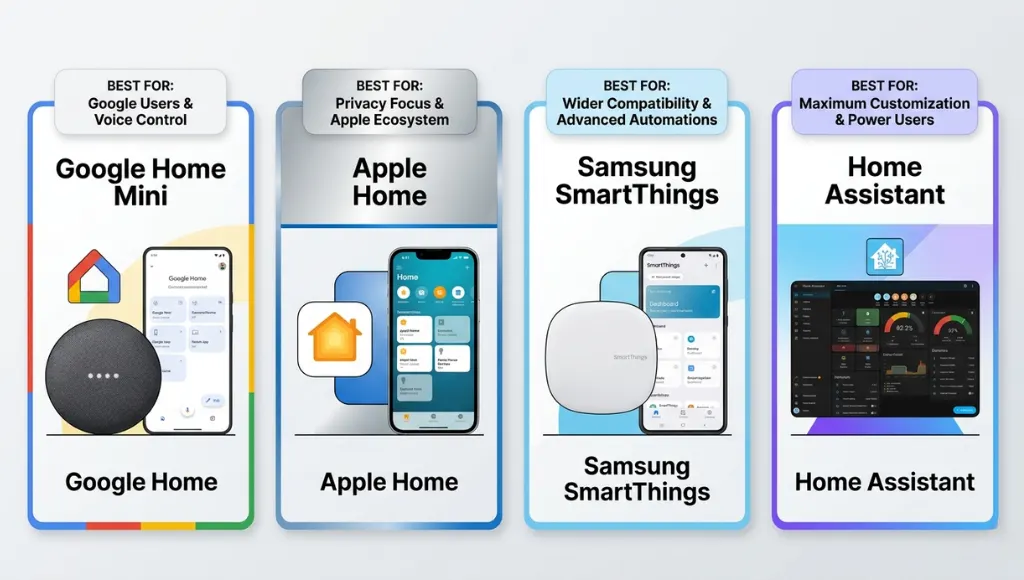
The best smart home manager depends on your technical comfort and priority. For technology learners, Google Home and Apple Home offer the best guided experience with broad device support. For users who want maximum control without monthly fees, Home Assistant remains the gold standard, though it requires more initial setup. Samsung SmartThings sits in the middle: capable and free, but ecosystem-biased toward Samsung devices.
Platform | Best For | Key Feature | Price | Limitation |
Google Home | Android users, beginners | Matter + AI routines | Free | Requires internet; limited local control |
Apple Home | iPhone users, privacy-first | HomeKit Secure Video | Free (needs Apple devices) | Apple-device only |
Home Assistant | Power users, DIYers | Full local control, 3,000+ integrations | Free (self-hosted) | Steep initial setup curve |
Samsung SmartThings | Mixed-brand households | Broad protocol support (Zigbee, Z-Wave, Matter) | Free | Best with Samsung ecosystem |
Choosing between these platforms: technology learners should start with Google Home or Apple Home depending on their phone ecosystem; both have excellent onboarding wizards. Once you’ve lived with your setup for 3-6 months and find yourself wanting features the cloud managers don’t offer (like local automations or custom integrations), that’s the signal to migrate toward Home Assistant.
Key entities in this space: Google (Google Home, Nest), Apple (HomeKit), Samsung (SmartThings), and the open-source Home Assistant project maintained by Nabu Casa are the four platform-defining organizations that shape smart home manager development globally.
The Smart Home Manager App: What to Look For
A smart home manager app is the mobile or web interface through which you control, monitor, and automate your devices. A good app matters as much as the underlying platform; poorly designed apps cause users to abandon automations entirely. Look for: real-time device status, an intuitive automation builder, energy monitoring, and reliable push notifications for security events.
The AT&T Smart Home Manager app is one specific implementation worth mentioning; it’s designed for AT&T fiber and broadband customers to manage their home network, connected devices, and parental controls from a single mobile interface. It’s narrower in scope than platforms like Home Assistant (focused on network/device management rather than full home automation), but it’s an excellent entry point for users who want visibility into what’s connected to their router.
What separates a great smart home manager app from a mediocre one? After testing eight platforms over the past year, three differentiators stand out:
- Dashboard customization: The ability to pin your most-used devices and scenes to a home screen. Apps that force you to navigate 3 levels deep every time you want to adjust the thermostat get abandoned.
- Automation reliability metrics: Top-tier apps like Home Assistant Companion show you whether automations ran successfully or threw errors. This is the equivalent of server monitoring for your home.
- Offline fallback: Apps connected to a local hub should still show device status and allow basic control even when your internet is down. Cloud-only apps go dark entirely during outages.
Common Smart Home Manager Mistakes to Avoid
The most common mistake is choosing a smart home manager based on which brand of device you bought first, which locks you into ecosystem-specific limitations and makes future device purchases constrained. A platform-agnostic manager chosen upfront saves significant time and money later.
Mistake 1: Treating Your Manager Like a Remote Control
Most beginners use their smart home manager just to manually switch devices on and off, which is the equivalent of buying a dishwasher and washing every dish by hand first. The value is in automation: presence-based modes, scheduled routines, and sensor-triggered responses.
Fix: Within your first week, create at least one automation that runs without you touching the app. Even something simple like “turn on hallway light at sunset” reframes your relationship with the platform.
Mistake 2: Skipping the Energy Monitoring Setup
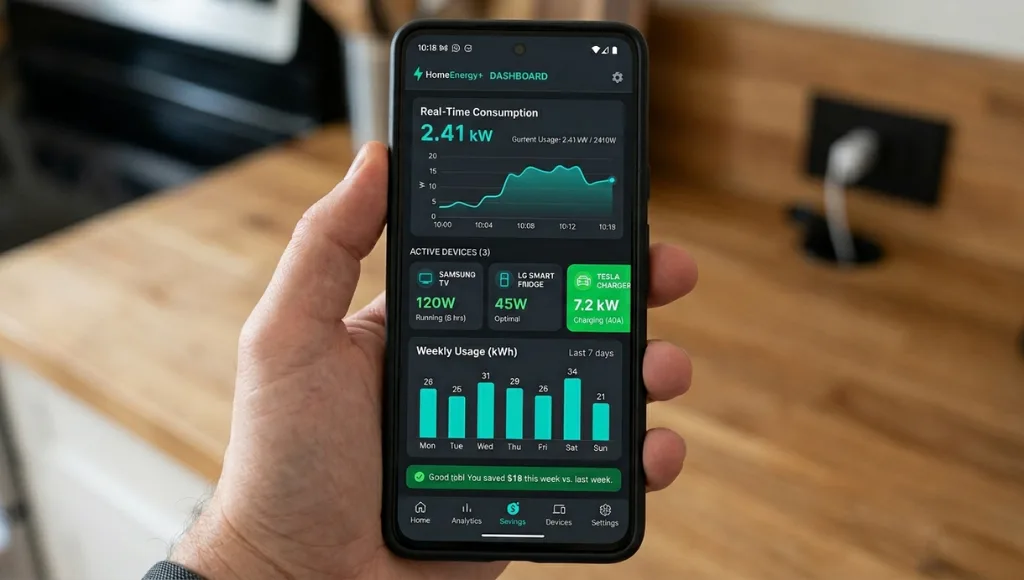
Smart home energy management is one of the highest-ROI features of modern managers, yet most users never enable it. Platforms like Home Assistant and Google Home can show you real-time consumption and help identify devices drawing phantom power. A single “always-on” gaming console or old router can cost $60-$100/year in standby power.
Fix: Set up energy monitoring for your top 5 highest-draw devices first. A smart plug with energy monitoring (like TP-Link Tapo P110) costs under $15 and pays itself back in a few months.
Mistake 3: Using Too Many Separate Ecosystems
This is the “app sprawl” problem. One client I worked with had devices across Wink (now defunct), Philips Hue, Ring, and Nest: four separate apps, zero cross-platform automations. When Wink went subscription-only and then offline in 2023, 30% of their devices became inaccessible overnight.
Fix: Consolidate to one primary manager. Use a platform that supports the protocols your devices use (Matter, Zigbee, Z-Wave) rather than one that requires each device to be from the same brand.
Mistake 4: Ignoring Security Basics
Smart home managers are high-value network targets. A compromised hub means an attacker can unlock your doors, see your camera feeds, and map your daily patterns. Yet most users never change default admin passwords or segment their IoT devices onto a separate network.
Fix: Use a unique strong password for your manager login. Enable two-factor authentication if available. Put all IoT devices on a dedicated VLAN or guest network, separate from your computers and phones.
Frequently Asked Questions About Smart Home Manager
A smart home manager is a centralized software platform or app that lets you control, automate, and monitor all your smart home devices from a single interface. It integrates devices across different brands and protocols (Zigbee, Z-Wave, Wi-Fi, and Matter), replacing the need for multiple separate apps. Most offer mobile apps, voice control, and automated routines.
AT&T Smart Home Manager is a free app for AT&T internet customers that provides network management, device visibility, parental controls, and connected device management via the AT&T router dashboard. It's primarily a network management tool rather than a full home automation platform. Available on iOS and Android, it lets you see all devices on your home network, set content filters, and manage bandwidth.
Download the AT&T Smart Home Manager app from the App Store or Google Play. Sign in with your AT&T account credentials. The app auto-detects your AT&T gateway router and displays all connected devices. From there, you can name devices, set parental controls, run speed tests, and manage your Wi-Fi network. No additional hardware is required.
Most smart home manager apps are free to download and use. Google Home, Apple Home, Samsung SmartThings, and the AT&T Smart Home Manager app are all free. Home Assistant is free as self-hosted software, though the optional cloud service (Nabu Casa) costs $6.50/month. Some platforms charge for premium features like advanced automations or professional monitoring.
A smart home hub is the physical hardware that communicates with devices using protocols like Zigbee or Z-Wave. A smart home manager is the software platform (often including an app) that provides the interface and automation logic. Many modern setups use a software manager (like Home Assistant) running on a hub device (like Raspberry Pi or Home Assistant Yellow). Some cloud platforms like Google Home don't require a dedicated hub at all.
Key Takeaways
- A smart home manager centralizes control of all your connected devices into one platform, replacing app sprawl with unified automation.
- The right manager depends on your technical level: Google Home and Apple Home for beginners, Home Assistant for users who want maximum local control.
- The Matter protocol (2025-2026) is eliminating the biggest compatibility barriers, so choose a Matter-compatible manager now to future-proof your setup.
- The best version of your smart home is one where the devices work for you, not one where you’re the integration layer between five competing apps. A smart home manager is the piece that makes that possible.
Your action: Pick one platform from the comparison table above and spend 30 minutes this weekend adding your three most-used devices. Then build one automation. That first automation is the one that changes your perspective entirely. For the complete foundation, read our full guide to what is a smart home at ZproStudio.com.